







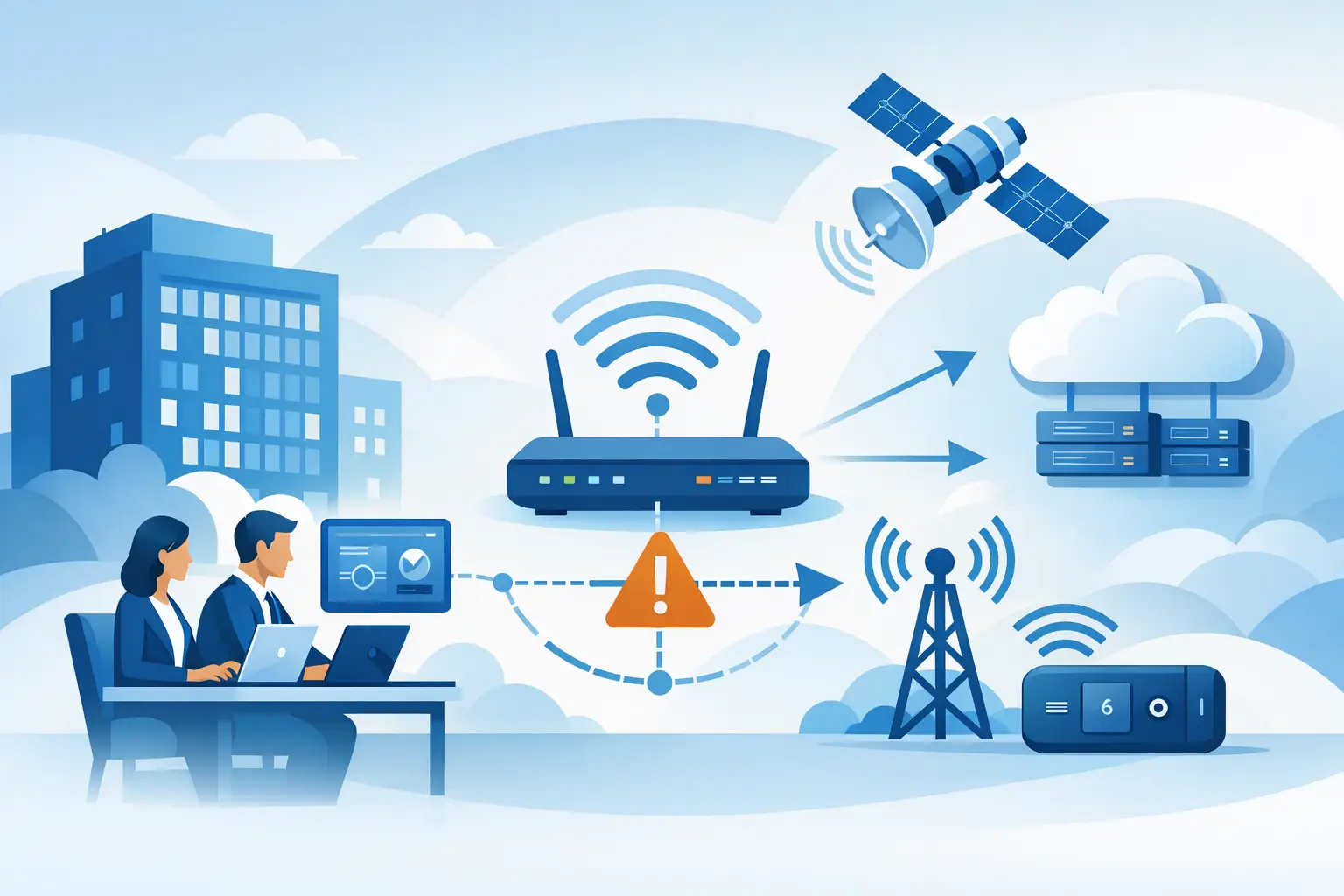
One broadband outage in the middle of trade is rarely just an inconvenience. For an SME, it can stop card payments, knock out cloud systems, disrupt phones, and leave staff waiting instead of working. That is why choosing the best failover internet options for SMEs is not really about buying a second connection. It is about protecting revenue, customer experience, and day-to-day operations.
The right setup depends on what your business can afford to lose, and for how long. A café that needs EFTPOS and guest WiFi has different priorities from a multi-site retailer, a professional office, or a warehouse with cloud-based stock systems. The common thread is simple: if the primary line fails, the backup needs to take over quickly, reliably, and without creating a new support headache.
What makes a failover option good for an SME?
A failover service is only as good as the outcome it delivers when something goes wrong. Speed matters, but so do independence, coverage, support, and how well it fits the way your business actually works.
The first question is whether the backup connection is truly separate from the main one. If both services rely on the same local access path or the same network fault domain, you may be paying for redundancy that disappears in a single outage. A fibre connection backed up by mobile broadband is often stronger than two services that share infrastructure in the same street.
The second question is how quickly traffic switches across. Some businesses can tolerate a few minutes of interruption. Others cannot. If your payment terminals, phones, cameras, or cloud applications are business-critical, automatic failover through a managed router or firewall is usually the right choice. Manual switching sounds cheaper until someone has to sort it out under pressure.
Then there is performance. Not every backup needs to match your main circuit. If your aim is to keep card payments live, maintain access to key systems, and let the team carry on, a lower-bandwidth service may be enough. If your business runs voice, video, large file transfers, and customer-facing services all day, the backup needs more headroom.
The best failover internet options for SMEs
4G failover
For many smaller businesses, 4G backup is the practical starting point. It is widely available, quick to deploy, and independent from fixed-line faults. If a digger cuts fibre outside the premises or the main broadband service drops, a 4G connection can keep essential traffic moving.
This option suits retailers, hospitality venues, small offices, and service businesses that need a sensible balance of resilience and cost. It is especially effective when paired with managed equipment that automatically prioritises critical traffic such as payments, business applications, and voice.
The trade-off is capacity and signal quality. In a strong coverage area, 4G can be more than adequate for failover. In weaker locations, or at peak times, performance may dip. That does not rule it out, but it does mean testing matters. A backup that looks fine on paper but struggles inside the building is not much use when you need it.
5G failover
5G is increasingly attractive where higher throughput is needed or where fixed broadband options are limited. For SMEs that rely heavily on cloud services, multiple simultaneous users, or richer digital experiences in-store, 5G can provide a more capable safety net than 4G.
It can also work as a primary service in some sites, with another service acting as backup. That is useful for temporary locations, fast openings, or sites where fibre lead times are a problem.
The catch is availability and consistency. Coverage varies by location, and indoor reception can still be a factor. 5G hardware and service costs may also be higher than 4G. For the right site, it is excellent. For the wrong one, it can be an expensive assumption.
We've got your back
Dual fixed-line connections
If downtime carries a higher cost, dual fixed-line connectivity is often the stronger answer. This could mean fibre with a second fibre service, or fibre paired with a different fixed technology. The aim is to create more capacity and more resilience than mobile failover alone can provide.
This approach fits businesses with heavier traffic, larger teams, multi-site dependencies, or customer-facing systems that must stay responsive during an outage. It is also worth considering where cyber controls, hosted telephony, cloud platforms, and payment systems all depend on stable connectivity.
However, dual fixed-line only makes sense if the paths are genuinely diverse. Two lines from different providers can still converge on the same local infrastructure. That is why design and supplier accountability matter. Resilience should be engineered, not assumed.
Fibre plus mobile failover
For most SMEs, this is the sweet spot. Fibre handles normal operations, while 4G or 5G provides a separate backup path if the fixed service fails. It gives a good blend of performance, independence, and cost control without overcomplicating the setup.
This model works particularly well for operationally busy businesses that want business continuity without managing multiple moving parts themselves. With the right managed network equipment, failover can happen automatically, traffic can be prioritised, and support can be handled through one service relationship instead of several.
That last point matters more than many businesses realise. During an outage, nobody wants to work out whether the fault sits with the ISP, the router, the firewall, or the payment network. A single accountable partner removes a lot of wasted time.
How to choose between them
The simplest way to choose is to start with business impact rather than connection types. Ask what must stay live if your main internet service drops for an hour. For some, that list is short: EFTPOS, email, and access to a booking system. For others, it includes VPNs, voice, CCTV, cloud applications, customer WiFi, and site-to-site links.
Once that is clear, bandwidth requirements become easier to size. You do not need to pay for a backup that mirrors every part of normal usage if the goal is continuity for critical services only. On the other hand, if a branch site still needs to trade at full pace during an outage, underpowered backup will create its own problems.
You also need to look at the local environment. Mobile failover is only strong if signal quality is proven inside the premises. Fixed-line diversity is only worthwhile if the access paths are genuinely separate. This is where a proper site assessment helps, especially for multi-site operators and payment-heavy environments.
Security should be part of the decision too. A failover service that bypasses your normal firewall policies, monitoring, or content controls may keep you online but expose the business in the process. Good failover design should preserve security policies as traffic moves between connections.
Why managed failover usually wins
Some SMEs build their own backup arrangements with consumer routers and standalone mobile devices. It can work, but it often leaves gaps. Switching may not be automatic, visibility is limited, and when faults appear, support becomes fragmented quickly.
Managed failover is different because it treats connectivity as part of the wider business environment. The internet connection, network equipment, security layer, and monitoring are set up to work together. If there is a problem, the business is not left coordinating separate vendors and hoping someone takes responsibility.
That matters most in businesses where connectivity underpins payments, customer service, and staff productivity. A backup line is useful. A backed-up service with monitoring, escalation, and real support is what reduces downtime in practice. That is the model providers such as Vetta Group are built around, particularly for SMEs that want one partner to own outcomes rather than pass faults around.
The option that fits most SMEs
If there is one answer that fits the broadest range of SMEs, it is fibre with managed 4G or 5G failover. It covers the most common outage scenarios, keeps costs reasonable, and gives businesses a cleaner path to continuity without excessive complexity. For sites with higher traffic or tighter uptime demands, dual fixed-line services may be justified, but they should be designed carefully.
The best failover internet options for SMEs are the ones that match business risk, not just technical preference. If a short outage means lost sales, frustrated customers, and staff standing still, backup internet stops being a nice-to-have. It becomes part of how you keep the business moving when the day does not go to plan.
A sensible failover setup should feel uneventful. When the main line drops, the business carries on, customers keep paying, and your team stays focused on work instead of chasing providers. That is the standard worth aiming for.





