







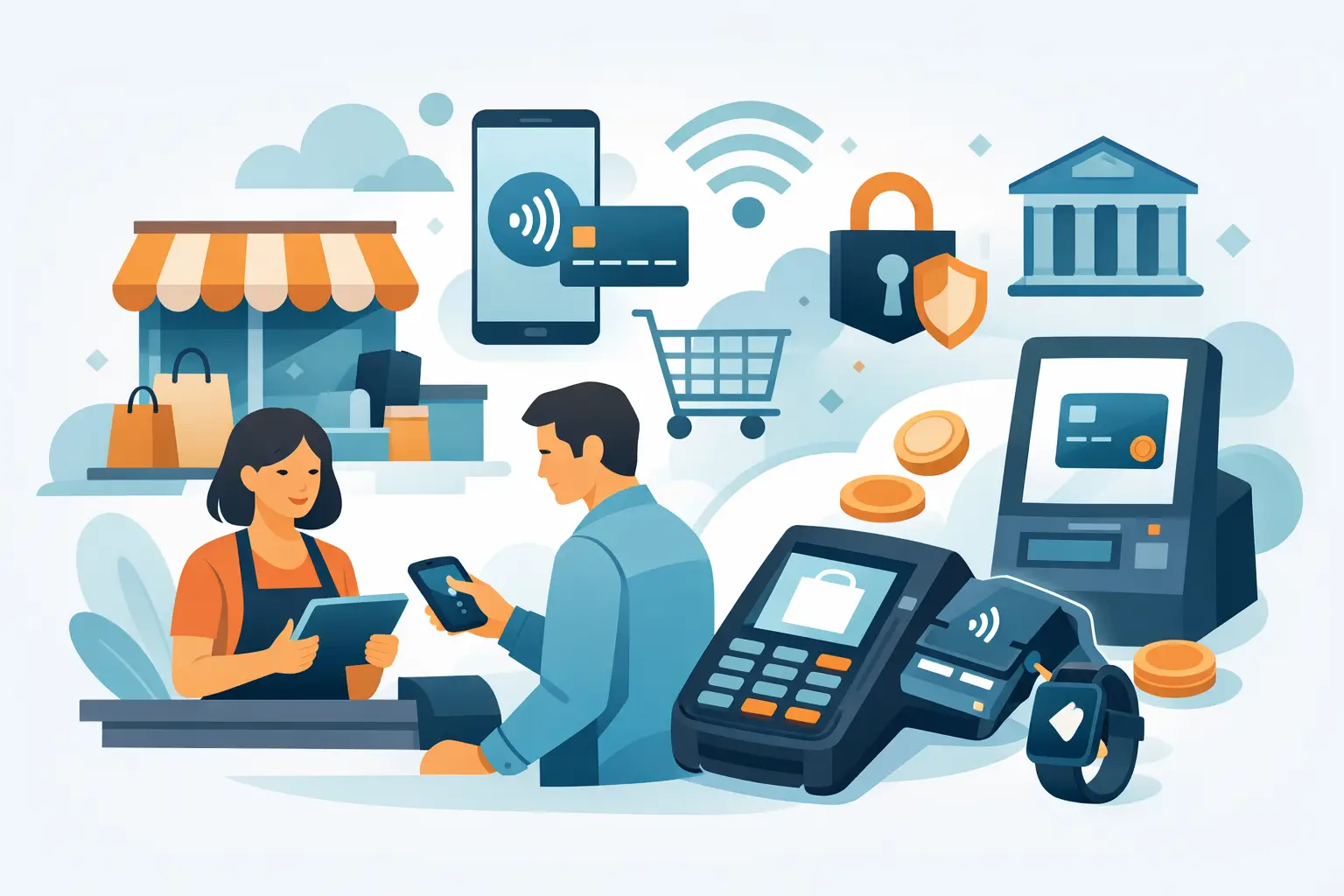
Saturday trading is no time to discover your EFTPOS terminal cannot talk to your point of sale, your backup internet was never configured, and support is pointing between three vendors. That is exactly why a retail payments technology guide matters. For busy retailers, payments are not a standalone device on the counter. They sit at the intersection of connectivity, software, security, staff workflows and customer experience.
The mistake many businesses make is treating payments as a simple hardware purchase. In practice, every transaction depends on several moving parts working together. If one fails, the sale stalls, queues build, and staff are left improvising. The right setup reduces that risk and gives you one clear path to support when something does go wrong.
What a retail payments technology guide should cover
A useful retail payments technology guide starts with a basic truth: the cheapest terminal is rarely the cheapest outcome. Retailers need to think about card acceptance, terminal type, POS integration, internet resilience, device management, PCI-related security controls and support coverage as one operating environment.
That matters even more for small and mid-sized businesses. Most do not have time to manage separate providers for broadband, WiFi, firewalling, terminals, POS software and field support. When suppliers are fragmented, faults take longer to isolate and longer to fix. Accountability disappears into vendor handoffs.
A better approach is to decide what your business needs to achieve first. For some shops, that is fast tap-and-go with simple daily settlement. For others, it is stock-aware POS, mobile checkout on the shop floor, multi-lane payment orchestration, or support across several sites. The technology choice follows the operating model, not the other way round.
Start with how your retail operation actually works
Before comparing terminals or payment contracts, look at the way your team serves customers. A high-volume convenience store has different needs from a boutique retailer or a garden centre with indoor and outdoor sales areas. If you process many low-value transactions, speed at the till matters most. If you sell high-consideration items, staff may need mobile payment options so customers can pay anywhere in the shop.
Multi-site operators should pay particular attention to consistency. If each branch has a different mix of terminals, broadband providers and support contacts, even minor issues become operationally expensive. Standardising the setup across sites improves training, reporting and fault resolution. It also makes upgrades less disruptive.
This is where many retailers underestimate connectivity. Payments do not just rely on having internet access. They rely on stable, prioritised, well-managed connectivity, with sensible failover where the cost of downtime is high. A backup connection may sound excessive until your primary line drops during the lunch rush.
Choosing terminals and POS without creating gaps
The terminal itself is only one part of the decision. Countertop devices suit fixed checkouts where power and network access are stable. Mobile terminals are useful for hospitality-style service, queue busting, larger retail footprints or temporary trading spaces. Integrated POS and payment setups can reduce double entry and speed up reconciliation, but only if the integration is properly supported.
There is a trade-off here. Tightly integrated environments can improve efficiency, yet they also create dependencies. If the POS application fails, payments may be affected too. Standalone devices can offer resilience, but they may require staff to re-key values or manage separate reports. The best fit depends on whether your priority is speed, flexibility, resilience or a balance of all three.
Retailers should also think beyond day one. Will the chosen setup support new lanes, pop-up sites, tablets, self-service or online and in-store reporting later on? Payment technology should not box you into an operating model you outgrow in a year.
Security is part of the payment experience
Customers may only see a quick card tap, but behind that moment sits a security environment that needs active attention. Payment systems are attractive targets because they touch money, customer data and business-critical operations. For retailers, security is not just about preventing fraud. It is also about staying open.
We've got your back
That means looking at network segmentation, secure WiFi, managed firewalls, access control, password hygiene, software patching and monitored endpoints. If your payment traffic, guest WiFi and back-office systems all sit loosely connected on the same environment, risk increases. So does the chance that an avoidable issue turns into an outage.
Compliance also needs a practical lens. Many SMEs hear PCI and assume it is only a paperwork exercise. In reality, the underlying job is to reduce exposure and maintain good operating discipline. The right provider should help you keep the environment sensible and supportable, not leave you with a checklist and no ownership.
Why support model matters as much as hardware
Retail payment issues rarely arrive neatly labelled. A terminal timeout could be a network problem, a WiFi coverage issue, a switch fault, an application error or a provider-side issue. If different suppliers own each layer, your team becomes the coordinator. That is not a good use of management time, and it slows down recovery.
For that reason, support should be considered part of the solution, not an add-on. Look for clear escalation paths, monitored services, on-site capability where needed, and a provider willing to own the outcome. This is especially important for retailers with extended opening hours or multiple locations where even short outages add up quickly.
A single partner model is not about bundling for the sake of it. It is about making sure connectivity, devices, security and payments are designed to work together and supported as one environment. When one team can see the whole picture, fault isolation gets faster and accountability is much clearer.
Cost should be measured against downtime
Retailers understandably compare monthly fees, terminal hire and transaction charges. Those figures matter, but they are not the whole commercial picture. A lower-cost setup that fails more often, takes longer to support or forces manual work can cost more over time than a properly managed service.
It helps to think in three layers. First, the visible costs: hardware, software, connectivity and transaction pricing. Second, the operational costs: staff time, training, reconciliation effort and vendor management. Third, the risk costs: lost sales, abandoned purchases, reputational damage and after-hours firefighting.
This is where predictable service models can make sense. If support, monitoring and lifecycle planning are built in, budgeting is easier and nasty surprises are fewer. That does not mean every retailer needs the most feature-rich package. It means the chosen solution should be proportionate to the cost of failure.
A practical way to assess your current setup
If you are reviewing your environment, start with the points where trading is most exposed. Ask how payments behave when the internet drops, whether your branches use the same setup, who owns fault resolution, and how quickly your team can get a real person on the phone. Then look at security basics, software versions and whether your WiFi and network design still match the way the business operates.
Also ask whether your reporting and reconciliation processes are helping or hindering the team. A technically functional system can still create unnecessary admin. If managers are stitching together reports from different tools every week, there is room to improve the operating model.
For many SMEs, the answer is not adding more technology. It is simplifying the stack and choosing a provider that can coordinate the parts properly. That is the difference between having payments equipment and having a payments environment you can rely on.
Vetta Group’s approach is built around that principle: one accountable partner across connectivity, IT, security, field services and payments, so retailers spend less time chasing suppliers and more time running the business.
The right decision is the one you can support at 5 pm on a Friday
Retail payments technology should make trading easier, not create another moving part for your team to manage. The best setup is not always the newest terminal or the lowest headline price. It is the one that fits the way you trade, stays available when the shop is busy, and comes with support that takes responsibility rather than passing the problem elsewhere.
If you are planning a refresh, think bigger than the device on the counter. Think about the whole chain behind each transaction, and whether it is built to keep your business online, protected and productive when it matters most.





