







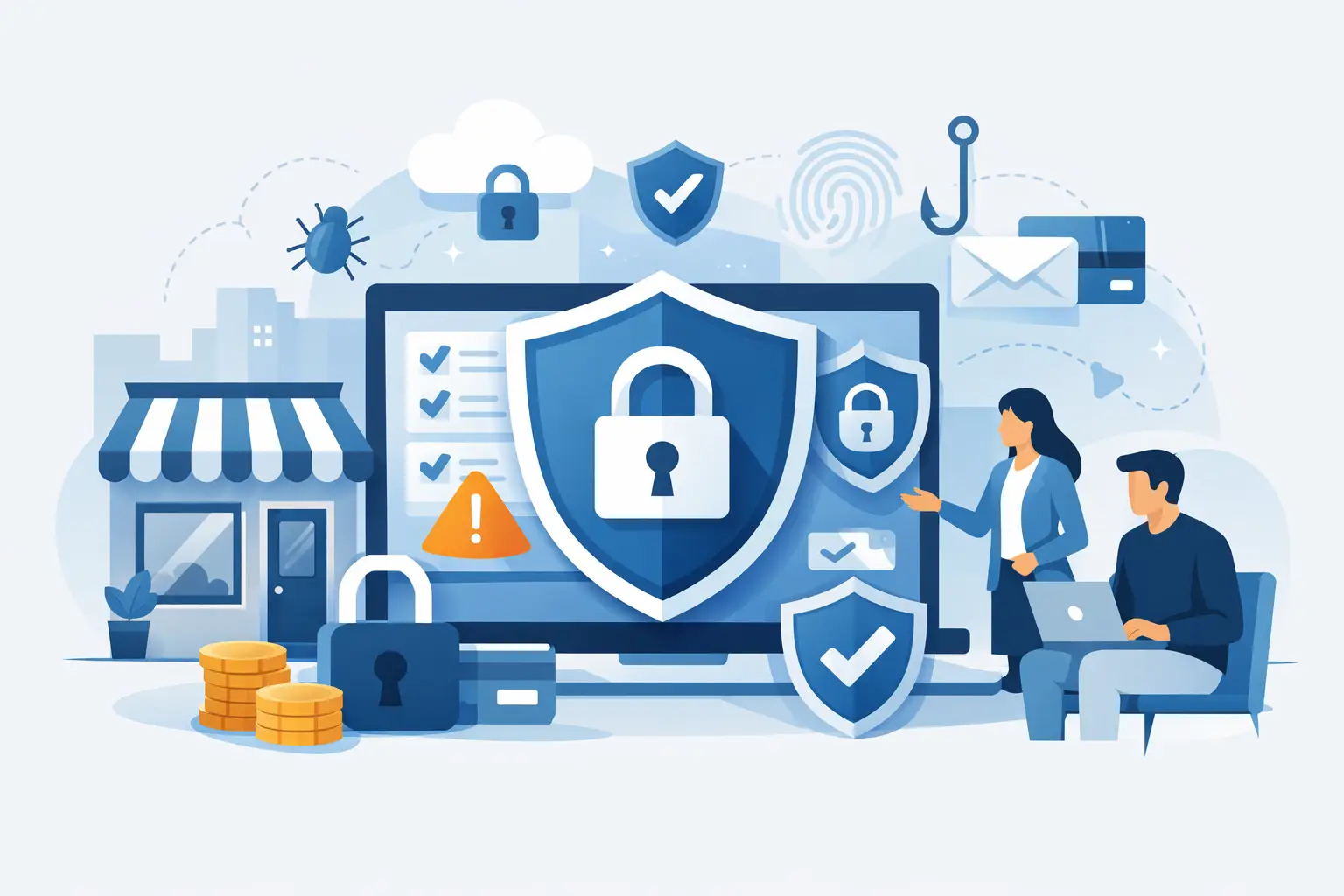
A staff member clicks a convincing invoice email on a busy Tuesday morning. By lunchtime, files are encrypted, card payments are disrupted, and customers are asking why your phones are down. That is usually the moment people stop asking do small businesses need cyber insurance and start asking what their policy would actually cover.
For many small businesses, the honest answer is yes – but not as a substitute for proper security. Cyber insurance can help with the financial shock of an incident, yet it only works well when it sits alongside sound controls, reliable support, and a clear response plan. If your business depends on internet access, cloud software, email, digital payments, or shared customer data, cyber risk is already part of your operating environment.
Why do small businesses need cyber insurance at all?
Small businesses are often more exposed than they realise. They tend to have fewer internal IT resources, less time to check every system properly, and more pressure to keep trading through an incident. Attackers know that. They also know many SMEs rely on the same handful of systems every day: Microsoft 365, cloud accounting, EFTPOS, point of sale, remote access tools, and email.
The risk is not just a dramatic ransomware event. It can be a staff member sending payroll details to the wrong person, a compromised email account used to redirect invoices, or malware that knocks out access to bookings and payment systems for two days. Even when the technical issue is fixable, the cost around it can build quickly – investigation, legal advice, customer notification, recovery work, lost revenue, and reputational damage.
That is where insurance has a role. It is there to soften the financial impact when prevention is not enough.
What cyber insurance usually covers
Policies vary, and the detail matters. In broad terms, cyber insurance is designed to help with the direct and indirect costs of a cyber incident. That often includes forensic investigation, legal support, data breach response, business interruption, system restoration, and in some cases ransom-related costs where legally permitted and carefully managed.
Some policies also cover third-party liability. That may matter if customer, employee, or supplier information is exposed and someone claims your business failed to protect it properly. For retailers and service businesses handling payments, a policy may also address some of the fallout from card-related security incidents, although payment-specific requirements are often treated separately.
What it does not do is magically fix poor systems. If there is no backup, no multi-factor authentication, weak password hygiene, or no documented process for handling incidents, you may find your cover is restricted, more expensive, or challenged at claim time.
When the answer is probably yes
If you are asking whether your business is “big enough” to need cyber cover, size is usually the wrong test. Dependency is the better one.
If you would struggle to trade without email, broadband, cloud systems, remote access, or card payments, cyber insurance deserves serious consideration. The same applies if you hold customer records, employee information, financial data, or commercially sensitive files. A medical practice, accountancy firm, retailer, manufacturer, logistics operator, school, and hospitality venue all have different risk profiles, but they share one thing: downtime costs money.
For multi-site businesses, the case gets stronger. More locations often mean more devices, more users, more points of failure, and more pressure to restore service quickly. If one branch loses connectivity or a compromised account spreads across shared systems, the operational effect can move well beyond a single desk or store.
Cyber insurance can also make sense where contract requirements or board expectations are tightening. Some customers now expect suppliers to carry cyber cover, especially where systems access or sensitive data is involved.
We've got your back
When it might not be enough on its own
There is a common mistake in this space: buying a policy and assuming the job is done. It is not. Insurance responds after something has happened. Security is what reduces the chance of it happening in the first place and limits the damage if it does.
That distinction matters because most small businesses do not fail because the recovery invoice was large. They struggle because operations stop, staff are left guessing, and no one owns the response across internet, devices, software, users, and security controls.
A policy cannot monitor your endpoints at 2am. It cannot patch vulnerable systems, isolate an infected device, secure remote access, or train staff to spot a phishing email. Those are operating disciplines, not insurance benefits.
The strongest position is layered. You want practical controls in place, backed by people who can respond quickly, and insurance to deal with the remaining risk.
The controls insurers increasingly expect
Cyber insurers have become more demanding, and for good reason. Too many claims stem from basic weaknesses. If you are applying for cover, expect questions about multi-factor authentication, backups, endpoint protection, email security, privileged access, patching, and incident response.
In some cases, those controls are now minimum entry requirements rather than nice-to-haves. If your business cannot show it manages cyber risk in a deliberate way, premiums can rise and cover can narrow. If an insurer believes you misrepresented your controls, claims can become difficult.
That is why small businesses should treat cyber insurance as part of a wider risk conversation, not a standalone purchase. Before you sign anything, be clear on what systems matter most, what data you hold, how quickly you need to recover, and who is accountable if something breaks.
How to decide if cyber insurance is worth it
Start with the operational question, not the policy wording. What would one day of disruption cost your business? Then consider three days, a week, and a month of partial recovery. Include lost sales, staff downtime, outside IT support, customer communication, and any regulatory or legal costs.
Next, look at your exposure. Do you process payments? Rely on cloud platforms? Support remote workers? Share files across sites? Store customer identity information? If the answer is yes to several of those, your cyber exposure is already meaningful.
Then look at your resilience. Are backups tested? Is multi-factor authentication enforced everywhere it should be? Do you have someone monitoring alerts and handling incidents, or would you be ringing around suppliers while the business is offline? This is often the real dividing line between businesses that recover cleanly and businesses that spend days in chaos.
For many SMEs, the most sensible approach is to reduce preventable risk first, then insure the residual risk that remains.
Do small businesses need cyber insurance if they already have IT support?
Often, yes. IT support and cyber insurance solve different problems.
Good IT support helps keep systems available, secure, and maintained. A managed security service helps detect threats, harden your environment, and respond when something goes wrong. Insurance helps pay for the aftermath when, despite those efforts, an incident still causes financial harm.
The best results come when these pieces work together. A single accountable partner can be especially valuable here because cyber incidents rarely stay in one lane. An email compromise becomes a payments issue. A broadband outage affects cloud access. A security event turns into a customer service problem. When support is fragmented across multiple vendors, response slows down and accountability gets fuzzy.
That is one reason businesses increasingly prefer an integrated model – connectivity, IT, security, and support working as one service rather than separate hand-offs.
What to watch before buying a policy
Read the exclusions carefully. Some policies are broad in marketing language and narrow in practice. Check waiting periods for business interruption, sub-limits on forensic and legal costs, requirements around approved suppliers, and any conditions tied to backups, patching, or authentication.
It is also worth checking how the insurer defines a security failure. Does cover extend to social engineering and invoice fraud, or only to unauthorised access? Are outsourced systems included? If a supplier is breached and it affects your business, what happens then?
This is not about buying the cheapest policy. It is about buying cover that matches how your business actually operates.
The practical answer for most SMEs
So, do small businesses need cyber insurance? If your business relies on connected systems to trade, stores useful data, or cannot absorb the cost of a serious outage, then yes, it is usually a sensible part of the picture.
But it should come after a more basic commitment: your business needs security that is active, supported, and accountable. That means reliable backups, monitored devices, protected email, strong access controls, and a support model that can respond without passing the problem around. Insurance can help pay for a bad day. It cannot run your recovery for you.
The businesses that handle cyber risk best are not the ones with the thickest policy documents. They are the ones that know what matters, put the right protections around it, and make sure someone is clearly responsible when things go wrong. That is how technology stays where it belongs – helping the business keep moving.





