





A lot of AI projects fail for a simple reason: they start with the tool, not the job that needs doing. If you want to understand how to implement AI workflows in a business setting, start with pressure points your team already feels – slow admin, inconsistent customer responses, duplicated data entry, delayed reporting, or staff spending hours moving information between systems.
That matters even more for busy SMEs. When you run retail sites, field teams, offices, payments, and customer communications at once, another disconnected platform is not helpful. AI only earns its place when it reduces effort, improves accuracy, or speeds up decisions without adding risk or support headaches.
What AI workflows actually look like in practice
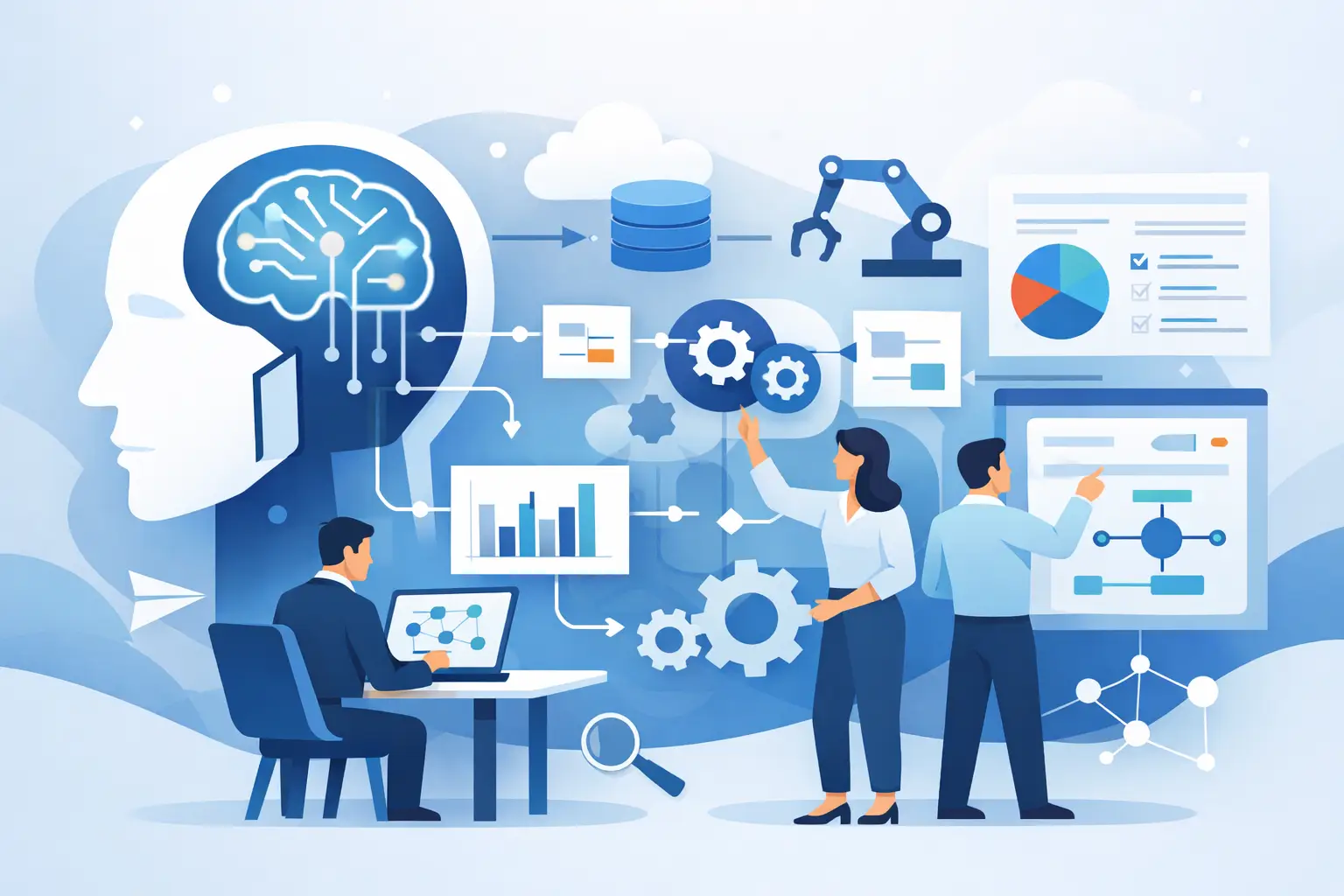
An AI workflow is not just a chatbot or a prompt in a browser. It is a repeatable process where AI handles part of the work inside a wider operational flow. That could mean reading incoming emails and routing them to the right team, drafting responses for approval, summarising service tickets, extracting data from invoices, or flagging unusual transactions for review.
The useful distinction is this: AI should sit inside a process your business already understands. If the process is unclear, inconsistent, or unmanaged, AI tends to amplify the mess rather than fix it. Good implementation starts with process discipline, then adds automation where it makes commercial sense.
Start with one business outcome, not ten ideas
The strongest AI projects are usually narrow at first. A business might want to improve customer response times, reduce time spent on manual data entry, or help managers get a daily operational summary without chasing multiple systems.
Pick one outcome with a clear owner. If nobody owns the process, nobody will own the result. Tie that outcome to a number you can measure, such as hours saved per week, reduction in rework, faster turnaround, lower error rates, or improved first-response time. This keeps the conversation grounded. It also stops AI becoming a vague innovation exercise that never reaches day-to-day operations.
For smaller businesses, the best starting points are often repetitive, high-volume tasks with low ambiguity. Think inbox triage, note summarisation, document classification, knowledge base search, stock or service reporting, and internal service desk support. These are easier to test, easier to govern, and easier to improve over time.
How to implement AI workflows without creating more complexity
The practical challenge is rarely the model itself. It is everything around it – systems access, user permissions, data quality, exception handling, security controls, and who supports the workflow when something goes wrong.
That is why implementation should follow the same standards you would apply to any business-critical system. Define where the workflow starts, what inputs it needs, how the AI makes or supports a decision, what confidence threshold is acceptable, and where a person steps in. If there is no clear path for exceptions, the workflow will break at the first edge case.
It also helps to map the systems involved before you build anything. Many SMEs already have data spread across email, accounting software, CRM, POS, file storage, line-of-business tools, and shared spreadsheets. If those systems do not talk to each other properly, AI outputs will be limited or unreliable. In many cases, the first piece of AI work is actually getting the plumbing right.
Get your data and security position sorted early
AI is only as reliable as the information it can access. If your source data is duplicated, outdated, or poorly structured, the workflow will produce mixed results. That does not mean you need perfect data before you begin. It does mean you should be honest about what the workflow can safely use.
Start by deciding which data sets are approved for the first use case. Then define who can access them, how long outputs are retained, and whether any personal, financial, or commercially sensitive information is involved. This is especially important for businesses handling payment environments, customer records, internal HR information, or contractual data.
We've got your back
Security should not be bolted on later. AI workflows can create new exposure points because they often connect multiple systems and move information automatically. The right controls depend on the use case, but common requirements include identity-based access, audit logs, approval steps for high-risk actions, secure API connections, endpoint protection, and clear rules around what data can be sent to third-party services.
For many businesses, this is where a single accountable technology partner makes a real difference. If connectivity, devices, cloud access, security controls, and support all sit with different providers, troubleshooting becomes slow and fragmented. AI workflows depend on the underlying environment working together.
Build with human review in the right places
One mistake businesses make is trying to remove people from the process too quickly. In the early stages, human review is not a sign of failure. It is part of controlled deployment.
A sensible approach is to begin with AI as an assistant rather than a decision-maker. Let it draft, summarise, classify, recommend, or highlight. Then let staff review and approve. Once accuracy and confidence improve, you can automate more of the flow for low-risk cases while keeping higher-risk actions under manual control.
This staged model is usually better for staff adoption as well. Teams are more likely to trust a system that helps them do their job faster than one that arrives with the message that it will replace judgement entirely. In most operational businesses, the real value comes from reducing routine effort so skilled people can focus on customers, exceptions, and decisions that need context.
Keep the rollout small enough to manage properly
If you are looking at how to implement AI workflows across a growing business, avoid the temptation to launch everywhere at once. A pilot should be small enough to monitor closely and broad enough to prove value.
Choose one department, one process, and one set of users. Run the workflow for a defined period. Measure what changed. Did response times improve? Did errors drop? Did staff save time? Did support requests increase because the workflow was confusing? Did security or compliance concerns emerge?
This is where many projects reveal their real shape. Sometimes the AI performs well, but the process around it is weak. Sometimes the business case is sound, but the staff guidance is poor. Sometimes the workflow works technically, but the integration points are brittle. A contained rollout gives you room to fix those issues before they affect wider operations.
Train staff on judgement, not just buttons
AI training is often treated as a quick system handover. That is not enough. People need to know what the workflow is meant to do, where its limits are, how to spot a bad output, and when to escalate.
This is particularly important in customer-facing and operational roles. If a member of staff receives an AI-generated response, recommendation, or summary, they need confidence in checking it against business context. That includes tone, accuracy, policy alignment, and whether the output is suitable for the customer or task in front of them.
Good training also reduces shadow IT. If staff do not understand the approved workflow, they may start using public AI tools on their own to fill the gap. That creates unnecessary risk. Clear guidance and supported systems are safer than hoping people make the right call under pressure.
Measure business value after go-live
Launching an AI workflow is not the finish line. The real question is whether it keeps delivering value after the novelty fades.
Look at operational measures first. Time saved matters, but so do quality, consistency, and resilience. A workflow that saves thirty minutes a day but creates rework, customer confusion, or support overhead is not a win. Equally, a workflow with modest time savings may still be worthwhile if it improves service levels or reduces key-person dependency.
You should also review whether the workflow remains aligned with the business as systems, policies, and teams change. AI workflows are not set-and-forget tools. Prompts, rules, data sources, access permissions, and fallback paths need regular review. The businesses getting the best results treat AI as part of managed operations, not a one-off project.
Where businesses should be careful
Not every process is a good fit. If a task is rare, highly complex, legally sensitive, or dependent on tacit knowledge held by a few experienced people, automation may offer limited value or create more risk than benefit. There are also cases where standard process improvement should come before AI. If a workflow is slow because approvals are unclear or systems are outdated, fix that first.
Cost is another trade-off. The cheapest AI tool is not always the best option once integration, support, governance, and security are factored in. For operationally busy businesses, dependability usually matters more than novelty. A stable workflow with clear accountability will outperform an impressive demo that no one can support six months later.
When AI is implemented properly, it should feel less like another platform and more like a practical improvement to how work gets done. The best results come from clear business goals, strong foundations, measured rollout, and support that takes responsibility when the technology meets real-world pressure.





