







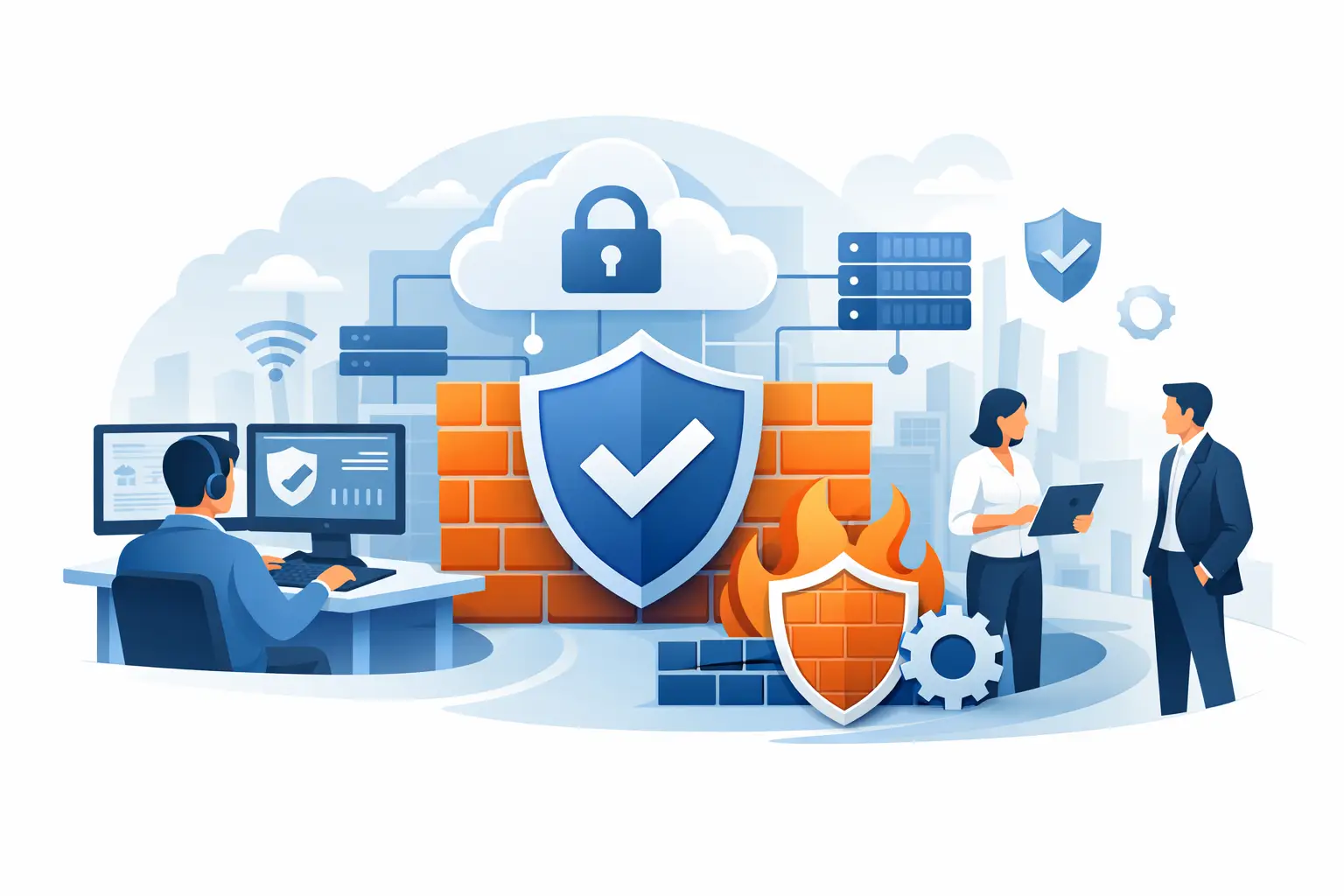
A firewall is often only noticed when something stops working – a payment terminal cannot connect, a staff member cannot access a cloud application, or an attempted attack triggers an alert. That is precisely why a managed firewall service review should look beyond the device itself. For a busy business, the real question is whether someone is actively accountable for keeping the network protected, available and easy to operate.
For retailers, multi-site operators and growing SMEs, a firewall sits at the junction of internet connectivity, WiFi, cloud systems, devices and payment environments. A poor fit can create friction for the people trying to work. An unmanaged or poorly monitored one can leave gaps that are not discovered until an incident is already affecting customers.
What a managed firewall service should actually deliver
A firewall controls the traffic moving between your network and the internet. Modern business firewalls can inspect traffic, separate guest WiFi from operational systems, restrict risky applications, support secure remote access and help prevent known threats from reaching devices.
Those capabilities matter, but buying a capable appliance is not the same as having a managed security service. Hardware needs correct design, configuration, software updates, licence management, monitoring and regular review. Rules also need to change as your business changes. A new site, cloud phone system, point-of-sale rollout or staff member working remotely can all alter what the network needs to allow and protect.
A worthwhile service assigns responsibility for that ongoing work. It should include proactive monitoring, timely security updates, clear escalation when suspicious activity is detected and real people who can investigate an issue. It should also establish who owns the outcome when security and connectivity overlap. That accountability is where managed services earn their value.
Managed firewall service review: the questions that matter
A review should begin with your operating requirements, not a list of firewall features. The right service for a small office with cloud applications will differ from the right service for a retailer processing card payments across several branches. Both need protection, but their network design, risk exposure and tolerance for downtime may be very different.
Is monitoring active around the clock?
Threats and equipment faults do not wait for business hours. Ask whether the provider monitors firewall health, internet connections and security events 24/7, and what happens when an alert is raised. Some providers notify customers of events but leave the investigation and response to internal staff. Others will assess the alert, take agreed action and escalate only when business input is needed.
The distinction is significant. A flood of raw alerts is not reassurance if nobody has the time or expertise to interpret them. You want a provider that can separate routine noise from activity requiring action, while keeping you informed in plain language.
Who manages changes and updates?
Firewall rules are necessary, but every exception introduces risk. A service should have a disciplined process for approving, documenting and implementing changes. That includes opening access for a new supplier connection, enabling a remote worker, or supporting new software.
Ask how urgent changes are handled, whether standard requests are included in the monthly service, and how rules are reviewed over time. Old rules tend to accumulate. A secure configuration six months ago may no longer reflect the systems, staff and sites using your network now.
Security updates deserve the same scrutiny. Firewalls require firmware and signature updates to address vulnerabilities and recognise emerging threats. Applying updates blindly can create disruption, particularly where specialised systems or older devices are involved. The best approach balances speed with change control: assess the update, plan it, apply it appropriately and verify that services continue to work.
Does it fit the whole network?
A firewall cannot be assessed in isolation. Its performance, configuration and support model need to match the broadband connection, routers, switches, wireless access points, cloud platforms and endpoints around it.
We've got your back
For example, a shop may need payment terminals, tills and back-office systems separated from guest WiFi. A multi-site business may need reliable, secured connections between locations. A business using cloud-based phones needs traffic policies that protect quality of service rather than accidentally restricting calls. These are design questions as much as security questions.
A single partner that manages both connectivity and IT can shorten the path to resolution when something fails. There is less time spent proving whether the fault belongs to the internet provider, firewall supplier, WiFi installer or software vendor. Vetta Group takes this integrated approach, coordinating the network, security and support layers so customers have one accountable team to call.
What visibility will you receive?
Managed should not mean invisible. Business owners and internal IT leads need meaningful reporting that shows what is being managed and where attention is required. The level of detail should suit the audience: an operations manager may need a clear view of service status, risks and actions taken, while an IT lead may need event detail, rule-change records and network insights.
Look for reports that explain trends rather than simply listing technical statistics. Useful reporting might identify repeated blocked threats, devices generating unusual traffic, sites with connectivity instability or rules due for review. It should support informed decisions, not create another pile of information to interpret.
Security is a service, not a box at the edge
One common weakness in firewall procurement is treating it as a one-off purchase. The business buys the appliance, it is installed, and attention moves elsewhere. That can work only if there is capable in-house resource with time to maintain it properly. Many SMEs do not have that capacity, nor should they need to build it for every aspect of technology.
A managed service changes the model from ownership of a device to ongoing protection. It creates a predictable operational process for monitoring, maintenance and support. It also gives the provider context: they understand your normal network patterns, critical applications and escalation contacts before a high-pressure event occurs.
That does not remove every risk. No firewall can guarantee that a user will never click a convincing phishing message or that every new attack will be blocked. Firewalls are most effective as part of a wider security position that includes secure email, password management, endpoint protection, cloud backup, staff awareness training and incident planning. The firewall provides a vital control point, but it should not carry the entire burden.
Where pricing can be misleading
Comparing monthly prices alone can lead to an expensive decision. A lower-cost offer may cover hardware and basic licence renewals but exclude after-hours support, configuration changes, threat investigation, reporting or replacement equipment. Conversely, a higher monthly fee may include the management work that prevents issues from becoming outages.
Ask for the service boundaries in writing. Clarify whether the price includes the firewall hardware, security subscriptions, installation, monitoring, maintenance, support, replacement arrangements and travel where on-site assistance is needed. Also ask what happens at the end of the contract and whether the service can scale as you add people, locations or bandwidth.
Predictable pricing is valuable, but only when the scope is clear. The goal is not to avoid every additional charge. It is to avoid discovering, during an incident, that the response you assumed was included is actually billable or unavailable.
Signs a provider is ready to take ownership
The strongest providers ask detailed questions before recommending a product. They want to know how you connect to the internet, which systems are business-critical, whether you process payments, how sites communicate and what a disruption would cost. They will discuss recovery expectations and operational priorities, not just ports and throughput figures.
They should be equally clear about their own responsibilities. Who watches alerts? Who contacts you? Who can make an urgent change? How quickly can faulty equipment be replaced? What support is available outside office hours? If the answers are vague, the accountability is likely to be vague when it matters most.
Choose the service that reduces operational pressure
The right managed firewall is not necessarily the one with the longest feature list. It is the one that fits your network, protects the services customers and staff rely on, and comes with a team prepared to act when something is wrong.
Before making a decision, map your critical systems and walk a prospective provider through a realistic failure scenario. Ask what they would see, what they would do first and when they would involve your team. Their answer will tell you far more than a product brochure – and it can help ensure technology keeps making life easier when the pressure is on.





