







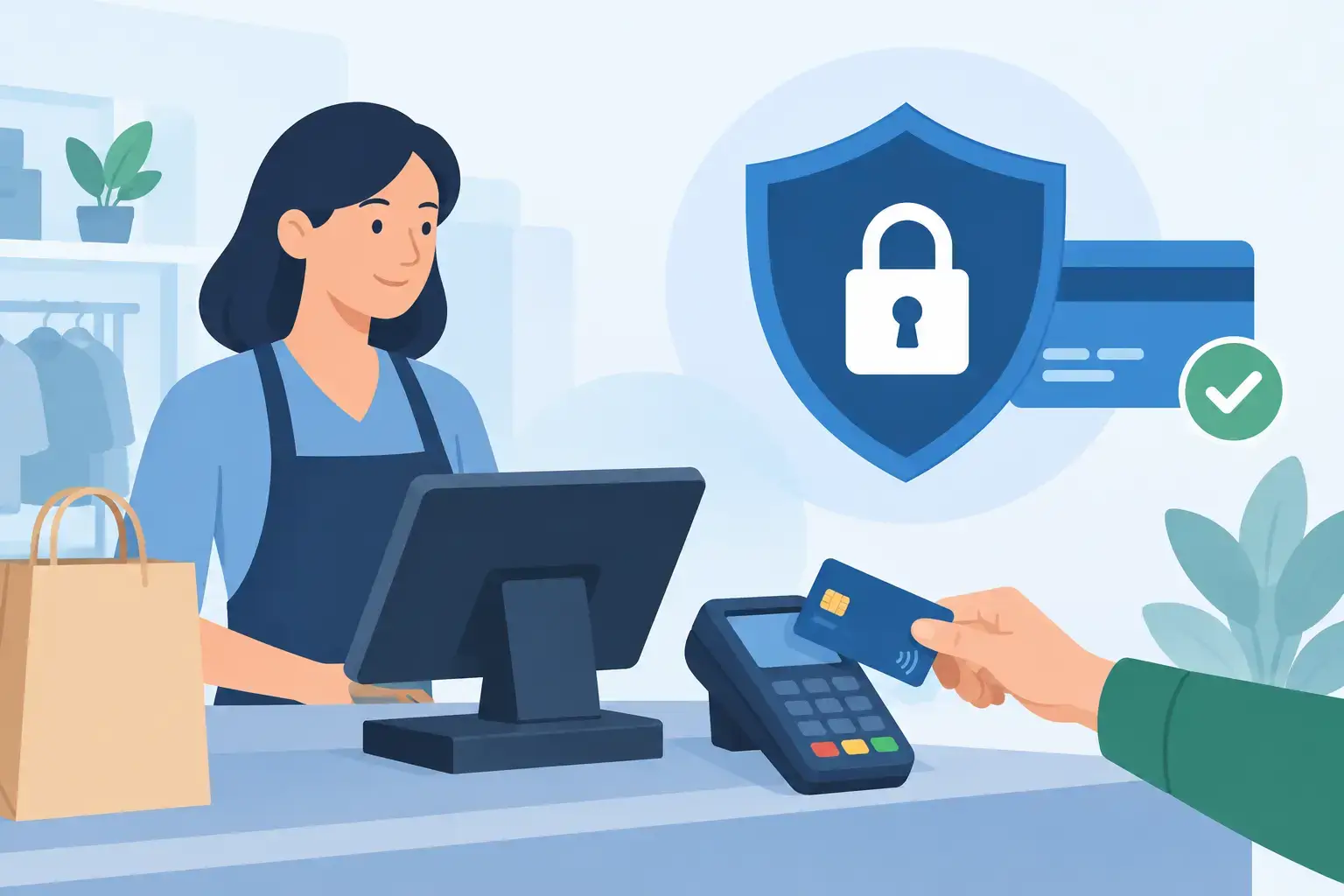
A card terminal that works at the counter is only part of a safe payment setup. Behind every tap, online checkout and payment taken over the phone sits a set of responsibilities designed to protect cardholder data. So, do retailers need PCI compliance? If your business accepts, stores, processes or transmits payment card details, the practical answer is yes.
PCI compliance is not just a concern for major chains or online-only businesses. A single independent shop, a multi-site retailer and a business taking occasional card-not-present payments can all fall within scope. The amount of work involved varies, but the responsibility does not disappear because payments are handled through a third-party provider.
What PCI compliance means for retailers
PCI refers to the Payment Card Industry Data Security Standard, usually shortened to PCI DSS. It is a security standard created by the major card schemes to reduce fraud and protect cardholder data.
PCI DSS is not generally a law in the same way as tax or employment obligations. Instead, it is normally a contractual requirement set through your bank, acquirer or payment provider. Failing to meet it can still carry serious consequences: financial penalties, higher transaction fees, forensic investigation costs, loss of the ability to accept cards and damage to customer trust after a breach.
For retailers, the central question is not whether card data matters. It is where that data touches your business. A modern payment environment can include EFTPOS terminals, point-of-sale systems, WiFi, broadband connections, office computers, e-commerce platforms, payment links, call-centre processes and third-party support access. Each connection needs to be understood and controlled.
Do retailers need PCI compliance if they use a payment terminal?
Yes. Using a standalone, approved payment terminal can reduce the amount of PCI work you need to do, but it does not remove your obligations altogether.
If staff enter card details directly into a payment terminal and the terminal is supplied and managed by a reputable payment provider, your card-data environment may be relatively small. You may be asked to complete a simpler Self-Assessment Questionnaire, often called an SAQ. Your acquirer will determine which questionnaire and validation process applies.
The position changes if your point-of-sale system connects to the terminal, if payment devices share a network with business computers, or if staff can access terminal administration functions. A compromised till, router or remote-support connection may give an attacker a route into the payment environment even when the terminal itself is secure.
The same principle applies to online retail. Redirecting customers to a hosted payment page can sharply reduce exposure. Collecting card numbers on your own website, storing them in a customer record or accepting them by email creates far greater risk and more demanding obligations.
PCI scope is often larger than retailers expect
The most common mistake is assuming PCI only covers the device that takes payment. In reality, scope can include systems that store, process or transmit cardholder data, as well as systems that could affect their security.
For example, a retailer may have a compliant terminal but still create risk through an outdated point-of-sale computer, shared staff passwords, an unsecured guest WiFi network or remote access configured by an external supplier. A cybercriminal does not need to break the payment terminal if they can compromise a connected system and intercept, alter or disrupt payment activity.
Retailers should pay particular attention to four areas:
We've got your back
- Point-of-sale devices and software: Terminals, tills and integrated POS platforms must be approved, supported and kept on current software.
- Networks and remote access: Payment traffic should be separated from guest WiFi and everyday office devices. Remote access must be tightly controlled and monitored.
- Staff processes: Card details should never be written down, emailed, photographed or kept in spreadsheets. Staff need clear instructions for exceptions and customer queries.
- Third-party suppliers: Payment providers, IT support companies, e-commerce platforms and POS vendors all have roles to play, but their involvement does not transfer every responsibility away from the retailer.
This is why a quick compliance tick-box exercise can be misleading. Retailers need a clear picture of how payments move through their operation and who is accountable for each part.
What retailers usually need to do
Your exact PCI DSS requirements depend on how you accept cards, transaction volumes and the rules set by your acquirer. However, most retailers should expect to complete some form of annual compliance validation and maintain the security controls that support it throughout the year.
Start by mapping every payment method. Include counter payments, online checkout, payment links, recurring payments, manual entry, phone orders and refunds. Then identify every system, device and supplier involved. This often reveals old processes that nobody intended to keep, such as an inbox receiving card details or a legacy computer still used for end-of-day reporting.
Next, reduce the amount of card data your business handles. Use payment providers that tokenise card details or host payment pages where appropriate. Do not store full card numbers unless there is a compelling, validated business need and the right controls are in place. For most small and mid-sized retailers, avoiding storage is safer, simpler and less expensive than trying to protect it.
You also need dependable day-to-day security. Keep operating systems, POS software, firewalls and terminals up to date. Remove former staff access promptly. Use unique logins and multi-factor authentication for administration tools. Protect routers and WiFi with secure configurations, and maintain backups that are separated from the systems they protect.
Some businesses will need external vulnerability scans from an approved scanning vendor. Others may need more detailed assessment or penetration testing, particularly where their environment is complex or they have experienced a security incident. Your acquirer or payment provider should confirm the validation level that applies.
PCI compliance is shared, but accountability stays with you
Retailers often hear that their payment provider is PCI compliant. That is good news, but it is only one part of the picture.
A provider may be responsible for securing its terminals, processing platform or hosted checkout service. The retailer remains responsible for using those services correctly, protecting its own network and devices, managing staff access, and completing required validation. If a staff member records card details in a notebook or an unsupported POS computer is infected with malware, the provider’s certification will not solve the problem.
This is where fragmented suppliers can create blind spots. One company manages broadband, another supplies WiFi, another supports the POS, another handles payments, and nobody has a complete view when an issue occurs. The result can be slow fault-finding and uncertainty over who owns the fix.
For multi-site retailers especially, a joined-up approach makes compliance easier to manage. Connectivity, network separation, managed security, payment hardware and on-site support should work as one operating model. Vetta Group helps businesses bring these moving parts together, with clear ownership when payment technology or security needs attention.
Avoid treating PCI as an annual form
Completing an SAQ once a year does not make a payment environment safe for the other 364 days. PCI DSS is most useful when it reflects normal operating practice: patching systems, reviewing access, checking devices, training staff and responding quickly when something looks wrong.
A practical routine is better than a large annual scramble. Review who has access when staff roles change. Check terminals for signs of tampering. Confirm that guest WiFi is separated from payment systems. Test backups and incident contacts. Ask suppliers what they are responsible for and keep their PCI documentation on file.
If you suspect a payment device, POS system or network has been compromised, act quickly. Isolate the affected equipment where safe to do so, preserve relevant information, contact your acquirer or payment provider, and involve qualified security support. Trying to quietly rebuild a system before reporting the issue can make an investigation harder and may breach contractual requirements.
The right level of PCI effort depends on your setup
A café using standalone terminals has different needs from a retailer with online sales, loyalty data, multiple branches and centrally managed tills. The goal is not to build an enterprise-grade security operation where it is not needed. It is to understand your exposure, choose payment methods that limit it, and maintain controls that fit your business.
PCI compliance should make payment risk more manageable, not turn into another disconnected technology project. When your payment devices, network, security and support arrangements are clear, staff can focus on serving customers and managers can be confident that a card payment is not creating an unseen weak point.





