







At 2:13am, the till stops talking to the card terminal. The duty manager restarts it twice, the queue grows, and someone suggests using the hotspot on a personal mobile phone. By 9:00am, your team is on the phone to three different providers: internet, IT support, and payments. Nobody can say, with confidence, where the fault sits – and that uncertainty is what turns a small incident into a long day.
That is the gap managed IT services are supposed to close. Not with a once-a-month check-in or a best-effort helpdesk, but with continuous visibility, fast response, and one party taking responsibility for outcomes.
Managed IT services with 24/7 monitoring: the practical reality
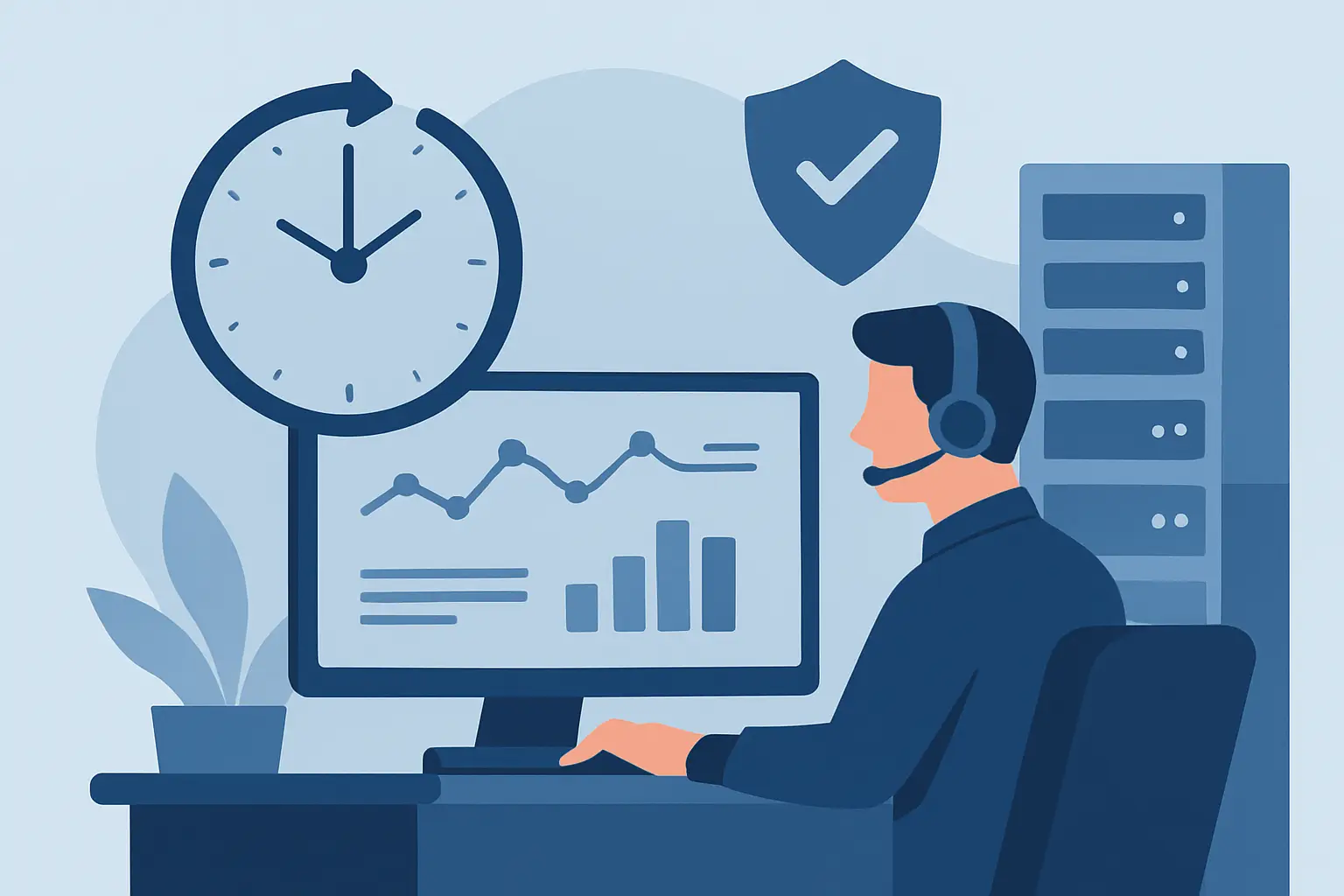
The phrase “managed IT services with 24/7 monitoring” is often used as shorthand for peace of mind. In practice, it means your core systems are being watched, measured, and acted on around the clock – not just when someone reports a problem.
Monitoring is the difference between “call us when it breaks” and “we see it breaking and fix it before your team notices”. It usually covers endpoints (laptops and desktops), servers, network gear, key cloud services, backups, and security signals. The monitoring platform raises alerts when thresholds are hit or behaviour changes, and an operations team follows defined runbooks to resolve issues or escalate them.
There is a trade-off worth stating plainly: 24/7 monitoring without the ability to act is noise. And action without good monitoring is guesswork. The value is in the combination – the tooling, the process, and the people authorised to make changes.
What 24/7 monitoring should cover (and what it often misses)
For an operationally busy SME, you do not need dashboards. You need coverage that maps to the things that stop trading, stop staff working, or create risk.
At a minimum, you should expect visibility over device health (disk space, CPU, memory), patch status, failed services, and unusual login activity. On the network side, you want to know if your router is flapping, if WiFi access points are offline, if a site is losing packets, or if latency is climbing during peak periods. For servers and cloud workloads, monitoring should detect failing backups, low storage, certificate expiries, and performance drift.
Where many “managed” offers fall short is the awkward middle layer: applications and dependencies. A server can look healthy while a line-of-business app is timing out. Your internet can be up while DNS is failing. A payment terminal can have power and still be unable to route transactions because of a firewall change or an upstream outage. Good providers monitor the symptoms that matter – not just the infrastructure they happen to manage.
And some things are not realistically monitored without extra work: bespoke apps, odd legacy hardware, or third-party SaaS where you do not control the telemetry. In those cases, the right answer is not hand-waving. It is agreeing what can be monitored, what cannot, and what the response plan is when those gaps cause issues.
Why this matters more for multi-site and retail environments
Single-site offices can sometimes muddle through an incident. Multi-site operators cannot. When each location has different internet providers, different WiFi kit, different IT support, and a separate payments vendor, outages become a coordination exercise.
24/7 monitoring becomes especially valuable when it is paired with standardisation: the same firewall model, the same WiFi architecture, the same endpoint policies, and the same remote support tools across sites. That consistency means alerts are meaningful and fixes are repeatable. It also means change control is real – if something is updated at one site, you can see the impact quickly and roll it back if needed.
The other factor is time. Retail and hospitality issues do not respect office hours. If your busiest trading window is evenings or weekends, “we’ll look at it on Monday” is not a service level – it is a cost.
We've got your back
Beyond uptime: monitoring as a security control
If monitoring is only about availability, you miss half the point. The more common failure mode today is not a single device dying, but a chain of small security issues: a reused password, an unpatched browser, a staff member approving a suspicious MFA prompt, a mailbox rule quietly forwarding invoices.
Managed monitoring should feed into active security operations: detecting suspicious logins, mass file changes that might indicate ransomware, unusual outbound connections, or devices that suddenly disable security controls. It should also tie into practical prevention: patching, endpoint protection, email security, password management, and user awareness.
It depends on your industry and risk profile, but if you take card payments and store any customer data, you are already in a higher-stakes environment. Security needs to be “always on” because attackers are.
What you should expect during an incident
When something breaks at 2:13am, the experience matters as much as the fix. A mature managed service will have a clear sequence: detection, triage, containment, resolution, and follow-up.
Detection and triage are where 24/7 monitoring earns its keep. The provider should be able to tell you what is affected, how widespread it is, and whether it is a local device issue, a site network issue, or an upstream service problem.
Containment is often overlooked. If the incident is security-related, the first priority may be isolating a device, disabling a compromised account, or blocking traffic at the firewall – even before full root cause analysis.
Resolution should include practical communication: who is doing what, what the ETA is, and what workarounds are safe. Follow-up should not be a blame exercise. It should be a short, useful explanation of what happened, what changed, and what will prevent a repeat.
If you are hearing “we can’t tell, call your ISP” or “that’s your software vendor” during incidents, that is the signature of a fragmented setup – and it is exactly what the single-partner model is meant to remove.
The “single partner” difference: fewer handoffs, faster escalation
Many businesses do not fail because their technology is terrible. They fail because ownership is unclear. The broadband provider says it is your firewall. The firewall supplier says it is your switch. Your IT support says it is your payments network. Meanwhile your staff are stuck.
A single accountable partner changes the incentives. When one provider supplies and supports connectivity, networking, managed IT, and security, they can correlate signals across the whole stack. They can also escalate faster because they are not waiting on a third party to confirm what they can already see.
This is where providers that operate their own network have an edge. If an alert shows packet loss across a region or a specific backhaul issue, they can diagnose at the network layer rather than reading the same generic status page you are.
For UK readers, the principle still holds even if your sites are spread across different carriers: the value is in one team owning the end-to-end troubleshooting and coordinating suppliers so you are not the project manager during an outage.
How to choose a managed service that will actually help
Most managed IT contracts look similar on paper. The difference is operational discipline.
Start by asking what is monitored, how often it is checked, and what triggers action. “We monitor everything” is not an answer. You want examples: backup failures, certificate expiry, disk thresholds, abnormal login patterns, internet latency, VPN tunnel drops.
Then ask about response. Is it 24/7 response or 24/7 alerting with business-hours action? Who is on-call, and what can they change without waiting for approvals? What are the escalation paths when a site is down and taking payments?
Finally, check how they manage change. A lot of incidents are self-inflicted: firmware updates done without a maintenance window, policy changes pushed without testing, licences expiring silently. Good providers treat changes as a controlled process with documentation and rollback plans.
If you want to reduce vendor handoffs, look for a provider that can bundle the parts that most often collide: connectivity, firewall, WiFi, endpoints, and security operations. In New Zealand, that integrated model is exactly how Vetta Group positions its service – one partner across network, IT, security, and on-site support, backed by 24/7 monitoring and real humans you can reach.
Costs, trade-offs, and when fully managed is not the answer
Managed services are not automatically cheaper than hiring a technician ad hoc. They are a different way of buying outcomes. You are paying for prevention, continuous oversight, and predictable support – not just labour when something breaks.
There are situations where a lighter model can be sensible. A very small business with a handful of cloud devices, no on-prem servers, and low compliance requirements might only need baseline endpoint management and security controls, with on-call support for the occasional issue.
On the other hand, if downtime costs you real revenue, if you have multiple sites, if you rely on payments, or if you have any meaningful data risk, the economics shift quickly. One prolonged outage, one ransomware event, or one invoice fraud incident can outweigh a year of managed service fees.
The right question is not “what’s the monthly price?” It is “what problems will this prevent, and how fast will you respond when prevention fails?”
What good looks like after the first 90 days
If managed IT is working, you should feel a little bored – in the best way. Incidents become rarer, smaller, and better explained. Patch compliance improves. Backups are verified, not assumed. New starters get set up quickly and consistently. When a site slows down, someone is already looking at it.
You should also have clearer visibility on risk and spend. That might be a simple monthly service report that highlights what was fixed, what is ageing, and what decisions are coming up – licensing renewals, hardware refresh windows, or security improvements.
Technology should not demand your attention every day. If your current setup forces you to chase vendors, guess at causes, or accept that problems will wait until morning, 24/7 monitoring is not a luxury. It is the difference between reacting to disruptions and running your business with confidence.
The most helpful test is simple: next time something breaks after hours, ask yourself whether you want to be the one coordinating the fix – or whether you want a partner who already has eyes on the issue and is accountable for getting you trading again.





