







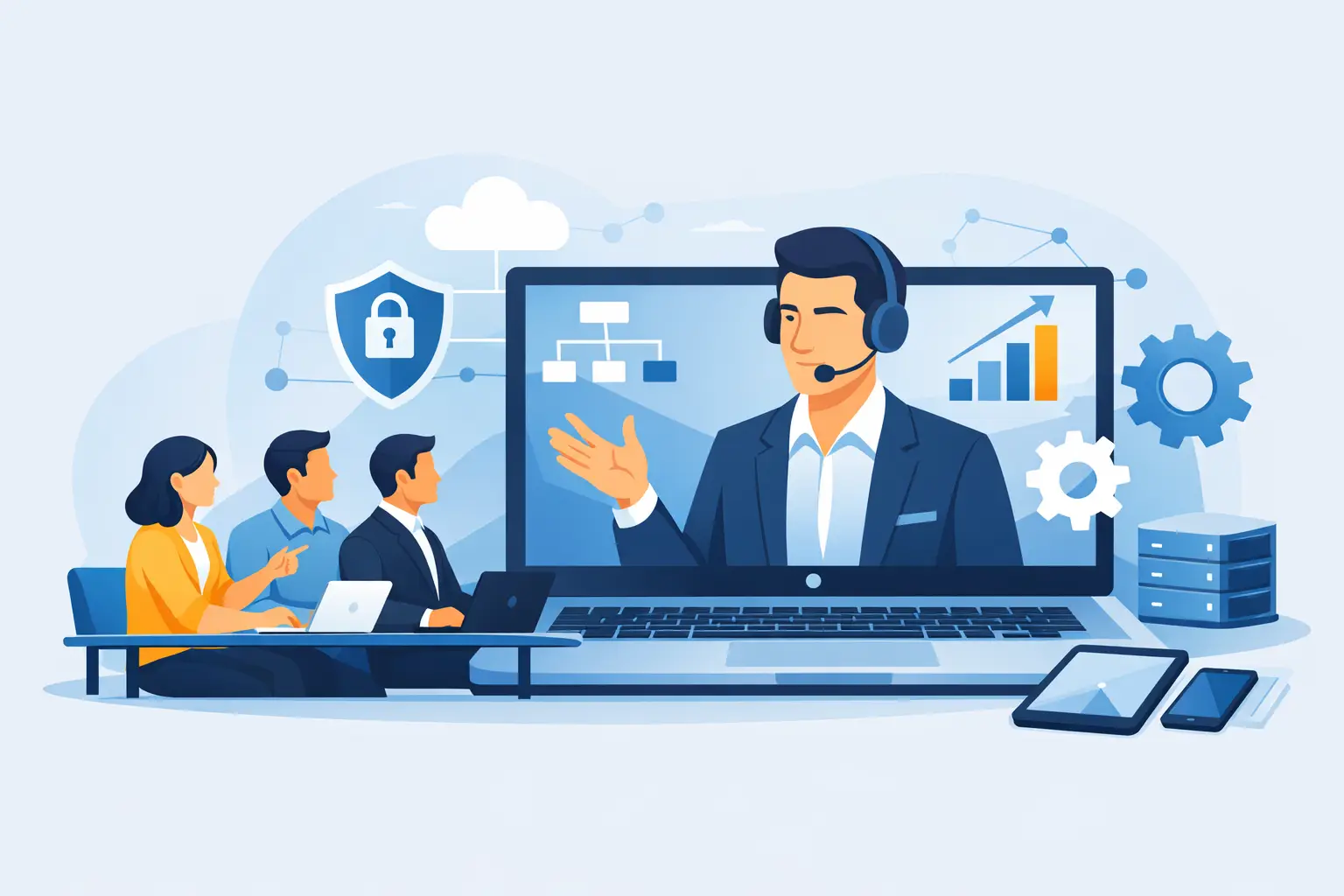
Monday morning starts with a failed payment terminal, patchy WiFi at one branch, a staff member locked out of email, and a software renewal no one realised was due. For many growing businesses, that is not an IT problem in isolation. It is an operations problem. A virtual CIO for SMEs exists to stop technology becoming a string of separate fires and turn it into something managed, planned and accountable.
For small and mid-sized businesses, the real cost of weak IT leadership is rarely one dramatic outage. It is the steady drag of poor decisions, duplicated tools, rising risk and too much time spent chasing suppliers. When systems, connectivity, security and support all sit with different providers, nobody truly owns the outcome. That is where a virtual CIO earns its place.
What a virtual CIO for SMEs actually does
A Chief Information Officer is responsible for aligning technology with business goals. In a large organisation, that is a full-time executive role. In an SME, the need is still there, but the budget usually is not. A virtual CIO gives you that strategic layer on a part-time or shared basis.
That does not just mean recommending new software. A good virtual CIO looks at how your business operates day to day, where downtime hurts, which risks matter most, and what needs to happen next to support growth. They help set priorities, shape budgets, review suppliers, plan upgrades and keep technology decisions tied to outcomes rather than impulse purchases.
The role also fills a common gap between technical support and business leadership. Managed IT teams can keep systems running well, but someone still needs to decide what should change, what can wait and where money will have the biggest effect. Without that guidance, many SMEs either overspend on the wrong things or delay essential work until a problem forces the issue.
The signs your business has outgrown ad hoc IT
Most businesses do not wake up one day and decide they need strategic IT leadership. Usually, the pressure builds gradually. A second site opens. More staff work remotely. Payment systems, cloud software, phones, broadband and security tools all become business-critical. Suddenly the old approach of calling someone when something breaks is not enough.
You may already be at that point if technology decisions are being made by whoever has the loudest problem that week. The same is true if your office manager is effectively running IT supplier relationships, or your internal IT person spends all their time on support and no time on planning.
Another common sign is fragmentation. One provider handles internet, another manages devices, another sold the firewall, another supports phones, and a separate vendor looks after payments. Each may be competent in their lane, but when an incident affects several systems at once, finger-pointing starts quickly. SMEs do not need more moving parts. They need clearer ownership.
Strategy matters, but so does accountability
Some businesses hear “virtual CIO” and think of high-level advice delivered in a quarterly meeting deck. That can be part of it, but it misses the point. Strategic guidance only matters if it leads to action, and action only works if someone takes responsibility for follow-through.
A useful virtual CIO should be close enough to your environment to make practical decisions, not abstract ones. They should know which systems are ageing, where your cyber risk sits, how your sites connect, what your staff struggle with and which suppliers are adding complexity. They should also be able to translate technical choices into business language – cost, risk, uptime, compliance and operational impact.
That accountability matters even more in SMEs because there is less room for waste. A poor software choice, delayed hardware refresh or weak backup plan lands harder when teams are lean and every hour counts. Good IT leadership reduces that exposure by making priorities clear and keeping plans realistic.
Where a virtual CIO adds the most value
The strongest value usually shows up in four areas: planning, security, supplier control and change management.
We've got your back
Planning is the obvious one. Instead of reacting to scattered requests, you get a roadmap. That might include replacing ageing network hardware, standardising devices, tightening Microsoft 365 security, improving backup coverage, or preparing systems for a new site. The important part is sequencing. Not everything has to happen at once, but the right things need to happen in the right order.
Security is often where SMEs feel the most exposed. Attackers do not ignore smaller businesses. In many cases, they target them because controls are weaker and response is slower. A virtual CIO should help you treat security as an ongoing operating discipline, not a one-off purchase. That means policy, awareness training, email protection, access control, backup, monitoring and incident response all being reviewed together.
Supplier control is another major gain. Many SMEs are tired of chasing multiple providers when broadband, hardware, cloud systems and support intersect. A virtual CIO can rationalise that sprawl, identify overlap and push towards a setup that is easier to manage. Fewer handoffs usually mean faster fixes and less confusion.
Change management sounds formal, but in practice it is simple. When the business grows, opens locations, introduces new software or changes how people work, technology needs to keep up. Someone has to assess the impact before changes hit the floor. That is especially important for retailers and multi-site operators, where downtime affects revenue immediately.
It is not just for businesses with no internal IT
One of the most common misconceptions is that a virtual CIO is only relevant if you do not have an internal IT person. In reality, the model often works best alongside one. Internal IT teams know the business, support users and keep daily operations moving. A virtual CIO adds strategic structure, senior oversight and wider commercial perspective.
That can be a strong combination for SMEs whose internal IT lead is capable but stretched. It gives them a sounding board, helps with prioritisation and removes pressure to carry every strategic decision alone. It also gives owners and general managers a clearer line of sight on risk, spending and future needs.
Of course, it depends on the business. A smaller company with straightforward systems may only need periodic strategic input. A more complex operation with several sites, payment environments, compliance obligations and frequent change may need a much closer engagement. The right model is the one that matches operational reality, not a fixed template.
Why the single-partner model matters
Technology breaks down when responsibility is split too many ways. If your internet provider, managed IT company, cyber security vendor and payments partner all operate separately, issues take longer to resolve and nobody sees the full picture. That is frustrating in ordinary conditions and risky during an outage or security event.
A virtual CIO is most effective when they are backed by a delivery model that can actually execute the plan. Advice without operational control creates another layer of coordination for the customer to manage. By contrast, when one accountable partner can align connectivity, support, security and on-site services, decisions happen faster and outcomes improve.
That is especially relevant for SMEs that cannot afford prolonged downtime or internal wrangling. If a branch loses connectivity and payment systems are affected, the business does not care which contract the fault sits under. It needs one team to own the problem and sort it.
Choosing the right virtual CIO support
Not every provider offering strategic IT advice is delivering a true virtual CIO service. Some are really selling account management with a more senior title. Others focus heavily on technology recommendations but stay too far from day-to-day operations to drive change effectively.
The better test is whether they can answer practical questions. Do they understand your business model? Can they explain where your biggest operational risks sit? Do they bring a clear plan, not just product suggestions? Can they help with budgeting and prioritisation? Will they coordinate implementation, or leave your team to chase multiple third parties?
For many SMEs, the right answer is a partner that combines strategy with delivery and takes ownership from network through support. That is where the model becomes useful rather than theoretical. Vetta Group’s approach is built around exactly that principle: one accountable partner across connectivity, IT, cyber security and operational support, with strategic guidance that is tied to what the business actually needs next.
A virtual CIO should make technology simpler to run, easier to justify and less likely to let you down at the wrong moment. If your business is spending too much time managing issues between suppliers, reacting to preventable problems or second-guessing IT decisions, that is usually the cue. Better technology leadership is not about adding complexity. It is about putting someone in place who can see the whole picture and take responsibility for the result.





