







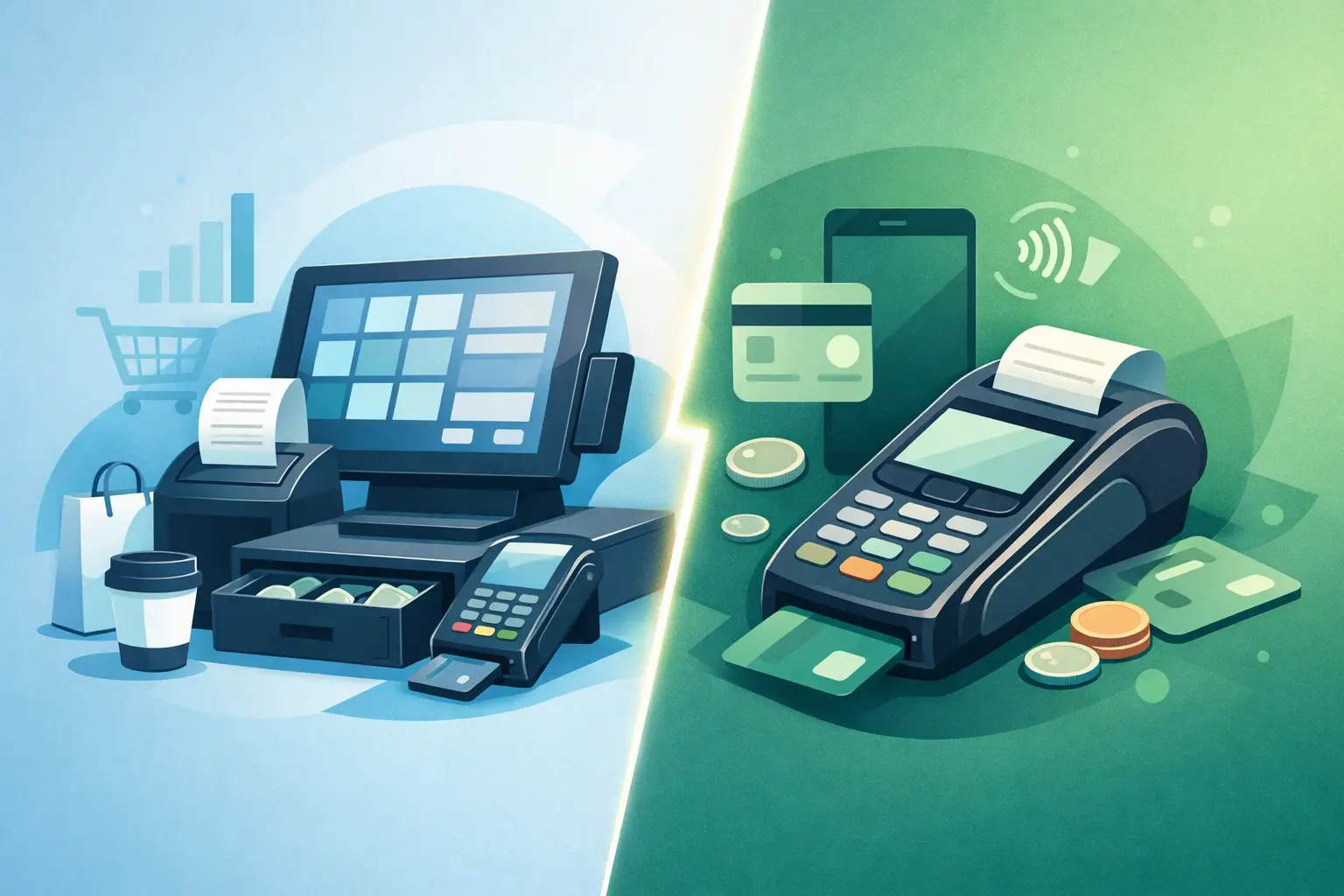
A card terminal stops taking payments on a Saturday lunch rush, and suddenly everyone in the building has an opinion about “the till”, “the EFTPOS machine” and “the POS”. The problem is they are not the same thing. If you are weighing up pos system vs eftpos, the right choice comes down to how your business runs, what you need to track, and who takes responsibility when something goes wrong.
For busy retailers, hospitality venues and service businesses, that distinction matters. One handles payment acceptance. The other can run much more of the front end of your operation. Choosing well can reduce admin, improve visibility and make support far less painful.
POS system vs EFTPOS: the simple difference
At its most basic, EFTPOS is the payment device or payment function used to take card payments. It lets customers tap, insert or swipe their card, and in some cases use digital wallets. Its job is to process the transaction securely and get the payment approved.
A POS system, or point of sale system, is broader. It is the combination of hardware and software used to process sales and manage what sits around them. That often includes a touchscreen, cash drawer, receipt printer, barcode scanner and software for products, pricing, staff logins, sales reporting and stock control.
So when people compare pos system vs eftpos, they are often comparing a single payment tool with a wider trading platform. That is why the two are frequently used together rather than treated as either-or.
What EFTPOS does well
If your priority is taking payments simply and reliably, EFTPOS can be enough.
For many smaller businesses, especially those with a straightforward sales model, an EFTPOS terminal is a practical choice. It is quick to understand, familiar to staff and customers, and usually faster to deploy than a full POS rollout. If you do not need detailed product tracking or integrated reporting, there is no sense paying for complexity you will never use.
A standalone EFTPOS setup can suit trades, mobile operators, market stalls, salons, small clinics and some professional services. In those environments, the payment itself is the main requirement. You may already handle bookings, invoicing or inventory elsewhere, so a dedicated card terminal fills the gap without changing the rest of your workflow.
That said, simple does not always mean flexible. A standalone EFTPOS terminal will not usually tell you which products sold best, how many units are left on the shelf, or whether one site is outperforming another. It takes the payment, but it does not run the business around it.
Where a POS system earns its keep
A POS system becomes more valuable as soon as your operation has moving parts.
If you sell many products, manage multiple staff, run promotions, need stock counts, or want clean end-of-day reporting, a POS system can remove a lot of manual work. It records what was sold, when, by whom and at what margin. That is useful for retail, but it also matters in hospitality, health services, franchise-style models and any environment where mistakes at the counter create problems later.
A good POS system can also improve consistency. Prices update properly, discounts follow the rules you set, and staff are not relying on memory or handwritten notes. Over time, that makes training easier and gives managers a clearer picture of performance.
We've got your back
For multi-site businesses, the value is even more obvious. When each site uses different devices, different reports and different support contacts, small issues become operational drain. A POS platform brings more of that into one place.
POS system vs EFTPOS in day-to-day operations
The easiest way to think about pos system vs eftpos is this: EFTPOS completes the payment, while a POS system manages the sale.
In a basic setup, a staff member enters the amount manually into the EFTPOS machine. The customer pays. The sale may then need to be recorded somewhere else. That works, but it creates extra steps and more room for error.
In a POS-led setup, the staff member selects the items on screen and the system calculates the total automatically. If the EFTPOS terminal is integrated, that amount passes straight through to the payment device. Once paid, the sale is logged against stock, reporting and tax records without duplicate entry.
That difference matters more than it sounds. Manual keying errors, mismatched totals and clumsy reconciliations all take time to sort out. The busier the business, the more those small inefficiencies add up.
Do you need both?
Often, yes.
This is where many buying conversations get muddled. Businesses ask whether they need POS or EFTPOS, when the better question is whether they need a POS system with integrated EFTPOS. In many cases, that combination gives you the speed of card acceptance with the control and visibility of a wider sales platform.
Integration can also improve accountability. If your POS, payment device, connectivity and support all sit with separate providers, diagnosing faults becomes a chain of handoffs. One supplier blames the terminal, another blames the internet connection, and your team is left waiting while the queue grows. A joined-up approach reduces that friction.
That is particularly important for sites where downtime has a direct revenue impact. If payments stop, trading stops. A supported, integrated setup gives you a clearer path to resolution.
How to choose the right setup
The right answer depends on how complex your operation is and how much visibility you need.
If you run a small business with a low volume of simple transactions, a standalone EFTPOS terminal may be the right fit. It keeps costs lower, training is minimal and there is less technology to manage. This can be a sensible option if you already use separate systems for bookings, accounts or invoicing and you do not need them tied together at the counter.
If your business depends on stock accuracy, staff controls, promotions, customer history or site-wide reporting, a POS system is usually worth the investment. It helps you spend less time piecing information together and more time acting on it.
There is also a middle ground. Some businesses start with EFTPOS and move to an integrated POS as they grow. Others adopt a POS first and add tighter payment integration later. Growth, transaction volume and reporting needs usually decide the pace.
The hidden factors people miss
Cost matters, but headline pricing is not the whole story.
A cheaper terminal can become expensive if it creates admin, errors or downtime. In the same way, an overbuilt POS platform can waste money if your team uses only a fraction of its features. What matters is fit.
Support is another factor that gets overlooked until there is a problem. Payments rely on more than the terminal on the counter. They depend on connectivity, device health, software configuration and secure handling of transactions. If those pieces are split across multiple vendors, resolution is slower and ownership gets blurred.
Security matters as well. Payment environments need to be looked after properly, especially as cyber risks continue to rise. Businesses should think beyond the device itself and consider network reliability, system updates, user access, backup processes and who is monitoring for issues. A payment setup should not sit outside the rest of your IT and security planning.
A practical way to decide
Ask what you need the front counter to do.
If the answer is simply “take card payments”, EFTPOS may be enough. If the answer includes “track stock”, “speed up reconciliation”, “manage staff access”, “report by site” or “reduce manual work”, you are looking at POS territory.
Then ask who will support it. That question is just as important as features. When payments, internet, devices and day-to-day support are treated as one service instead of separate products, businesses usually get better uptime and fewer excuses.
For many SMEs, that is the real decision behind pos system vs eftpos. Not just what the technology can do, but whether it comes together in a way that makes trading easier.
Vetta Group works with businesses that want payments, connectivity and support to function as one accountable service, rather than a patchwork of providers. That model suits operators who would rather spend time serving customers than chasing vendors.
The best setup is the one that matches the way you trade today, while giving you room to grow without rebuilding everything six months later. Choose the option that removes friction, keeps you online and gives your team confidence when the queue starts forming.





