







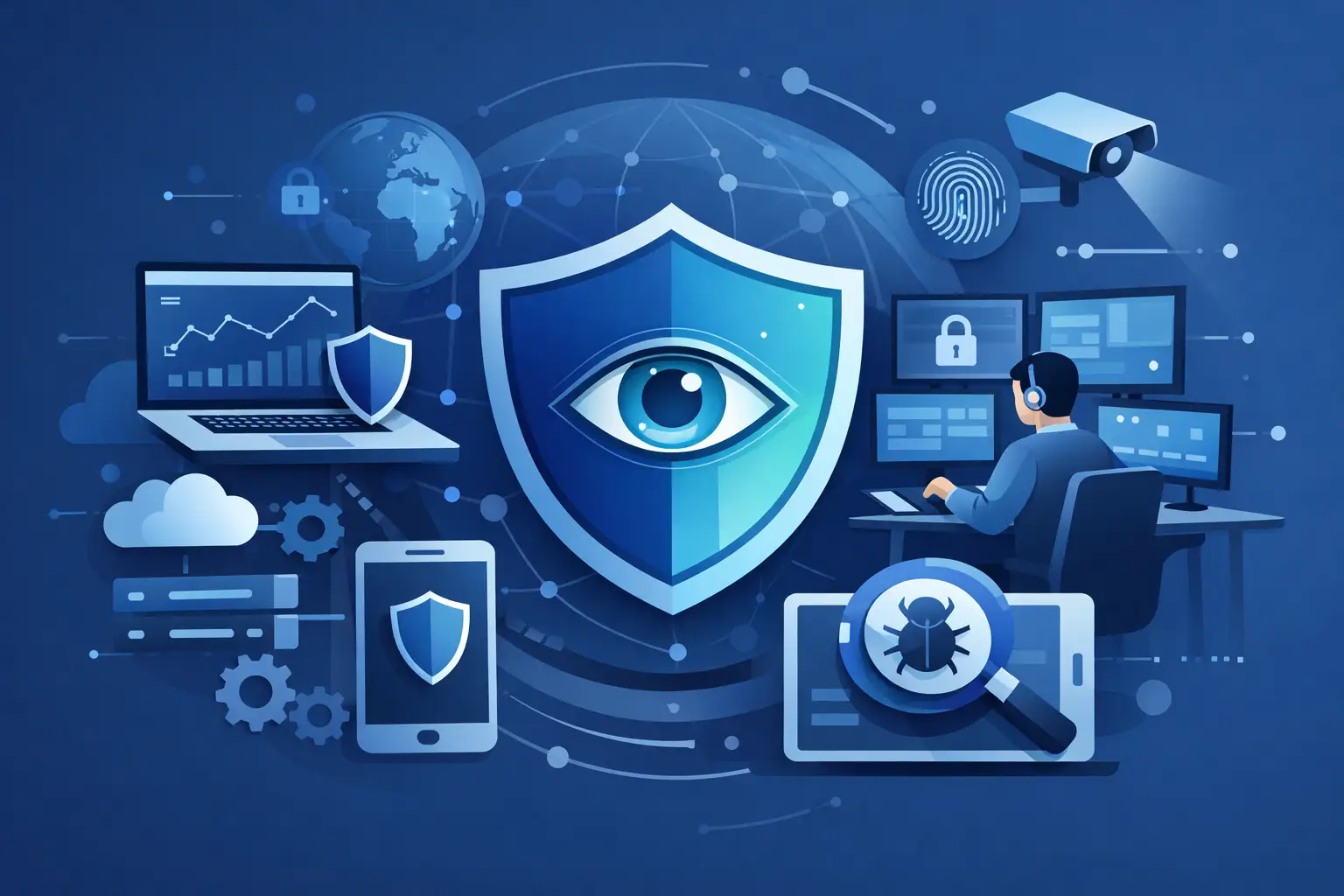
A ransomware alert at 2.13am does not wait for your IT person to start work. Nor does a suspicious login to Microsoft 365, a failed payment terminal connection, or a firewall rule quietly changed after hours. That is the practical answer to what is always on cybersecurity monitoring: continuous oversight of your systems, users and network so threats can be detected and acted on at any time, not just during business hours.
For busy small and mid-sized businesses, this matters because most security problems are not dramatic at first. They look like a normal password reset, an employee clicking the wrong attachment, a device behaving oddly, or a branch losing connectivity and falling back to an insecure workaround. If nobody is watching, small incidents become costly ones.
What is always-on cybersecurity monitoring?
Always-on cybersecurity monitoring is the ongoing collection, review and analysis of security activity across your environment, combined with response processes when something looks wrong. In plain terms, it means your security tools are not just installed and forgotten. They are being watched, alerts are being triaged, and suspicious behaviour is investigated.
That environment usually includes far more than a firewall. It can cover endpoints such as laptops and mobiles, cloud platforms, email, identity systems, backup status, network traffic, payment-related devices and site-to-site connections. The aim is simple: spot threats early, contain them quickly and keep the business operating.
The “always-on” part is important. Cyber risk is not a once-a-quarter exercise or an annual policy review. Threats appear after hours, during weekends and on public holidays. For a retailer, healthcare provider, professional services firm or multi-site operator, the impact of a delayed response can be lost trade, reputational damage and a very long morning.
How always-on cybersecurity monitoring works in practice
At a practical level, always-on monitoring brings together telemetry from multiple systems into a process that can identify unusual behaviour. A managed firewall might flag repeated connection attempts from a known malicious source. An endpoint tool might detect suspicious encryption activity on a staff laptop. Email security may quarantine a phishing message, while identity monitoring picks up impossible travel or repeated failed sign-ins.
On their own, those alerts can be noisy. Good monitoring is not just about generating notifications. It is about deciding what matters, filtering out what does not, and escalating the right issues quickly. That often involves a combination of automated rules and human review.
Human review is where many businesses feel the difference. A dashboard full of warnings is not the same as an accountable team assessing whether an event is benign, risky or critical. That distinction matters when you are trying to decide whether to isolate a machine, disable an account, block traffic, contact a staff member or leave it alone.
Response is the second half of the equation. Monitoring without action is only partial protection. Depending on the service, response can include containing an endpoint, updating firewall rules, forcing password resets, investigating logs, checking backups, advising staff and coordinating remediation. For many SMEs, the real value is having one partner who can see across connectivity, IT and security rather than pushing the issue between vendors.
Why it matters more for SMEs than many realise
Larger enterprises often have dedicated security teams. Most SMEs do not. They rely on a small internal IT function, an office manager, or a generalist provider trying to cover many moving parts. That setup can work for day-to-day support, but security incidents are different. They demand speed, context and a clear owner.
Always-on cybersecurity monitoring helps close that gap. It reduces the window between compromise and detection, which is one of the biggest factors in limiting damage. If an attacker gets access to an account on Friday evening and nobody notices until Monday, they have had a free run at email, files or finance systems for two full days.
There is also an operational reality here. Most businesses now depend on a mix of cloud services, remote access, mobile devices and internet-connected equipment. Add multiple sites and payment systems, and the attack surface grows quickly. The old model of installing antivirus and checking logs occasionally no longer matches how work actually happens.
We've got your back
For New Zealand businesses in particular, resourcing can be tight. Many organisations need enterprise-grade protection but not enterprise-level complexity. They want practical coverage, predictable cost and support they can actually reach. That is where a managed, service-led model makes sense.
What always-on monitoring should include
If you are assessing what “always-on” really means, look beyond marketing language. A credible service should cover visibility, analysis and action.
Visibility means the provider is collecting data from the key parts of your environment, not just one device or one application. Analysis means alerts are reviewed in context, with false positives reduced where possible. Action means there is a defined response path when something needs attention, including who does what and how quickly.
In most environments, that includes monitoring around firewalls, endpoint security, email protection, cloud accounts, identity and access controls, backup status and unusual network behaviour. In some businesses, it should also extend to payment environments, guest WiFi segregation, branch connectivity and on-site equipment.
There is a trade-off, though. More visibility often means more tools, and more tools can create more complexity. That is why integration matters. Businesses are better served when security monitoring sits alongside managed IT, connectivity and support, because problems rarely stay neatly in one category.
What it does not do
Always-on monitoring is not a guarantee that nothing bad will ever happen. No honest provider should present it that way. Attackers change tactics, users make mistakes and not every issue can be prevented outright.
What it does do is improve your odds considerably. It shortens detection times, improves response discipline and reduces the chance of a threat sitting unnoticed in your environment. It also gives leadership better visibility over risk, which is useful for compliance, insurance and customer assurance.
It is also not a substitute for the basics. Monitoring works best when paired with sensible access controls, patching, staff awareness training, tested backups and clear incident processes. If those foundations are weak, monitoring becomes harder and response takes longer.
Signs your business needs always-on cybersecurity monitoring
If your business has more than a handful of users, relies on cloud systems, processes payments, supports remote access or operates across multiple locations, you are already in the territory where continuous monitoring is worth serious attention.
The same applies if your team is stretched, your current provider only reacts when something breaks, or you are managing separate vendors for internet, IT and security. Fragmentation creates delays. During an incident, delays are expensive.
A common warning sign is uncertainty. If nobody in the business can say who is watching security alerts overnight, how a suspicious login would be handled, whether backup failures are being checked, or who coordinates response across network and endpoint issues, then the coverage is probably not as complete as it needs to be.
Choosing a service that actually reduces risk
The right service is not necessarily the one with the longest tool list. It is the one with clear accountability. You should understand what is being monitored, when alerts are reviewed, what response actions are included, and how incidents are escalated.
It also helps to ask whether the provider can support the wider environment around the incident. A security event can quickly involve broadband failover, firewall changes, endpoint isolation, staff communications and on-site support. When those pieces are split across several suppliers, responsibility gets muddy.
That is why many SMEs prefer a single partner model. If one provider can manage connectivity, IT operations and security together, issues are easier to trace and faster to resolve. For businesses that cannot afford downtime, that joined-up approach is often more valuable than adding yet another standalone security tool.
Vetta Group’s approach reflects that reality: always-on protection works best when the team monitoring the threat can also coordinate the network, devices and support response around it.
The business case is not just security
There is a tendency to view cybersecurity as a technical overhead. In practice, always-on monitoring is as much about continuity as it is about defence. It protects revenue, staff productivity and customer trust.
If a suspicious event is caught early, the outcome may be a password reset and a short investigation. If it is missed, the same event can turn into account compromise, invoice fraud, system downtime or a full rebuild. The cost difference is significant.
For leadership teams, the appeal is straightforward. You get fewer surprises, clearer ownership and a service model that supports the business outside office hours. Technology should make life easier, and security should do the same.
Always-on cybersecurity monitoring is not about adding fear to the day. It is about removing avoidable gaps, so your business can keep trading, your team can keep working, and problems can be dealt with before they become disruptions.





