







A payment terminal drops offline at the busiest point of the day. Staff cannot reach cloud software. Customers cannot use WiFi. In that moment, the managed firewall vs router question stops being technical jargon and becomes an operational one: what is protecting the business, and who is accountable for putting it right?
A router and a firewall often sit in the same cabinet, and some devices combine both jobs. That can make them seem interchangeable. They are not. A router gets traffic to the right place; a firewall decides what traffic should be allowed through and watches for activity that should not be there. For a growing business, the difference affects uptime, security, compliance and the time your team spends chasing suppliers.
Managed firewall vs router: the practical difference
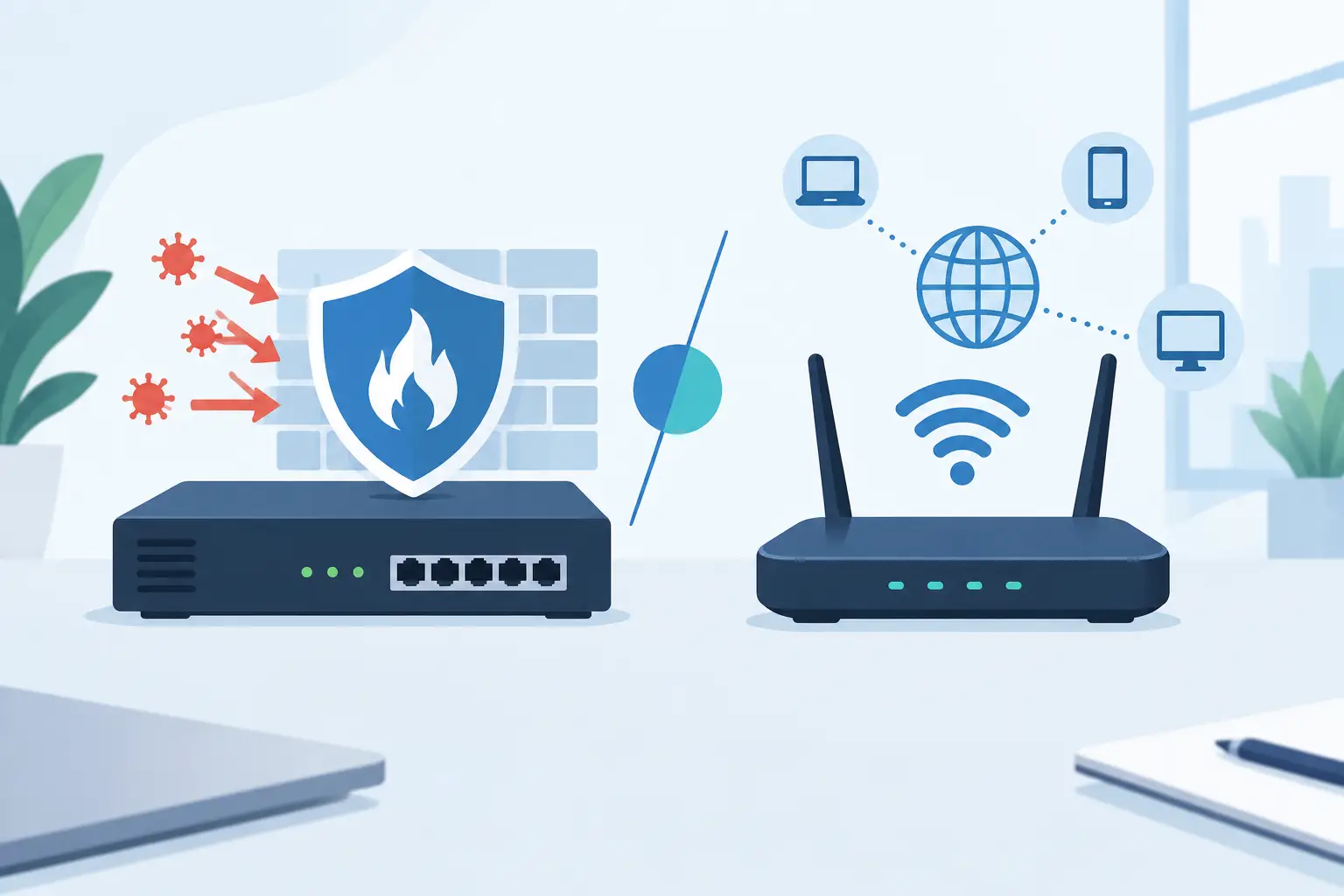
Think of a router as the traffic controller for your network. It connects your local network to the internet, directs data between devices and services, and usually provides features such as WiFi, DHCP and network address translation. Without it, laptops, tills, phones and cloud applications cannot reliably communicate beyond the site.
A firewall applies security rules to that traffic. It can allow approved services, block known threats, separate sensitive systems from guest WiFi, and record what is happening at the network edge. A modern business firewall may also inspect encrypted traffic, prevent intrusions, filter unsafe web destinations and establish secure connections for remote staff.
The word managed changes the conversation again. A managed firewall is not simply a firewall that has been installed. It is a service in which specialists configure the device, keep its security services current, monitor alerts, review changes and respond when suspicious activity or a fault needs attention. The value is ongoing oversight, not the box itself.
What a router does well – and where it stops
For a home office or a very simple site, the router supplied with a broadband service may be all that is needed to get online. It can provide dependable connectivity and WiFi without adding unnecessary complexity. Many routers also include basic firewall functions, such as blocking unsolicited inbound connections.
That baseline protection is useful, but it has limits. A standard router is usually designed first for connectivity and ease of setup, not detailed security policy or round-the-clock investigation. It may not provide meaningful visibility into devices, applications and threats. It may also be difficult to segment a guest network from business devices properly, especially as the business adds cloud systems, cameras, mobile devices and payment technology.
This does not mean every router is inadequate. Higher-end business routers can offer VPNs, VLANs, dual internet connections and useful traffic controls. The question is whether those features are configured correctly, maintained over time and backed by someone who will act when an alert appears at 2 am.
For operationally busy businesses, that ownership is often the gap. A device can be capable, yet still leave a risk if nobody checks whether its firmware is current, its rules remain appropriate or its logs show a developing issue.
What managed firewall protection adds
A managed firewall gives a business more control at the boundary between its network and the internet. Its policies can be built around how the organisation actually works, rather than relying on default settings.
For example, a retailer might separate point-of-sale equipment from staff devices and customer WiFi. A multi-site business may need branches connected securely to central applications. A professional services firm may need remote employees to access internal resources without exposing them to the open internet. These are different requirements, but all benefit from deliberate network segmentation and carefully controlled access.
Protection also needs to adapt. New vulnerabilities are discovered, applications change, staff join and leave, and cybercriminals alter their methods. Managed services provide a process for updates, monitoring and escalation. The provider can investigate unusual traffic, tune overly noisy alerts and recommend changes before a small weakness becomes a disruptive incident.
We've got your back
There is a practical uptime benefit too. When the firewall, connectivity and support are handled by separate companies, diagnosing an outage can become an exercise in hand-offs. The internet provider blames the firewall; the firewall provider asks whether the circuit is working; the business is left in the middle. A single accountable partner can test the connection, review the network edge and coordinate a resolution without asking staff to translate between vendors.
When a router is enough
A router-only approach can be reasonable where the risk and complexity are low. That could include a sole trader with a small number of devices, no sensitive customer data stored locally, no remote access requirement and no separate guest network. It can also suit a temporary connection where advanced controls would add cost without a clear benefit.
Even then, basic habits matter. Change default administrator credentials, apply firmware updates, use strong WiFi encryption, disable features that are not required and keep business devices off the same network as visitors. A router is not a set-and-forget purchase.
The calculation changes quickly when the business depends on internet-connected operations. If lost connectivity means missed sales, delayed work, unavailable phones or manual payment processing, the network is part of the business infrastructure. If a compromise could expose customer information, disrupt cloud applications or reach payment systems, basic router protection may no longer match the risk.
Signs your business needs a managed firewall
The strongest indicator is not company size. It is dependency. A ten-person business with online bookings, remote staff, cloud accounting and payment terminals may have more to protect than a larger business with a simple, isolated setup.
A managed firewall is worth serious consideration when you have multiple locations, staff working remotely, guest WiFi, IP phones, security cameras, servers or cloud workloads. It is also sensible when different users and systems should not have unrestricted access to one another, or when an incident would create a compliance, reputational or financial problem.
Payment environments deserve particular care. The firewall is not a substitute for proper payment security practices, but it can support them by isolating payment devices, limiting unnecessary connections and producing useful records for investigation. The same principle applies to backups and email security: security works best as connected layers, not as a collection of unrelated products.
Do not buy a firewall without defining the service
Two offers can both be called “managed firewall” while delivering very different outcomes. Before deciding, establish who owns configuration, patching, monitoring and incident response. Ask whether alerts are reviewed around the clock or only passed on during business hours. Confirm how changes are requested, how remote access is controlled and what happens if the device fails.
It is also worth asking how the service fits with your connection and wider IT support. A firewall cannot compensate for an unreliable circuit, poor WiFi design or unmanaged devices. Equally, fast broadband alone does not make a business secure. The best result comes from designing connectivity, network equipment and security as one service with clear responsibility.
Predictable monthly costs can be preferable to a large upfront purchase followed by ad hoc support bills. However, the cheapest option is not always the lowest-cost option over time. An unmanaged device may look economical until a misconfiguration, outage or security event consumes staff time and interrupts trading.
A better question than “which device should we buy?”
Rather than choosing between a managed firewall and a router in isolation, ask what needs to stay available, what needs to be protected and who will own the outcome. Most businesses need a router in some form. The decision is whether its built-in controls are sufficient, or whether the environment requires dedicated security and active management.
Vetta brings connectivity, managed IT and security together so there is a clear path from the network to the people supporting it. That matters when a branch cannot process payments, a remote employee needs secure access or unusual traffic needs a prompt human response.
Technology should make life easier, not create another supplier to manage. Build the network around the way your business operates, then make sure there is someone accountable for keeping it online and protected.





