





A member of staff pastes customer information into a public AI tool to draft an email. Another uses AI to shortlist job applicants. A third asks a chatbot for help resolving a technical fault. Each action may save time, but without clear rules, each can also create a privacy, security or fairness problem that someone will need to own.
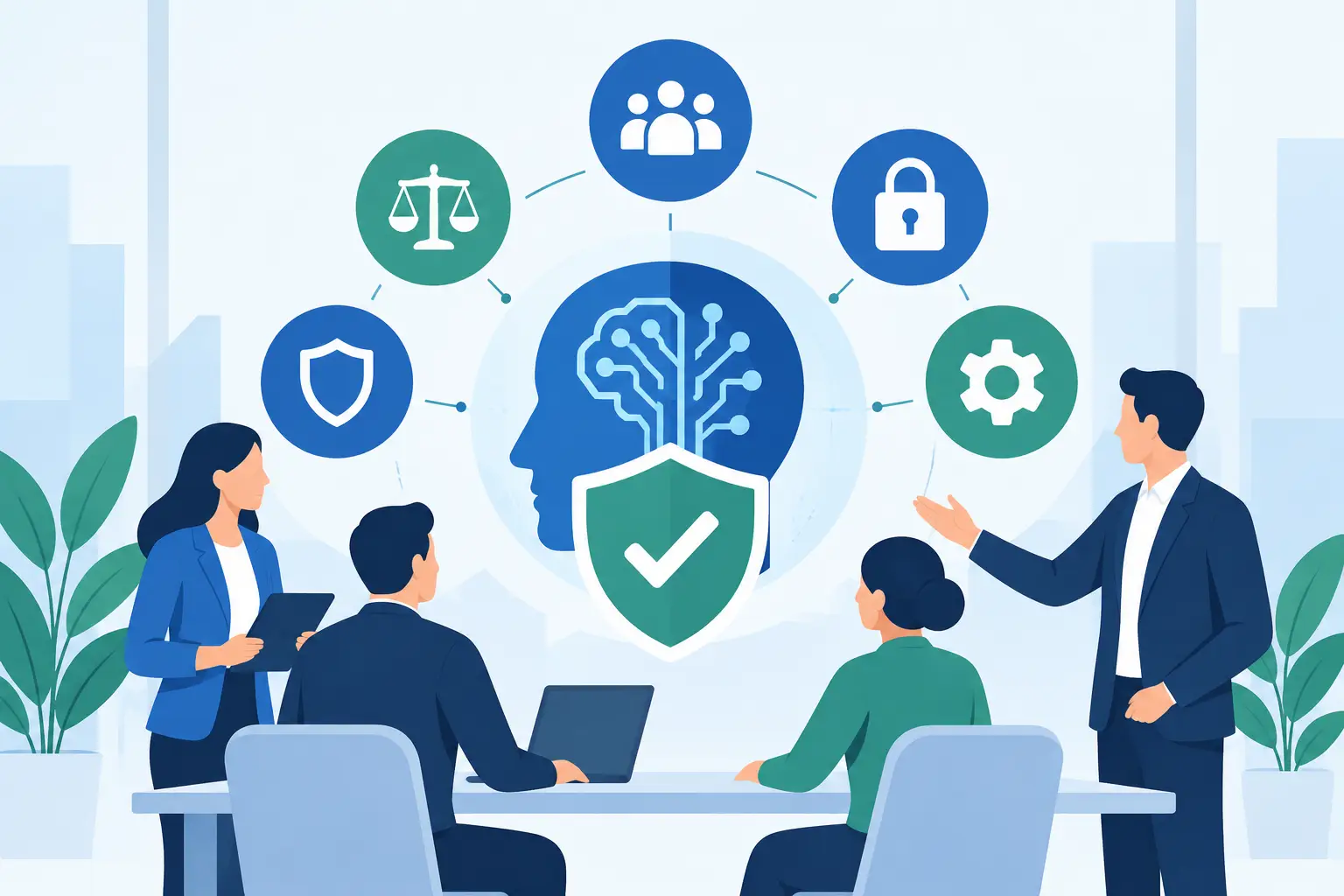
That is why learning how to implement AI governance matters before AI becomes embedded in everyday work. Governance is not a brake on useful technology. It is the practical framework that helps your people use AI confidently, protect sensitive information and keep decisions accountable.
For busy small and mid-sized businesses, the aim is not a large policy document that sits unread in a folder. It is a set of clear decisions, controls and responsibilities that work across the tools your business already relies on.
Start with the outcomes you need to protect
AI governance should reflect the way your business operates. A retailer using AI to write product descriptions faces a different level of risk from a business using it to assess credit, recruit staff or process customer personal data. Treating every use case identically creates unnecessary friction. Treating them all as low risk creates exposure.
Begin by agreeing what cannot be compromised. For most businesses, that includes customer trust, personal information, payment data, service continuity, legal obligations and the quality of decisions made about people. These principles give managers a practical test when a new AI idea appears: does it support the outcome we need, and can we control the risks it introduces?
Set a short statement of purpose as well. For example, AI may be used to improve productivity, support customer service and automate repeatable tasks, but not to make final high-impact decisions without human review. A clear purpose stops tools being adopted simply because they are available.
How to implement AI governance with clear ownership
AI governance fails when it is assigned vaguely to “IT” or left to individual teams. Technology, security, operations and leadership all have a role, but one accountable owner must coordinate the programme and make decisions when priorities conflict.
In a smaller business, this may be a senior operations leader supported by the IT lead or managed technology partner. Their job is not to approve every prompt an employee writes. It is to maintain the rules, ensure assessments happen, keep a record of approved tools and escalate higher-risk proposals.
Create a small AI governance group that meets regularly, particularly during the first months of adoption. Include the person responsible for operations, IT and security, plus a representative from any team using AI heavily. If AI will affect staff, customers or payments, bring the relevant business owner into the discussion early.
The group should be able to answer four simple questions for every significant use case:
- What business problem is the AI solving?
- What data will it receive, generate or retain?
- What happens if its output is wrong, biased or unavailable?
- Who checks the result and is accountable for the final decision?
This is proportionate governance. It gives the business an audit trail without forcing every low-risk task through a lengthy committee process.
Build an inventory before setting rules
You cannot govern AI you cannot see. Start with a short inventory of current and planned AI use, including built-in features in software already in use. Staff may not describe these features as AI, so ask about tools that generate content, summarise meetings, analyse data, automate customer replies or make recommendations.
We've got your back
For each entry, record the supplier, business owner, users, purpose, data types involved, where the data is processed and whether a person reviews the output. Also record what happens if the tool is unavailable. This matters for operational resilience: an automated process can become a single point of failure if no workable manual fallback exists.
Then classify use cases by risk. Low-risk examples might include drafting internal meeting notes from non-sensitive information. Medium-risk work could include customer-facing content or data analysis that requires checking. High-risk use includes decisions about people, sensitive personal data, financial outcomes, security actions or payment-related processes.
Higher risk should mean stronger controls, not automatic rejection. You may require a formal approval, supplier assurance, testing, documented human oversight and regular review. The right level depends on the data, the impact of an error and how easily that error can be detected.
Set practical rules for data and approved tools
Most avoidable AI incidents begin with data entering a tool that was never approved to receive it. Your policy should state plainly which information people must not enter into public or unapproved AI services. This normally includes customer details, employee records, passwords, payment information, confidential commercial information and security configurations.
Make the safer path easier than the risky one. Provide approved tools, explain what they can be used for and give people a clear route to request a new tool or use case. If staff have no supported option, they will often turn to free services under pressure to get work done.
Supplier checks should go beyond features and price. Understand whether your data is used to train models, how long it is retained, where it is processed, how accounts are secured and what happens when you leave the service. Where AI connects to business systems, confirm access permissions are limited to what the tool genuinely needs.
This is where AI governance connects directly with everyday cyber security. Use individual accounts rather than shared logins, enable multi-factor authentication, apply least-privilege access and monitor integrations. Keep software, devices and identity controls managed consistently across sites, remote staff and cloud services.
Keep humans responsible for meaningful decisions
AI can generate confident answers that are incomplete, wrong or based on assumptions hidden from the user. It is useful as an assistant, but it should not quietly become the decision-maker in areas where an error could harm a customer, employee or the business.
Define where human review is mandatory. Customer communications may need a sense check for accuracy and tone. Technical recommendations may need validation by a qualified engineer. Recruitment, pricing exceptions, credit decisions and disciplinary actions should always have a named person who can challenge the output and explain the final outcome.
Train people to verify rather than merely accept. They should check facts against trusted sources, look for missing context and avoid presenting generated material as certain when it has not been confirmed. For customer-facing work, clarity about when AI has assisted can also be appropriate, depending on the service and the expectation of the customer.
Test, monitor and improve the controls
Governance is an operating discipline, not a one-off launch task. Test important AI use cases before wide release using realistic scenarios, including poor-quality data, unusual customer requests and attempts to make the tool reveal information it should not access.
Once deployed, monitor for errors, complaints, unexpected costs, unusual access activity and changes in output quality. Agree how staff report an issue, who investigates it and when use of the tool should be paused. Your existing incident response process should include AI-related events, particularly where data exposure or fraud is possible.
Review approved tools and use cases on a regular schedule. Suppliers change model behaviour, terms and security settings. Your own workflows change too. A quarterly review is often a sensible starting point, with immediate review after a significant incident, supplier change or expansion into a higher-risk activity.
Make governance part of everyday work
The best policy is written in language people can use at the point of work. Give staff short examples: what they can enter into an approved AI assistant, when they need approval and what to do if an output looks wrong. Include AI in induction, security awareness training and manager briefings rather than treating it as a specialist subject for technical teams alone.
For organisations without a large internal IT function, a single accountable technology partner can help join the dots between connectivity, identity, devices, cyber security and AI tools. Vetta can support businesses to put practical controls around AI adoption while keeping the focus on reliable day-to-day operations.
Start small, with a few valuable use cases and rules your team can follow. The goal is not to eliminate judgement or slow innovation. It is to ensure that as AI takes on more of the routine work, your business remains responsible for the outcomes that matter.





