







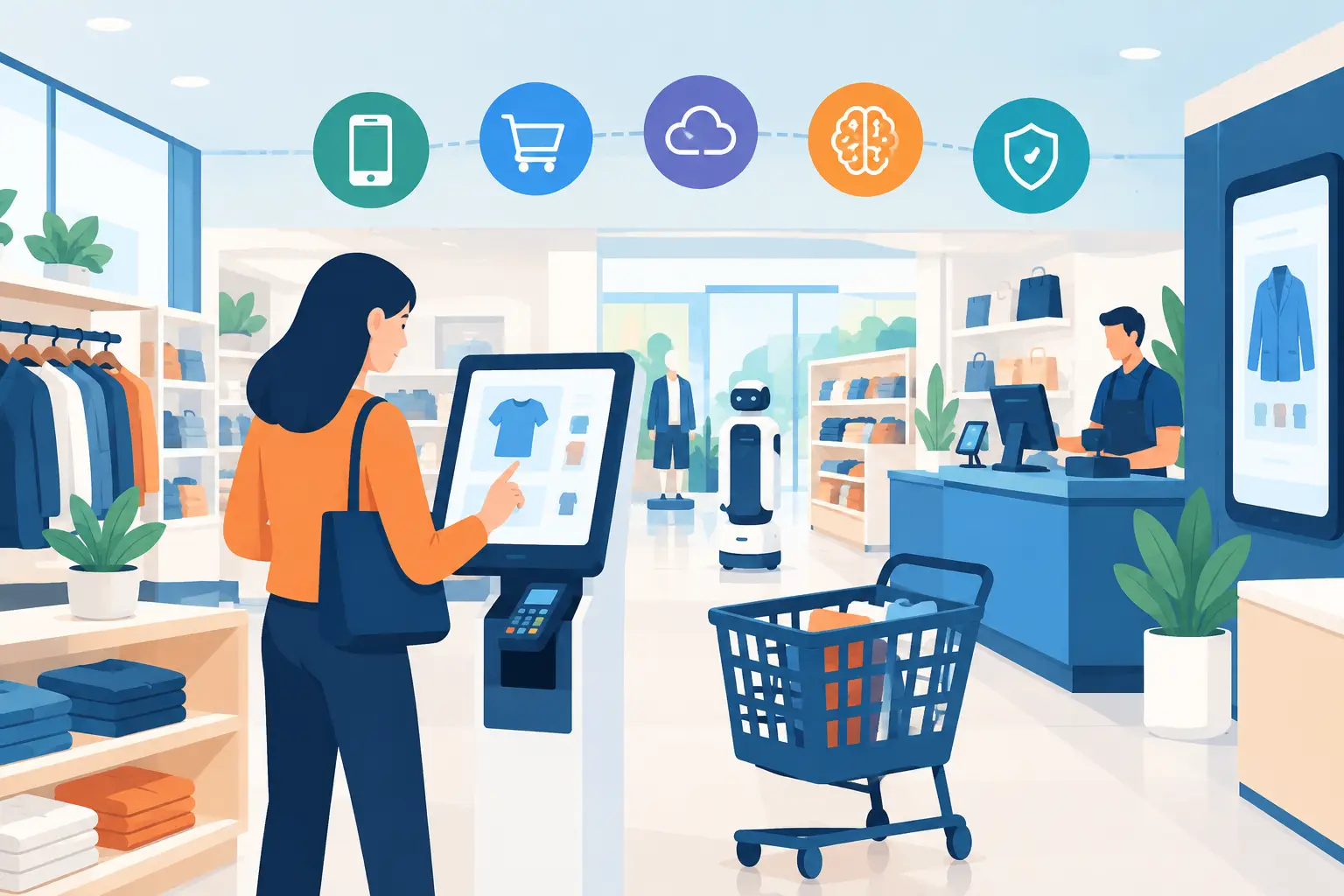
A queue at the till is rarely just a queue. It can be a payment terminal that has lost its connection, a slow point-of-sale system, a WiFi network overloaded by guest devices, or a team member forced to ring another supplier while customers wait. Retail technology trends matter because the systems behind the counter now directly shape sales, customer trust and a store’s ability to trade.
For small and mid-sized retailers, the goal is not to adopt every new tool. It is to make the essentials work together: reliable connectivity, secure payments, protected devices and support that takes responsibility when something goes wrong. The strongest technology choices reduce friction for staff and customers while making downtime less likely and easier to resolve.
Retail technology trends are becoming operational basics
The most useful changes in retail are not always the most visible. Digital receipts, self-service options and personalised offers can improve the customer experience, but they rely on the less glamorous foundations underneath: stable internet, well-managed networks, secure devices and payment systems that remain available at busy times.
This is especially relevant for multi-site operators. A retailer with three, ten or fifty locations does not need each branch to become an IT department. It needs standardised systems, visibility across every site and one clear route for support. When broadband, WiFi, point-of-sale equipment, security and payments are managed separately, a simple fault can quickly turn into a chain of vendor hand-offs.
The direction of travel is clear. Retailers are moving from isolated tools towards connected operating systems for the shop floor. That does not necessarily mean replacing everything at once. Often, it means fixing the foundation first, then introducing improvements in a measured way.
Payments are expected to work everywhere, every time
Customers increasingly choose how they want to pay: contactless card, mobile wallet, online invoice, pay-by-link or traditional EFTPOS. For the retailer, every option needs to be quick, secure and easy for staff to use. A failed transaction at the counter does more than delay a sale. It creates uncertainty at the exact moment a customer is ready to buy.
Integrated payments are therefore one of the most practical retail technology trends. When payment terminals and point-of-sale systems are selected, installed and supported as part of the wider technology environment, it is easier to identify whether a fault sits with the terminal, local network, broadband connection or software. That shortens resolution times and removes the familiar problem of being told to call someone else.
There is a trade-off. More payment options can increase complexity, costs and compliance obligations. Retailers should avoid adding methods simply because they are fashionable. The right approach depends on the business: a high-volume convenience store has different requirements from a furniture showroom, a café, or a retailer that sells through both a shop and website. Start with customer behaviour, transaction volume and the cost of a failed payment, then build the payment setup around those realities.
Connected stores need reliable connectivity
Retail networks now carry more than card transactions. They support cloud-based tills, stock systems, staff devices, security cameras, digital displays, guest WiFi and communications with head office. If these services all share a poorly designed connection, a busy Saturday can expose weaknesses quickly.
A dependable setup separates critical services from non-essential traffic. Payment terminals and core point-of-sale systems should not be competing with customer WiFi or staff video streaming. Managed networking can prioritise essential traffic, provide visibility into performance and help prevent a local issue from becoming a trading problem.
Resilience also deserves more attention. A single internet connection may be enough for a low-risk site, but it may not be sufficient for a flagship store or a location where every minute of downtime is costly. A secondary connection, such as mobile backup, can keep essential systems operating if the main service fails. It is an additional cost, but it can be far less expensive than losing a full day of transactions.
For retailers operating across New Zealand, nationwide coverage and clear escalation matter just as much as speed. A fast connection is valuable, but fast action when a store cannot trade is more valuable still.
We've got your back
Security is now part of customer service
Retail technology creates useful data: transaction records, customer details, staff information, inventory data and supplier accounts. It also creates more points of entry for criminals. A compromised email account can lead to fraudulent invoices. A weak password can expose cloud systems. An unmanaged till or back-office computer can become a route into the wider network.
Security should not be treated as a one-off installation or a policy staff sign once a year. It needs ongoing protection, monitoring and practical routines that fit a busy retail environment. That includes managed firewalls, email filtering, password management, multi-factor authentication, secure backups and staff awareness training.
Staff training is particularly important because retail teams are often time-poor, seasonal and customer-facing. Training should be brief, relevant and repeated. A colleague is more likely to spot a suspicious password reset request if they have seen a realistic example than if they have read a dense policy document months earlier.
Retailers handling card payments also need to understand their obligations around payment security. The detail can feel technical, but the operational principle is simple: keep payment environments separate, keep systems updated and know who is accountable for maintaining them. A supplier may provide the terminal, another may run the network, and a third may manage IT. Unless someone coordinates those responsibilities, gaps are easy to miss.
AI has value when it solves a real retail problem
Artificial intelligence is receiving plenty of attention, but its most useful retail applications are often practical rather than theatrical. It can help analyse sales patterns, forecast demand, draft product descriptions, route customer enquiries and identify recurring support issues. For a retailer with limited time, that can free people to focus on customers and operations.
AI should be introduced with care. Poor data produces poor recommendations, and customer-facing automation can damage trust if it is inaccurate or impossible to escalate to a person. It also raises privacy, security and governance questions, particularly if staff paste customer or commercial information into public tools.
A sensible starting point is an internal process with a clear owner. Choose one repetitive task, set a measurable outcome and define what information the tool can access. For example, a retailer may use AI to help summarise weekly sales reports, not to make final pricing decisions without review. Human judgement remains essential, especially where margin, customer relationships or compliance are involved.
What to prioritise before investing in new retail technology
Before buying another platform, retailers should assess whether their existing setup is reliable, supported and secure. The following questions expose the gaps that most often disrupt trading:
- Can staff take payments if the primary internet connection fails?
- Is there one support contact who can coordinate connectivity, IT, security and payments?
- Are point-of-sale devices, routers and computers patched, monitored and backed up?
- Can a manager quickly see which sites or systems are affected by an outage?
- Do staff know how to report a suspicious email, lost device or payment issue?
These questions are more useful than a generic technology checklist because they focus on operational consequences. A new feature is only valuable if the business can depend on it when the shop is busy.
The single-partner model reduces avoidable delays
Retail technology is often bought in pieces: broadband from one provider, WiFi from another, point-of-sale hardware from a third and cybersecurity from a fourth. Each service may be capable on its own, yet the business still carries the burden of coordinating them.
A single accountable partner changes that. It creates a clearer view of the whole environment, from the network connection through to devices, security controls and payment equipment. It also means support teams can investigate across those layers rather than stopping at their own boundary.
Vetta Group takes this approach by bringing connectivity, managed IT, cybersecurity, field services and payments together. For retailers, the practical benefit is not technology for its own sake. It is fewer hand-offs, clearer responsibility and support that focuses on getting the store trading again.
The best retail technology is often the kind customers never notice. The card payment goes through, stock information is available, staff can get help quickly and the shop keeps moving. Build towards that standard one priority at a time, with partners willing to own the outcome as well as the equipment.





