







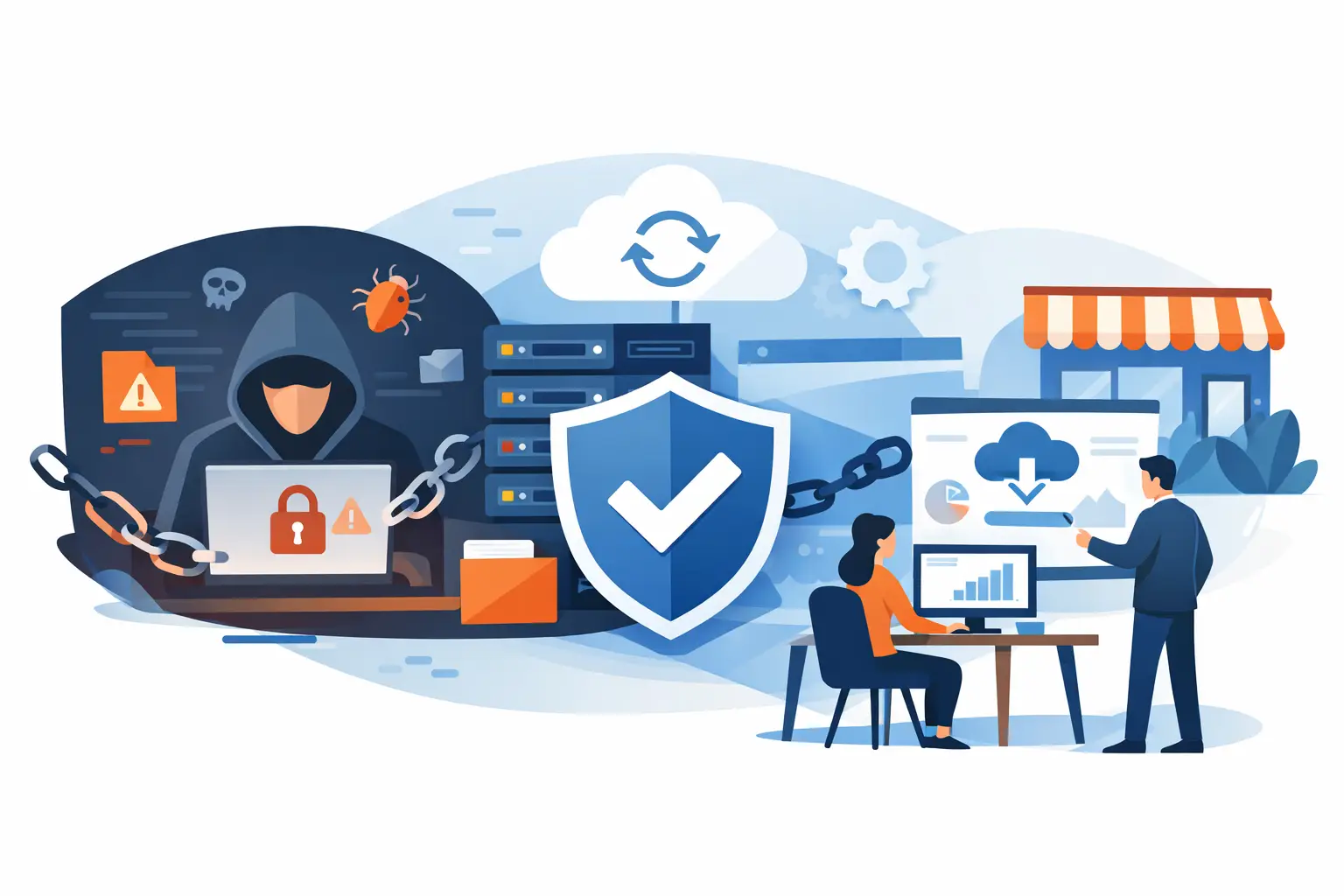
At 8:17 on a Tuesday morning, a five-site retail business found out its problem was not just “the server is down”. Staff could not open shared files. The point-of-sale back office was timing out. One site had lost access to supplier invoices, another could not print delivery labels, and a manager had spotted a ransom note on a desktop. This case study ransomware recovery for small business is based on a pattern we see too often – busy operators with decent day-to-day systems, but too many gaps between connectivity, devices, security, backups, and support.
The business was not careless. It had antivirus, cloud software, and local IT help on request. What it did not have was a joined-up response model. That matters, because ransomware is rarely just a “security issue”. It quickly becomes an operations issue, a communications issue, a payments issue, and in some environments, a compliance issue as well.
The business before the attack
The company had 42 staff, five locations, and a lean internal admin team. Like many small businesses, it had grown in layers. Different sites had different internet services, two generations of networking gear, a mix of Microsoft 365 and on-premise file storage, and a backup setup that had not been reviewed properly in over a year.
Nothing looked disastrous on the surface. The business was trading, staff were productive, and technology was “good enough” most days. The weakness was fragmentation. When an environment is stitched together from separate providers and ad hoc decisions, recovery becomes slower because nobody owns the whole picture.
How the ransomware attack got in
The initial compromise came through a phishing email sent to an accounts user. The message looked credible, referred to an overdue supplier invoice, and pushed the user to open an attachment. From there, the attacker harvested credentials, moved laterally, and gained access to a shared server and several endpoints.
That part is familiar. The more instructive detail is what happened next. Multi-factor authentication had not been enforced everywhere. Endpoint protection generated alerts, but those alerts were not being actively monitored. The backups existed, but one backup repository was still reachable from the network. In other words, the business had security controls, but not enough operational discipline around them.
The first six hours decide a lot
In this case study of ransomware recovery for small business, the first turning point was containment. The infected machines had to be isolated immediately. Internet access was restricted at affected sites, shared credentials were reset, and remote access channels were reviewed. Those are uncomfortable decisions in the middle of the working day, especially when trade is already being disrupted, but delaying containment usually makes the bill larger.
The second turning point was communications. Staff needed one clear message: stop using affected machines, do not reconnect disconnected devices, and report anything unusual. Leadership needed a realistic view of business impact, not guesswork. Customers and suppliers did not need every technical detail, but they did need consistent updates where service levels were affected.
This is one of the main lessons for smaller organisations. Technical recovery is only half the job. If nobody coordinates people, systems, and priorities, downtime spreads faster than the malware did.
What recovery looked like in practice
The business did not pay the ransom. That was the right call here, but it is not a moral slogan and it is not a shortcut. Some firms assume refusing payment automatically puts them on the high ground. In reality, it means you need a credible recovery path.
The recovery plan started with triage. Which systems were essential to trade today, which could wait until tomorrow, and which needed forensic review before anyone touched them? The priority order was point-of-sale support systems, shared finance files, email access, and site-to-site communications.
Clean devices were prepared first. There is no value restoring data onto systems you do not trust. User accounts were audited, privileged credentials were rotated, and access policies were tightened before broad restoration began. That slowed the first phase slightly, but it prevented a second incident during recovery.
We've got your back
Backups became the deciding factor. One local backup set had been compromised, but an isolated cloud backup remained intact. Because retention policies were in place, the team could restore from a clean recovery point before the encryption spread fully across the environment. Without that separation, the business would have faced a much longer outage and a far harder choice around ransom demands.
Downtime, cost, and the trade-offs
The business resumed partial operations the same day and recovered core systems over 48 hours. Full clean-up, device rebuilding, control testing, and documentation took closer to two weeks. That difference matters. Leaders often ask, “How fast can we get back online?” The better question is, “How fast can we get back online safely?”
There are always trade-offs. A rushed restoration may reduce headline downtime but leave persistence mechanisms behind. A slower, cleaner rebuild can protect the business from a repeat event, but it has an immediate operational cost. For small businesses, that tension is real because every extra hour offline affects revenue, payroll, service levels, and customer confidence.
The direct financial hit included emergency response, lost trading time, device rebuilds, and management time diverted from the business. The indirect cost was harder to measure but just as real: delayed projects, supplier friction, and a week of uncertainty that distracted staff across all sites.
What actually failed
It would be easy to frame this as “staff clicked a bad email”, but that is far too simple. Staff mistakes happen. Good systems are designed on the assumption that humans are fallible.
The real failures were layered. Security monitoring was not active enough to catch the warning signs early. Authentication controls were inconsistent. Backup design had not been tested against a ransomware scenario. Support arrangements were fragmented, so the response started with too much time spent figuring out who owned what.
That last point is where many SMEs get caught. They may have one supplier for internet, another for hardware, another for security software, and a local technician for general support. Each part may be reasonable on its own. During an incident, though, gaps open between vendors, and the business pays for the delay.
What changed after the incident
The post-incident work was not glamorous, but it was effective. The company standardised multi-factor authentication, removed stale accounts, segmented networks between sites and critical systems, and moved to monitored endpoint detection rather than basic alerting. Backup architecture was redesigned so recovery copies were isolated, regularly tested, and aligned to actual business priorities.
Just as importantly, the business simplified accountability. Instead of treating broadband, firewalls, endpoints, backups, and support as separate conversations, it moved towards an integrated operating model. That does not mean every business needs the same stack or the same spend. It means someone needs end-to-end responsibility for keeping the business online, protected, and recoverable.
For operationally busy SMEs, that model is often the difference between a contained incident and a prolonged outage. A single partner approach reduces handoffs, shortens escalation paths, and makes it easier to set sensible recovery targets. That is especially relevant for multi-site businesses where connectivity, payments, and staff access all depend on systems working together.
What small businesses should take from this case study ransomware recovery for small business
The lesson is not that every business needs enterprise-scale security. It is that smaller businesses need joined-up protection that matches how they actually operate. If you rely on shared files, cloud apps, card payments, remote access, and multiple sites, then your recovery plan has to cover all of that – not just the server room.
Start with a blunt question: if ransomware hit at 8:17 tomorrow morning, who would coordinate the response, who would isolate affected systems, who would verify backups, and how would you keep trading while recovery happens? If the answer involves calling three or four providers and hoping they cooperate quickly, there is work to do.
The most resilient small businesses are not the ones with the fanciest tools. They are the ones with clear ownership, monitored controls, tested backups, and support they can actually reach when things go wrong. That is where practical resilience comes from.
Technology should make life easier, not leave you negotiating with criminals while trying to keep the doors open. The right time to fix recovery is before you need it.





