







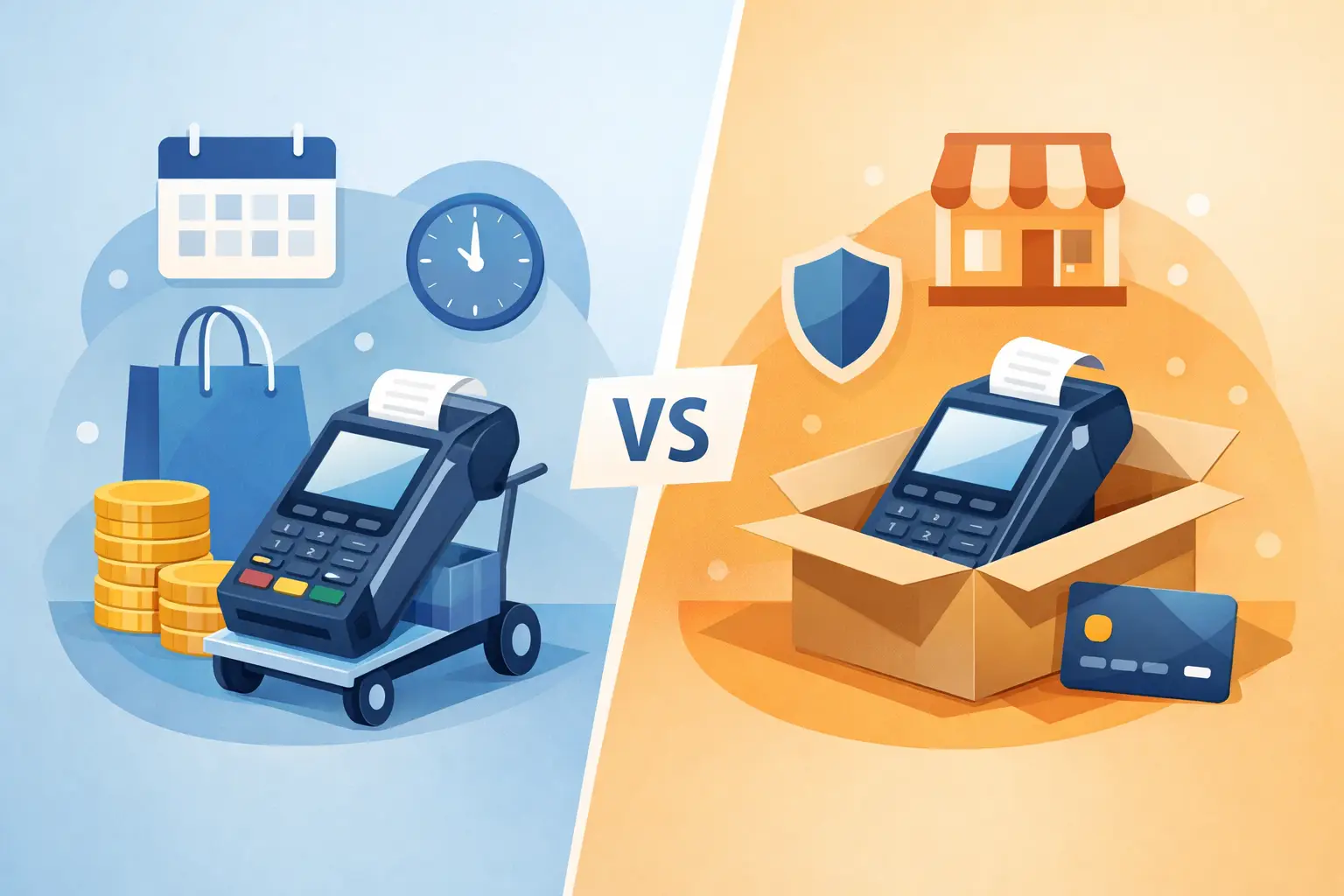
A payment terminal rarely causes trouble at a convenient time. It fails during the lunch rush, drops connection on a Saturday, or starts behaving oddly just as your busiest staff member is serving a queue. That is why the question of EFTPOS hire vs purchase is not just about the sticker price. It is about uptime, support, cash flow and how much responsibility you want to carry when something goes wrong.
For many small and mid-sized businesses, the right answer depends less on the terminal itself and more on how your operation runs day to day. A single-site café with steady trade has different priorities from a growing retailer, a mobile service business or a multi-site operator that cannot afford finger-pointing between providers.
EFTPOS hire vs purchase: the real difference
At a basic level, hiring means paying an ongoing fee to use the terminal and usually receiving support, replacement options and a service arrangement as part of that package. Purchasing means you own the device outright, either by paying upfront or financing it separately, and you take more responsibility for its lifecycle.
That sounds simple enough, but the practical difference shows up over time. Hire tends to suit businesses that want predictable operating costs and a clearer support path. Purchase can suit businesses that want to reduce long-term recurring fees and are comfortable managing equipment ownership.
Neither option is automatically better. The better choice is the one that matches your trading pattern, risk tolerance and internal capability.
When hiring makes more sense
Hiring is often the stronger fit when continuity matters more than squeezing every possible pound from the asset over several years. If your business relies on taking card payments all day, every day, a supported monthly model can be easier to justify than a cheaper-looking upfront purchase.
The biggest advantage is predictability. Instead of a larger capital outlay, you spread the cost across a fixed monthly fee. For operationally busy businesses, that matters. It keeps cash available for stock, wages, fit-out costs or marketing rather than tying it up in hardware.
There is also the support factor. When payments, connectivity and devices all affect the same customer transaction, isolated suppliers create delays. One blames the internet, another blames the terminal, and your staff are left waiting while sales stall. A hire model is often chosen by businesses that want a single accountable partner to coordinate the service and deal with faults quickly.
Hiring also gives you more flexibility if your needs change. If you add lanes, open another site, move to mobile payments or need newer hardware, the path is usually simpler than replacing owned equipment. For growing businesses, that flexibility is often worth more than the theoretical savings of ownership.
Seasonal businesses can benefit too. If your trading pattern changes throughout the year, an equipment model that can be adjusted is often easier to work with than owning terminals that sit underused for long periods.
When purchasing can be the better move
Buying a terminal can make sense if your business is stable, your requirements are unlikely to change soon and you are happy to manage the asset over its useful life. If you plan to use the same terminal setup for years, purchasing may lower your total cost compared with ongoing hire fees.
Ownership can be attractive for businesses with straightforward operations and in-house capability. If your team already manages devices, software and replacements across the wider business, adding EFTPOS hardware to that list may not feel like much extra work.
We've got your back
It can also suit businesses that prefer capital expenditure over monthly operational costs. Some owners simply want to buy the equipment, put it on the books and move on. That approach can be perfectly sensible, particularly where budgets are set up to favour owned assets.
But ownership comes with trade-offs. The savings only hold up if the equipment remains fit for purpose, stays compatible and does not create support headaches. A lower upfront total is less compelling if an outage takes hours to resolve and costs you sales.
Cost is more than the terminal price
This is where comparisons often go wrong. Businesses look at the purchase price and compare it with a monthly hire fee, then stop there. In reality, the cost of payment hardware sits inside a bigger operating picture.
Start with cash flow. A purchased terminal may be cheaper over three to five years, but the upfront spend still leaves your business account today. Hiring preserves working capital, which can be more valuable than a lower total equipment cost.
Then look at support and replacement. If an owned terminal fails outside warranty, what is the replacement process, how quickly can you get trading again, and who handles the issue? Those questions matter more than a narrow comparison spreadsheet.
There is also the cost of obsolescence. Payment technology changes, security requirements evolve and customer expectations shift. A terminal you own may still function, but that does not always mean it remains the best fit. Hiring can reduce the risk of being stuck with ageing equipment simply because you have already paid for it.
Finally, consider internal time. Every hour spent diagnosing faults, chasing vendors or organising replacements is time your team is not spending on customers or core operations. For many SMEs, that hidden cost is real.
EFTPOS hire vs purchase for growing businesses
If your business is changing quickly, hire usually gives you more room to move. Growth introduces complexity – more sites, more staff, more transactions, more chances for something to break. What worked for one location may not work for three.
A purchased setup can become limiting if you need to standardise across stores, roll out new devices or support mobile trading. By contrast, a managed hire arrangement usually fits better with staged expansion because the equipment and support model can scale with you.
This matters even more when payments rely on other services. If your EFTPOS estate depends on strong connectivity, secure network design and responsive technical support, then the equipment decision should not be made in isolation. The businesses that operate most smoothly tend to treat payments as part of the wider technology environment, not as a standalone device on the counter.
Questions worth asking before you decide
The right choice becomes clearer when you look at operational realities rather than feature lists. Ask yourself how costly downtime is for your business. If a failed terminal during peak trade has a direct and immediate effect on revenue, support should carry serious weight in the decision.
Think about how often your setup may change over the next two years. If the answer is probably not at all, ownership becomes more attractive. If the answer is possibly quite a bit, flexibility starts to matter more.
You should also look at who will own the problem internally. If you have an experienced IT lead and clear processes for device management, purchasing may be manageable. If your managers and front-of-house team are already stretched, a supported hire model may remove a lot of friction.
And be honest about vendor coordination. Payments are not just about a machine. They depend on connectivity, configuration, security and someone picking up the phone when trade is on the line. That is why many businesses choose a single partner approach rather than assembling separate providers and hoping they cooperate when it matters.
What a practical decision often looks like
For a new or growing SME, hiring is often the safer operational choice. It keeps upfront costs down, makes budgeting easier and places more of the service burden with the provider. That is especially useful when reliability matters more than owning the hardware.
For a stable business with predictable payment volumes, limited change and confidence in managing equipment, purchasing can be financially sensible. The key is not to underestimate the value of support, replacement speed and accountability.
A blended approach can also work. Some businesses hire for core sites where uptime and support are critical, then purchase in lower-risk environments where the usage pattern is settled. It depends on how each location trades and how much disruption the business can absorb.
Where a provider can support connectivity, devices and payments together, the conversation becomes more useful. Instead of buying a terminal in isolation, you are looking at whether the whole payment environment is dependable. That is the standard we work to at Vetta – not just supplying equipment, but helping businesses reduce downtime, simplify support and keep trading with confidence.
The best EFTPOS decision is usually the one that leaves your team with fewer problems to solve, not just a lower number on a quote. When payments are central to your day, peace of mind has a value of its own.





