






At 9:07 on a Monday morning, nobody cares how your IT is structured. They care that the tills are down, staff cannot log in, customer WiFi is patchy, and your phones are suddenly unreliable. That is why managed IT versus internal IT is not an abstract procurement debate. For busy businesses, it is an operations decision that affects uptime, security, cost control and how quickly problems get fixed.
For many small and mid-sized businesses, the real question is not which model sounds better on paper. It is which one gives you dependable support without finger-pointing, missed handovers or technology that works well enough until it really matters. The answer depends on your size, risk profile, internal capability and how connected your systems are to day-to-day trading.
Managed IT versus internal IT: what is the difference?
Internal IT means you employ your own people to run your technology environment. That can be one capable IT manager, a small in-house team, or a broader department covering infrastructure, devices, software, security and support. You set priorities directly, build knowledge internally and keep day-to-day control close to the business.
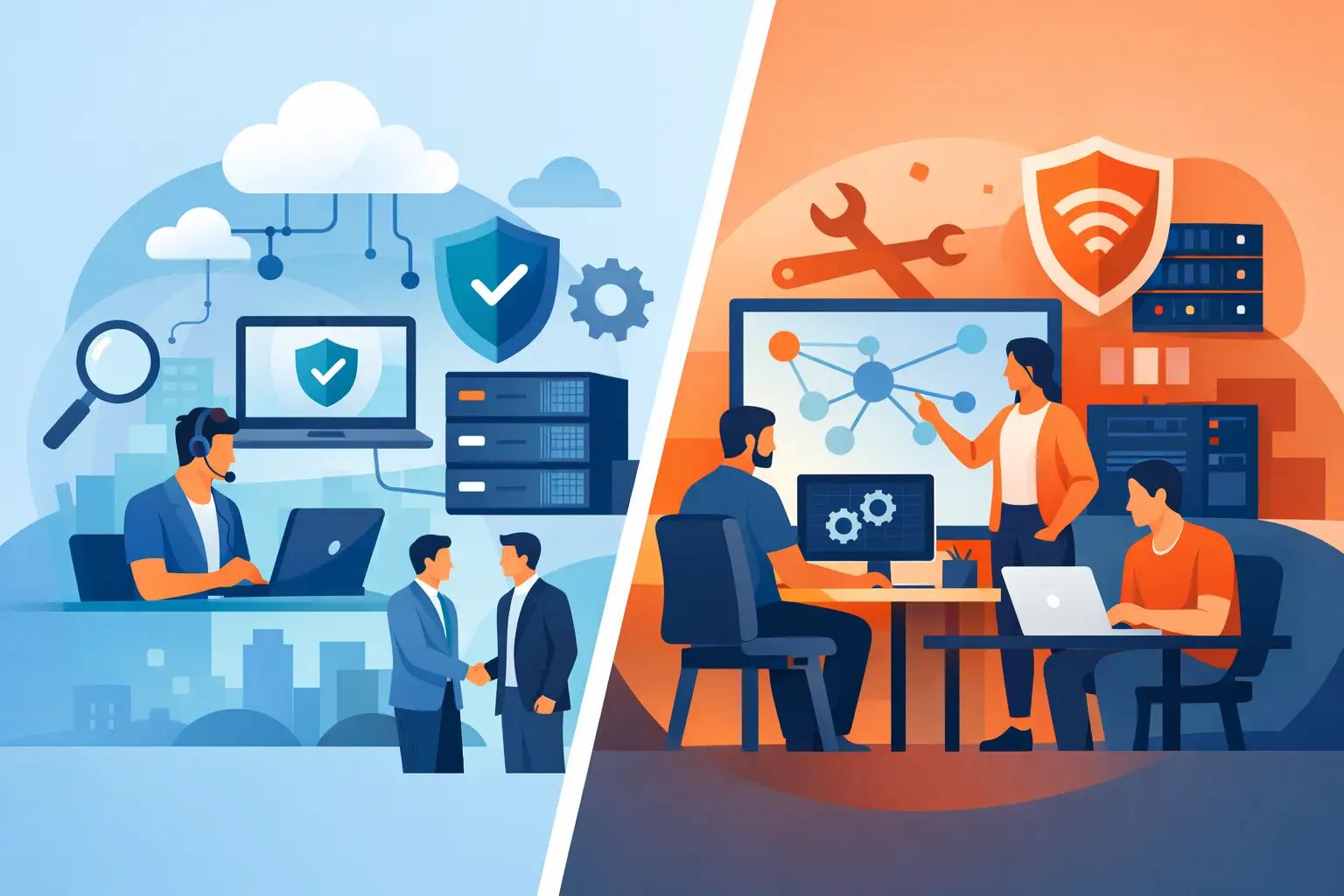
Managed IT means you outsource some or all of that responsibility to a provider. Instead of building every capability in-house, you pay for ongoing services such as monitoring, helpdesk, cybersecurity, backups, network support, patching, cloud management and strategic advice. In stronger managed service models, the provider does not just react to faults. They monitor, maintain and plan ahead so issues are less likely to disrupt the business in the first place.
There is no universal winner. A manufacturer with complex legacy systems may need a different setup from a retail chain with multiple sites, payment systems and a constant need for reliable connectivity. What matters is how well the model supports your operating reality.
Cost is rarely as simple as salary versus service fee
Internal IT can look cheaper at first glance, particularly if your needs seem modest. A single in-house person may cover user support, device setup, Microsoft 365 administration and supplier coordination. But the true cost is broader than salary. You also carry recruitment, leave cover, training, tools, security platforms, after-hours support and the risk of key-person dependency.
That last point catches many businesses out. If one internal team member holds most of the knowledge, what happens when they are off sick, leave the business or are tied up on a project when an urgent outage hits? A lean internal team can be highly effective, but it can also be fragile.
Managed IT usually shifts spending into a predictable monthly model. That appeals to businesses that want clarity, especially when growth or multi-site expansion makes ad hoc support expensive and inconsistent. The trade-off is that not every managed service agreement covers the same depth of support. Some are genuinely proactive. Others are little more than outsourced helpdesk with a nicer label. The detail matters.
Internal IT gives proximity. Managed IT gives coverage.
A strong internal IT team understands your people, systems and quirks better than anyone. They know which printer always misbehaves, which team needs extra support during stocktake, and which software issue creates the most disruption on the shop floor. That proximity can make support feel quicker and more aligned to the business.
But proximity is not the same as breadth. Most internal teams, especially in SMEs, cannot be experts in every area. Cybersecurity, cloud infrastructure, networking, identity management, backup strategy, compliance, telephony and payment environments all require different skills. Expecting one or two people to cover all of it well is unrealistic.
Managed IT providers spread specialist capability across a wider team. That means access to network engineers, security analysts, cloud specialists and service desk support without hiring each role yourself. For businesses that rely on systems working together, that breadth is often the deciding factor.
Security changes the conversation
If your business handles payments, customer data or multiple locations, security cannot sit in the background as a once-a-year task. Threats move too quickly, and the damage from weak controls is not limited to data loss. It can mean downtime, fraud, reputational harm and compliance headaches.
We've got your back
This is where managed IT versus internal IT becomes less about preference and more about operational resilience. Internal teams can absolutely run secure environments, but they need time, budget and specialist support to do it properly. Security monitoring, patching, email protection, password management, backup testing, user awareness and incident response all need consistent attention.
Managed IT has an advantage when security is built into the service rather than bolted on later. Round-the-clock monitoring, managed firewalls, email security, cloud backup and awareness training are easier to sustain when they are part of an ongoing operating model. That is especially valuable for smaller businesses that cannot justify a full in-house security function.
Accountability is where many models succeed or fail
One of the biggest differences is not technical at all. It is who owns the outcome.
With internal IT, accountability is direct. Your team sits within the business, reports internally and usually understands the commercial impact of outages first-hand. That can be powerful. When done well, internal IT becomes a trusted operational partner rather than a back-office function.
With managed IT, accountability depends on structure. If your provider only handles a narrow slice of the stack, you can still end up juggling multiple suppliers when something breaks. Internet provider blames the firewall. Firewall provider blames the switch. Software vendor blames the network. Meanwhile, your team is stuck coordinating everyone.
That is why service design matters as much as technical capability. A single accountable partner, particularly one that can support connectivity, devices, security and field services together, removes a lot of wasted time. Instead of managing handoffs, your business gets one route to resolution and one team responsible for getting systems back on track.
When internal IT is the better fit
Internal IT often makes sense when technology is central to your competitive edge and needs close day-to-day alignment with operations. If you run bespoke applications, have highly specialised workflows, or need constant collaboration between departments and technical teams, in-house capability can be the right investment.
It is also a strong fit for larger businesses with the scale to support multiple roles properly. An internal team works best when it is not stretched across every discipline at once. If you can cover infrastructure, user support, vendor management and security with enough depth, the model gives you direct control and retained knowledge.
Even then, many businesses still use external partners for overflow, specialist projects or strategic advice. Internal IT does not have to mean doing everything alone.
When managed IT is the better fit
Managed IT is often the better choice when your business needs dependable outcomes more than internal headcount. Retailers, hospitality groups, professional services firms and multi-site operators rarely want to spend their time coordinating fragmented technology suppliers. They want systems that stay online, support that answers quickly and predictable costs.
It is particularly useful when your environment spans broadband, WiFi, phones, endpoints, cloud services, cybersecurity and payment systems. Those elements affect each other, and issues rarely stay in neat categories. A managed model is stronger when it treats technology as an integrated service rather than a collection of isolated contracts.
This is where a provider such as Vetta Group fits naturally. For businesses that want one accountable partner across connectivity, managed IT, security and on-site support, the value is not just outsourcing. It is reducing complexity so operations can keep moving.
The hybrid model is often the smartest answer
For many SMEs, the best answer is neither fully managed nor fully internal. It is hybrid.
An internal IT lead may own business priorities, application decisions and vendor relationships, while a managed provider handles monitoring, helpdesk, cybersecurity, backup, after-hours response and project delivery. That gives your business internal oversight without forcing one small team to carry every technical and operational burden.
Hybrid models also work well during growth. A company may start with managed IT, then hire internal capability as complexity increases. Or it may keep a small internal team and use managed services to fill capability gaps. The point is not purity. It is making sure support, security and accountability match the pace of the business.
How to choose without overcomplicating it
Start with operational risk rather than technology preference. If systems fail, what stops? Sales, payments, customer service, dispatch, compliance, remote access? The more directly IT affects revenue and customer experience, the more you need coverage, clarity and fast escalation.
Then look honestly at internal capacity. Not whether your team is talented, but whether they have enough time and depth to stay ahead of support demands, maintenance, security and change. Good people still fail when the model around them is too thin.
Finally, look at ownership. When something breaks at 2 am or across multiple sites, who is monitoring it, who is coordinating the fix and who is answerable for the result? That answer tells you far more than any brochure will.
The right IT model should make your business easier to run, not harder to manage. If your current setup creates uncertainty, delays or too many supplier handoffs, that is usually the signal to rethink the model before the next outage forces the decision for you.





