







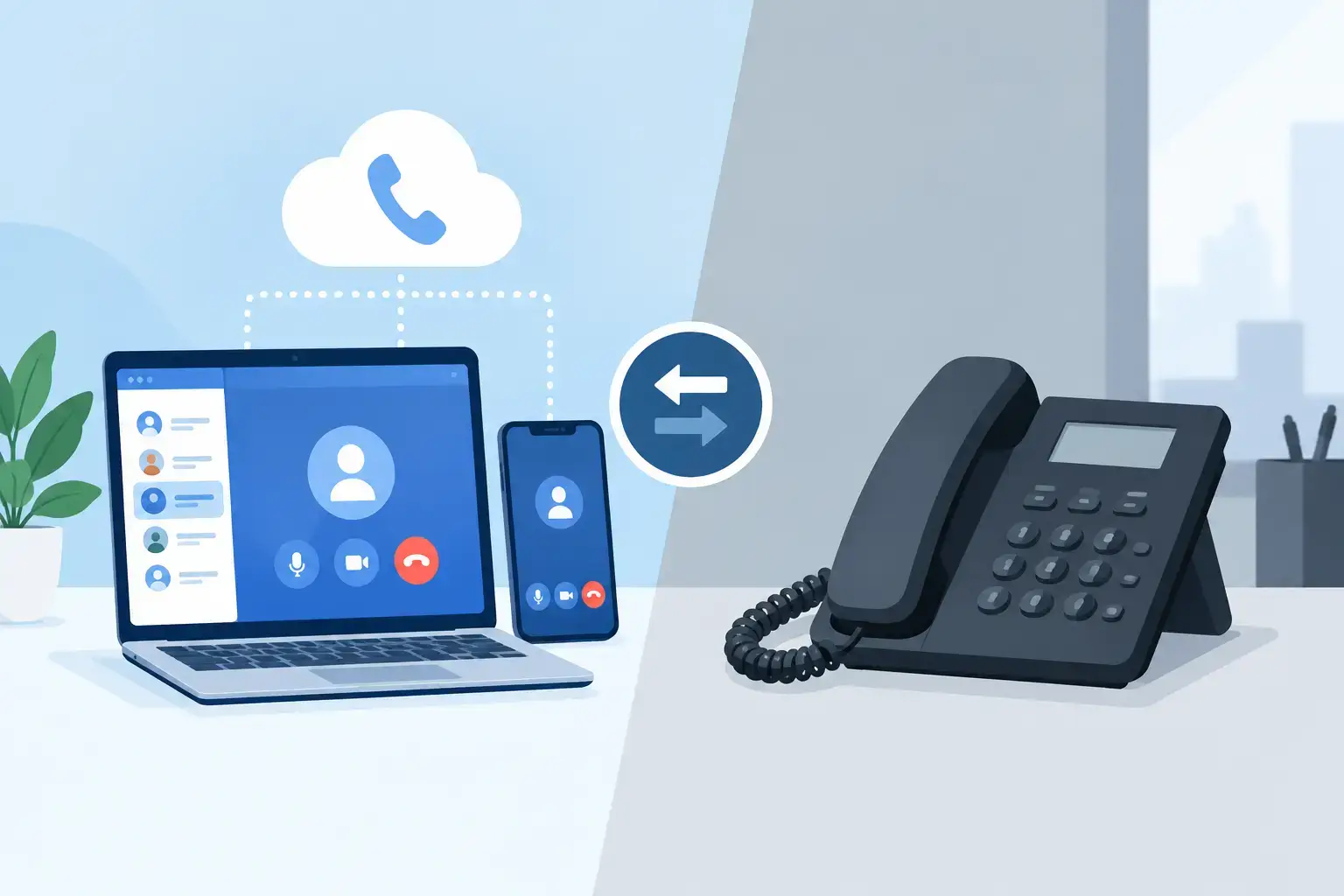
A missed call can be more expensive than it looks. It may be a customer trying to place an order, a supplier chasing a delivery detail, or a team member needing help while working off-site. That is why the choice between VoIP versus traditional phone is not simply about handsets or monthly line rental. It is about how reliably your people can communicate when the business is busy.
For many small and mid-sized businesses, VoIP is now the practical default. But traditional phone services can still have a place in certain environments. The right answer depends on your connectivity, site requirements, existing equipment and tolerance for downtime.
VoIP versus traditional phone: the core difference
Traditional phone systems send calls over dedicated copper telephone lines or older private branch exchange equipment on site. The service is tied to physical lines, and adding extensions, moving staff or changing locations can require a technician visit and new wiring.
Voice over Internet Protocol, or VoIP, sends calls as data over an internet connection. Your business number can work through desk phones, a computer application or a mobile app, provided the user has an approved connection and the right permissions. That makes the phone system less tied to a particular desk or building.
This distinction matters because most businesses now operate across more than one setting. Staff may move between a shop floor, warehouse, office, home and customer site in a single week. A phone service that follows the person, rather than the socket on the wall, can remove a great deal of friction.
Where VoIP delivers the clearest value
VoIP is particularly useful when a business needs flexibility without making communications harder to manage. New users can usually be added quickly, numbers can be retained when premises change, and calls can be routed according to opening hours, teams or availability.
A receptionist does not need to transfer every call manually. Calls can ring a sales group, overflow to another location, or be directed to voicemail with an email notification. Managers can also see call activity, review missed-call patterns and make better decisions about staffing at peak times.
For multi-site businesses, this is often a major advantage. A single phone platform can present one consistent customer experience across locations while allowing calls to reach the team best placed to answer. A customer sees one business number, rather than needing to know which branch or department they need.
Cost can also be more predictable. Rather than maintaining ageing on-site equipment and separate phone lines at each location, businesses can pay per user or per service plan. International calling, mobile integration and advanced call handling may still affect the final price, so compare the full service rather than focusing only on a headline monthly rate.
VoIP also works well with other business systems. Depending on the setup, it can connect with customer relationship management tools, contact centre software and collaboration platforms. The goal should not be to add technology for its own sake. It should be to reduce repeated data entry, make calls easier to answer and give teams the information they need when a customer gets in touch.
The trade-off: VoIP depends on your network
VoIP is only as dependable as the connectivity and local network supporting it. If broadband is slow, unstable or competing with heavy downloads, cloud backups and guest WiFi, callers may experience delay, distortion or dropped calls.
That does not make VoIP unreliable. It means it needs to be designed properly. Business-grade connectivity, sufficient bandwidth, network prioritisation for voice traffic and professionally managed WiFi all contribute to consistent call quality. A provider should assess the whole environment, not sell a phone service in isolation and leave your team to diagnose problems later.
We've got your back
Power resilience also matters. A traditional copper phone could often continue working during a local power cut. VoIP handsets, routers and switches need power. Businesses that rely on phone access for bookings, support or payment enquiries should consider battery backup, an uninterruptible power supply and a failover plan using mobile connectivity or call forwarding.
For critical sites, resilience should be discussed before installation. Ask what happens if the primary connection fails, how quickly traffic switches to a backup service, and whether inbound calls will still reach staff. The answer should be clear, tested and appropriate for the cost of downtime.
When traditional phone services may still suit
Traditional phone systems can remain suitable where a business has a stable, single-site setup with limited need for remote access or advanced call routing. They may also be used alongside specialised legacy equipment, such as alarm panels, lift phones, older fax devices or analogue terminals.
However, keeping an older system because it is familiar can create hidden costs. Replacement parts become harder to source, specialist knowledge may be limited, and changes can take longer than they should. In many regions, legacy copper networks are being retired or shifted to newer infrastructure, so it is sensible to understand your provider’s long-term plans before committing to an ageing platform.
Some devices do require a separate solution. This is not a reason to rule out VoIP altogether. It is a reason to identify every service connected to existing lines before migration, then plan replacements, adapters or alternative connectivity where needed.
Call quality, security and emergency calling
A modern phone system must do more than make calls. It needs to protect business information and support staff when something goes wrong.
With VoIP, security should include strong account controls, multi-factor authentication where available, protected administrator access and monitoring for unusual call activity. Toll fraud, where unauthorised users make expensive calls through a compromised system, can be costly if it is not detected quickly. Voice services should sit within a wider security approach that includes managed firewalls, secure networks and user awareness.
Emergency calling needs particular care. Internet-based phone services must have accurate location information, especially where staff work from multiple sites or take desk phones home. Ensure users know how emergency calling works on desk phones, mobile applications and any backup service. Do not assume every device or connection provides the same location information.
Call quality is similarly a shared responsibility. The phone platform, broadband connection, router, switches, WiFi design and endpoint devices all play a part. When these components are supplied and supported by separate companies, it can be difficult to establish who owns the issue. A single accountable partner can investigate the full path from connection to handset and coordinate a fix without passing the problem between vendors.
How to choose the right option for your business
Start with the way calls affect your operation, not with a handset catalogue. Consider how many people take customer calls, whether staff work across sites, what happens after hours and how much revenue or service risk is attached to a missed call.
Then review your existing environment. Check broadband performance at busy times, list any alarms or legacy devices using phone lines, and identify the systems your team would benefit from connecting to the phone platform. If a retail site relies on both broadband and payment services, resilience should cover the entire transaction journey, not just voice calls.
Finally, ask prospective providers who will support the service when something fails. The useful answer is not a list of exclusions. It is a clear explanation of monitoring, escalation, backup options, onboarding and ownership. Vetta Group takes this integrated approach by bringing connectivity, managed IT and security into one supported service, so customers have a team accountable for keeping their communications working.
A phone system should remove work, not create it
VoIP is usually the stronger long-term choice for businesses that need flexibility, visibility and easier growth. Traditional phone services may still be appropriate for a narrow set of legacy or highly specific requirements, but they should be assessed against future support and resilience needs.
The best decision is the one that keeps customers able to reach you, gives staff a reliable way to respond and leaves your team with fewer suppliers to chase. Build the phone service around how your business actually operates, then make sure someone is responsible for every part that keeps it running.





