







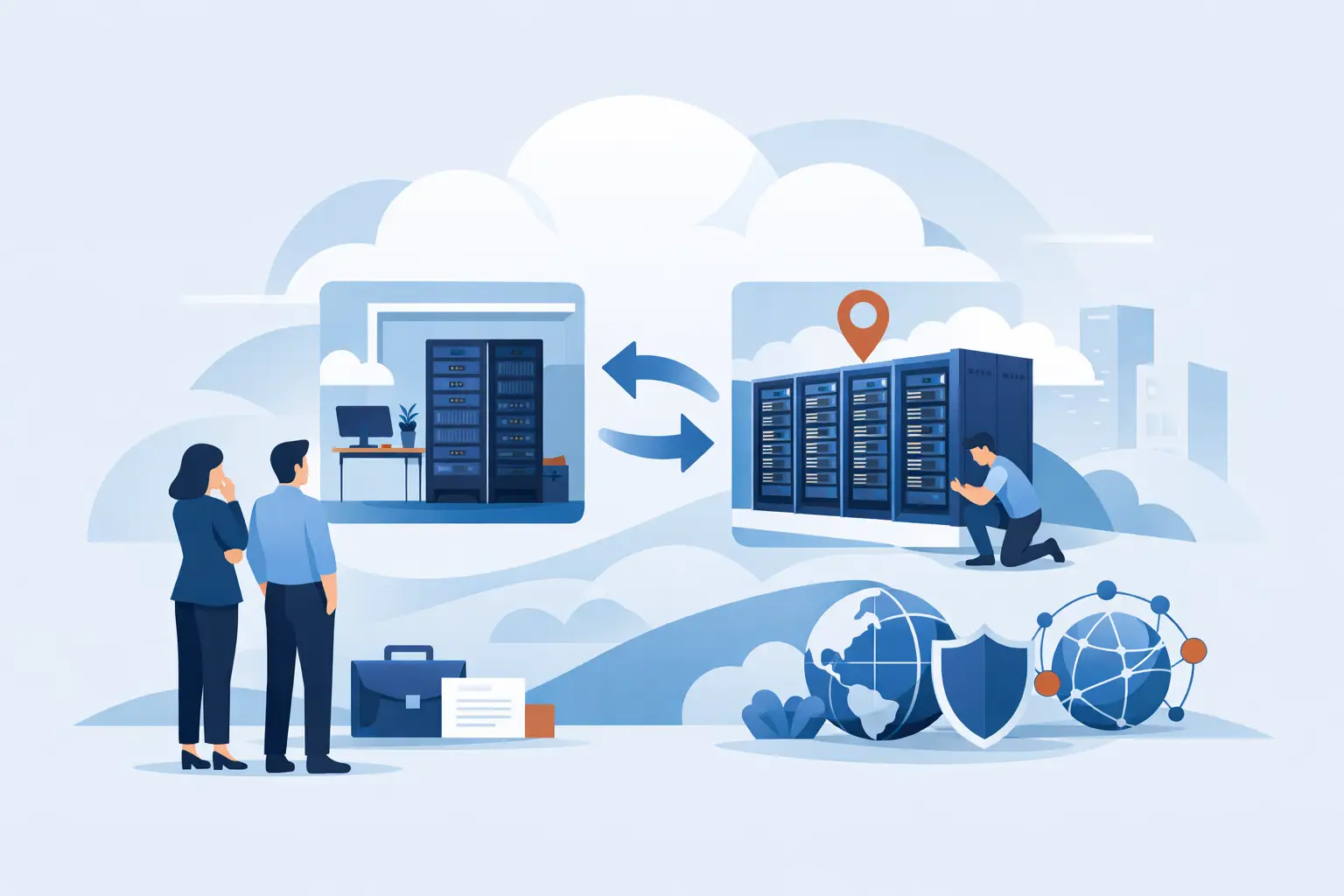
A server tucked in a back office often works fine – until the day it does not. The internet drops, the air conditioning fails over a hot weekend, or a power cut takes out systems your team and customers rely on. That is usually the point when people start asking when does a business need colocation, and whether keeping critical infrastructure on-site is still worth the risk.
For many small and mid-sized businesses, colocation sits in the middle ground between a full cloud move and running everything in-house. You keep ownership and control of your hardware, but place it in a purpose-built data centre with reliable power, cooling, connectivity and physical security. It is not the right answer for every business, but it becomes a sensible one when downtime, compliance and growth start to outpace what an office comms cupboard can realistically support.
When does a business need colocation in practical terms?
The clearest answer is this: a business needs colocation when its systems have become too important, too sensitive or too demanding to leave in a standard office environment.
That can happen earlier than many owners expect. A single site retailer with a modest server may not need it yet. A multi-site operator relying on central applications, shared files, phone systems, payment integrations or line-of-business software may already be there. If a failure in one box or one broadband line can stop trading across multiple locations, the infrastructure has outgrown the spare-room approach.
Colocation also makes sense when the business wants control without taking on the burden of building data centre conditions itself. Most offices are designed for people, not always-on equipment. They rarely offer redundant power, controlled cooling, fire suppression, monitored access or diverse network paths as standard. Trying to recreate that properly on-site is usually more expensive than it first appears.
The signs your current setup is no longer enough
One of the most common signs is repeated downtime or near misses. If your business has already had outages from power issues, overheating, internet instability or accidental unplugging, the risk is no longer theoretical. It is already affecting operations.
Another sign is growth. More staff, more sites, more transactions and more connected systems all increase the cost of failure. A small interruption that was once inconvenient can become a serious operational event when phones, remote access, stock systems, payment tools and customer platforms are all tied together.
Security and compliance pressures matter too. If you handle sensitive customer information, financial records or payment environments, physical security becomes part of the wider risk picture. Locking a server room is helpful, but it is not the same as housing infrastructure in a monitored facility with controlled access and round-the-clock oversight.
You should also look at internal capability. Some businesses have strong IT teams that want to manage their own servers but do not want to manage cooling, racks, power resilience and carrier relationships. Colocation supports that model well. Others have lean internal resources and need a partner to manage not just the rack space, but also connectivity, monitoring, security and support. In those cases, colocation works best when it is part of a broader managed service rather than a standalone facility decision.
Colocation versus keeping servers on-site
On-site infrastructure can still be the right choice if your workloads are small, downtime is tolerable and the cost of interruption is low. It can also suit businesses with specialist equipment that must stay at a premises for operational reasons.
But most office-based server setups carry hidden weaknesses. Power is usually single-feed. Cooling is designed for comfort rather than equipment load. Connectivity may depend on one access path. Physical security is often basic, especially after hours. Backup processes can be inconsistent, and disaster recovery planning tends to rely too heavily on good intentions.
Colocation addresses those weaknesses by giving your hardware a better operating environment. The benefit is not just technical neatness. It is business continuity. If you trade across locations, run customer-facing systems, support remote teams or rely on integrated payment and IT services, that continuity directly protects revenue and reputation.
We've got your back
Colocation versus cloud
This is where the answer becomes more nuanced. Colocation is not automatically better than cloud, and cloud is not automatically simpler or cheaper.
Cloud makes sense when you want rapid scalability, consumption-based pricing and less responsibility for hardware lifecycle management. It can be ideal for modern applications, bursty workloads and businesses that want to reduce their physical infrastructure footprint.
Colocation tends to suit businesses that need predictable performance, want to retain control over hardware, run software that does not move neatly to the cloud, or have already invested significantly in servers and networking. Some organisations also find that long-term cloud costs rise faster than expected for steady, always-on workloads.
In practice, many businesses land on a hybrid model. Critical applications may stay on dedicated hardware in colocation, while backup, collaboration, email or selected workloads run in the cloud. That approach often gives SMEs a better balance of control, resilience and cost.
When does a business need colocation for resilience?
If the answer to any of these questions is yes, colocation deserves serious attention.
Would an outage stop your staff from working? Would it interrupt sales, bookings or payment processing? Would it affect multiple sites at once? Would recovery take hours rather than minutes? If so, the business impact is high enough that infrastructure resilience should be treated as an operational priority, not an IT nice-to-have.
Resilience is about more than uptime percentages. It is about how quickly you can recover, how many single points of failure exist, and whether support is coordinated when something goes wrong. That is one reason many businesses prefer a single accountable partner rather than separate providers for hosting, internet, firewalls and on-site support. When systems are interconnected, fragmented ownership usually slows resolution.
Cost: the part that needs honest discussion
Colocation is not the cheapest option on paper if you compare it only to keeping a server in the office. There are monthly facility costs, connectivity charges and hardware considerations. If you need remote hands support, managed security or backup services, those add to the monthly spend.
But the better comparison is total cost and total risk. What does one serious outage cost in lost trade, idle wages, missed transactions, customer frustration and emergency remediation? What is the cost of replacing failed equipment damaged by poor cooling or power events? What internal time is being spent managing infrastructure that could sit in a more suitable environment?
For many growing SMEs, colocation becomes cost-effective not because it is the cheapest line item, but because it prevents expensive disruption and gives a more predictable operating model.
Who usually reaches this point first?
Retailers and multi-site businesses often reach it early because central systems affect several locations at once. If stock, payments, phones, reporting or access to key applications depend on infrastructure sitting in one vulnerable office, the operational risk compounds quickly.
Professional services firms, healthcare providers, logistics operators and businesses with compliance-sensitive data also tend to feel the pressure sooner. They need availability, auditability and stronger controls than a basic office setup can usually deliver.
Internal IT teams also recognise the breakpoint. When they spend too much time nursing ageing on-site infrastructure, arranging ad hoc fixes or dealing with connectivity issues that should not exist in the first place, the business is already paying a penalty.
What to assess before making the move
Start with impact, not hardware. Identify which systems truly matter to trading, service delivery and staff productivity. Then map the dependencies: internet access, remote connectivity, authentication, telephony, payment systems, file access, backups and recovery.
Next, look at your current single points of failure. One broadband line, one switch, one UPS, one comms cupboard, one person who knows how it all fits together – these are common warning signs.
Then consider support responsibility. A colocation environment is strongest when it sits inside a joined-up service model. If connectivity, security, server management and field support are handled in silos, issues can still drag on. Businesses usually get better outcomes when one partner can coordinate the full picture and take ownership of results.
That is where providers such as Vetta Group can make the decision simpler. Colocation works best when it is not treated as rented rack space alone, but as part of a broader operating model that keeps connectivity, security, monitoring and support aligned.
The real trigger is not technology – it is business dependency
Most businesses do not move to colocation because the idea sounds sophisticated. They move because their systems have become too central to leave exposed to office-grade risks. Once technology underpins trading, customer service, payments, remote work and security, the environment around that technology matters just as much as the equipment itself.
If your infrastructure has become business-critical, colocation is worth considering before the next outage forces the decision for you. The right time is usually a little earlier than people think – while you still have room to plan properly, reduce risk and make technology easier to live with.





