






A failed payment terminal at the counter, a broadband outage at a remote site, or a suspicious email reaching an employee can quickly become an operational problem. That is why the managed services or in-house IT decision is about more than who resets passwords. It determines how quickly your business can recover, how well risks are managed, and whether there is clear ownership when technology stops working.
For a growing business, the right model is rarely about choosing the cheapest option on paper. It is about matching the level of support, specialist capability and accountability to the way your business actually operates.
Managed services or in-house IT: what is the real choice?
In-house IT means employing people directly to manage your systems, users, devices and projects. Depending on the size of the team, they may also look after suppliers, cybersecurity, cloud services, networks and business applications. It offers proximity to the business and direct control over priorities.
Managed services place some or all of that responsibility with an external technology partner. The provider monitors, maintains and supports agreed systems for a predictable monthly fee, while providing access to a broader team of specialists. The scope can include end-user support, servers, networks, backups, cybersecurity and strategic technology planning.
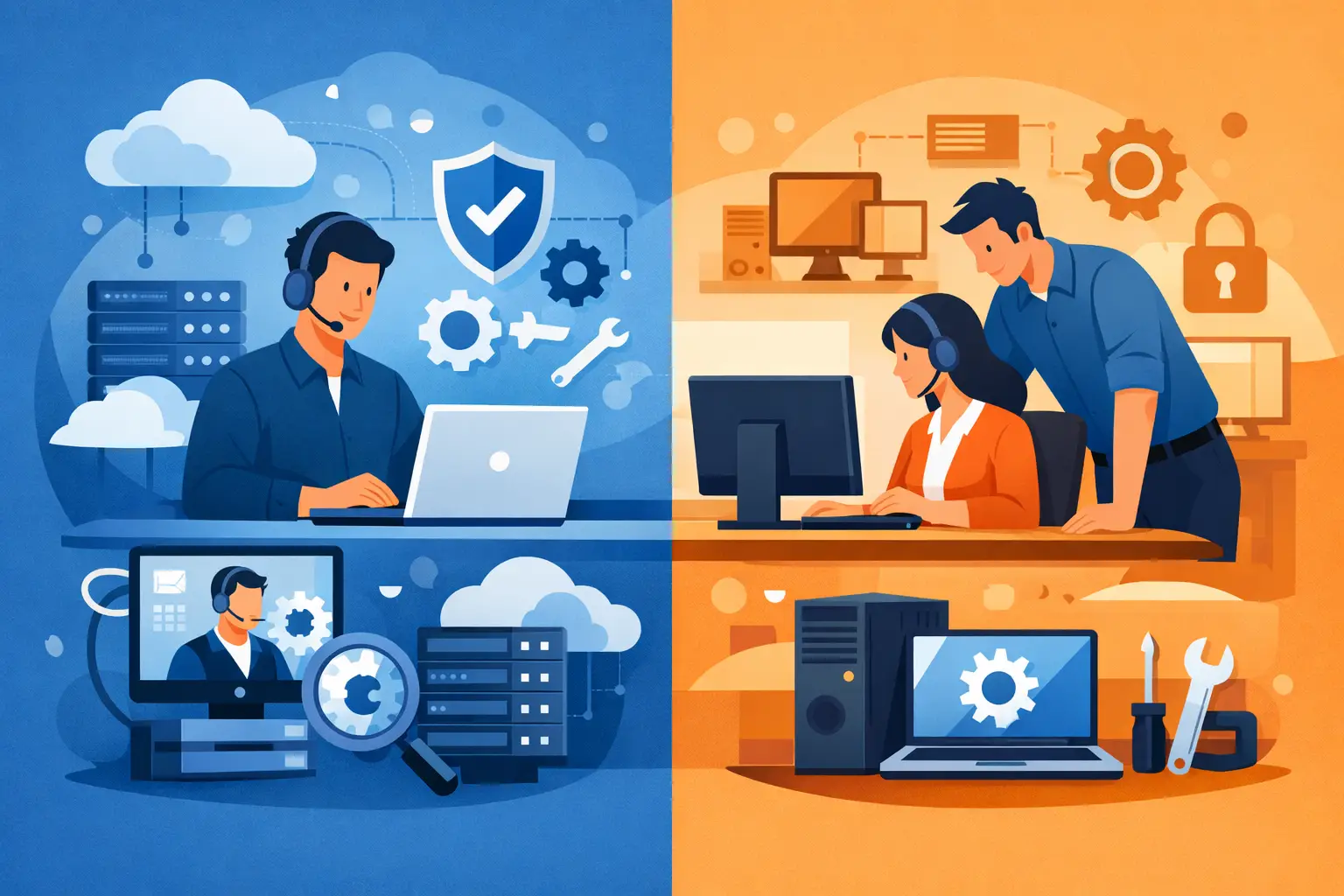
Neither approach is automatically better. A business with a large, complex technology environment and a mature IT leadership function may need a strong internal team. A multi-site retailer, professional services firm or operationally busy SME may find that a managed model provides deeper coverage without the cost and risk of building every capability internally.
The key question is not, “Do we want to outsource IT?” It is, “Who is accountable for keeping our people productive, our customers served and our systems protected?”
Where in-house IT works well
An internal IT team can be highly effective when technology is central to your product, your organisation has enough scale to support specialist roles, or your environment requires deep knowledge that takes years to build. An in-house team can work closely with departments, understand informal processes and respond quickly to changing internal priorities.
It is also valuable when technology development is a core competitive advantage. For example, a business building proprietary software may need permanent technical leadership and development capability embedded alongside commercial teams.
However, in-house IT has a practical limit. One capable IT manager cannot reasonably be a service desk, network engineer, security analyst, cloud architect, procurement lead and strategic adviser at the same time. Holidays, illness and turnover create further exposure. If there is only one person who understands the network or payment environment, the business has a single point of failure.
Recruitment is another consideration. Skilled technology and security professionals are expensive, and finding the right people can take time. Even a small internal team needs ongoing training to keep pace with changing threats, licensing, cloud platforms and compliance obligations.
What managed services change
A managed service is not simply outsourced helpdesk support. Done properly, it creates an operating model for technology: documented systems, proactive monitoring, clear service levels, regular maintenance and a known route for escalation.
Instead of relying on someone to notice a problem, monitoring can identify issues with devices, backups, connectivity or security controls before they become a major interruption. Rather than calling different providers when the internet, firewall, WiFi and point-of-sale system are involved, the business has one team responsible for coordinating the response.
We've got your back
That matters most in the moments customers remember. If a store cannot take payments, staff cannot access cloud applications, or an employee is locked out during a busy period, vendor hand-offs waste time. A managed partner should own the investigation, communicate clearly and keep working until the service is restored.
For many SMEs, the major advantage is access to a wider bench of expertise. You may not need a full-time cybersecurity specialist every day, but you do need sound security controls, monitored protection, tested backups and expert support when something looks wrong. Managed services make that capability available without recruiting each role separately.
Cost: compare the full picture
It is tempting to compare a monthly managed service fee with the salary of an IT employee. That is not a like-for-like comparison. The full cost of an in-house model includes salaries, recruitment, leave cover, training, tools, software, security platforms, emergency contractor support and the cost of downtime when capacity is stretched.
Managed services generally turn a portion of those costs into a predictable operating expense. That can make budgeting easier, particularly for businesses planning new sites, adding staff or replacing ageing equipment. It also means support can scale more easily as user numbers and locations change.
Predictable pricing does not mean every requirement should be included in one flat fee. New office fit-outs, major migrations, specialist software development and large hardware refreshes may sit outside a standard support agreement. The important part is clarity: what is covered, what is billed separately, and who approves work before costs are incurred.
In-house IT can be more economical for organisations with sufficient size and stable demand. But when a business only has enough work for one or two generalists, it often ends up buying specialist skills reactively at the most inconvenient moment.
Security needs coverage, not good intentions
Cybersecurity is where the limitations of a thinly staffed IT function become most visible. Security requires continuous attention: patching, access control, email protection, password management, firewall oversight, backup checks, staff awareness and response planning. A once-a-year review will not protect a business from a fast-moving threat.
An internal team can manage this well when it has the right people, tools and time. But routine support requests often take priority over preventative work. The result is familiar: updates postponed, old accounts left active, backups assumed to be working and security improvements delayed until after an incident.
A managed model should build security into everyday operations rather than treat it as a separate project. This is particularly important where customer data, remote access and payment systems are involved. Clear responsibility for monitoring, escalation and recovery reduces uncertainty when an incident occurs.
Ask prospective providers how they test backups, respond to alerts and report on risk. Ask what happens outside business hours. Security is not a badge on a proposal. It is a service that must perform under pressure.
The hybrid model is often the practical answer
The choice does not have to be all or nothing. Many successful businesses keep an internal IT lead or small team while using managed services for 24/7 monitoring, cybersecurity, network support, cloud infrastructure or service desk coverage.
This arrangement protects internal knowledge while removing pressure from routine support and specialist work. Internal staff can focus on business improvement, application ownership and projects that need close knowledge of operations. The managed partner handles the underlying environment and provides extra capacity during change or incidents.
For a multi-site business, this can be especially useful. Your internal lead may understand how each location operates, while an external partner can coordinate connectivity, managed WiFi, firewalls, devices and payment-related technical services across every site. There is less time spent chasing suppliers and more time spent improving the customer experience.
Vetta Group works in this way for businesses that want technology, connectivity and security managed as one accountable service, while retaining the level of internal control that suits their team.
Questions to ask before choosing
Start with the service your business cannot afford to lose. Is it the ability to take payments, access customer records, answer phones, process orders or connect remote staff? Then map the technology and suppliers behind that service. If a failure touches several providers, decide who will coordinate recovery.
Look honestly at your current capability. Do you have documented systems, tested backups, up-to-date security controls and cover for key IT staff? Can your team respond to a critical issue after hours? If the answer is no, the risk may be greater than it appears during a quiet week.
Finally, consider where your internal people add the most value. If they spend most of their time fixing printers, resetting accounts and following up suppliers, they are not being used for the work that moves the business forward. Managed support can free them to focus on improvements, while ensuring day-to-day service does not depend on one person being available.
The best decision is the one that gives your business clear ownership when something goes wrong and enough capacity to prevent problems where possible. Technology should make life easier for your staff and customers. Choose the model that leaves you confident someone capable is watching, responding and taking responsibility for the outcome.





