







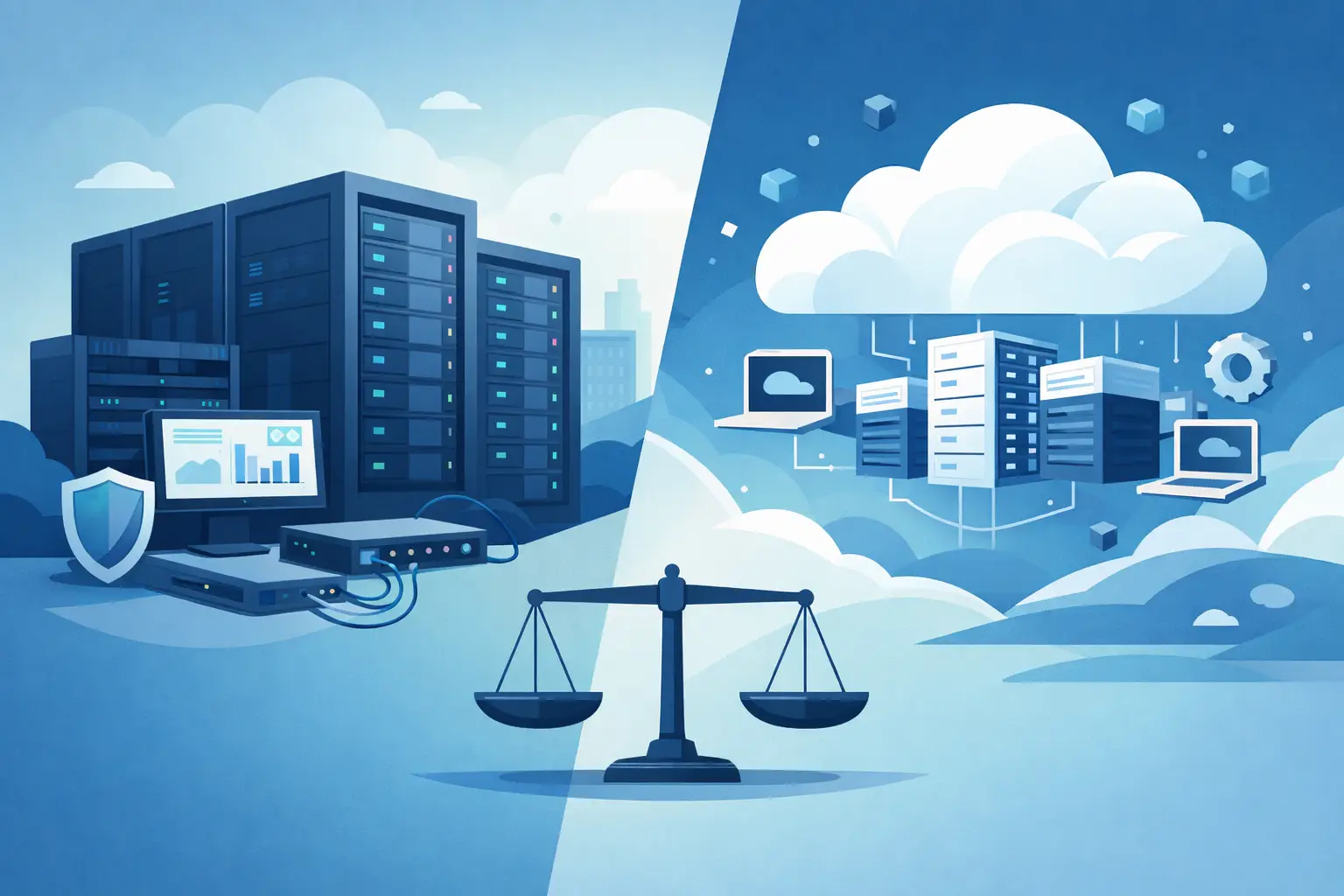
When a server decision goes wrong, the pain shows up fast – slow systems, finger-pointing between suppliers, rising costs, and an operations team stuck managing risk instead of running the business. That is why colocation vs cloud servers is not just an infrastructure question. For many growing businesses, it is a decision about control, accountability, and how much complexity they want to carry.
For a retailer with multiple sites, a professional services firm with strict data requirements, or an SME that cannot afford downtime, the right answer depends less on hype and more on how the business actually works. Both models can be excellent. Both can also be the wrong fit if they are chosen for the wrong reasons.
Colocation vs cloud servers: the core difference
Colocation means you own the server hardware, but house it in a specialist data centre. You pay for space, power, cooling, physical security, and connectivity, while keeping control of the equipment itself. In simple terms, the server is yours, but the facility is shared.
Cloud servers are different. You are not buying and managing the physical hardware. Instead, you rent computing resources from a provider and scale them up or down as needed. The infrastructure sits behind the service, and the customer consumes it as an operating expense rather than a capital purchase.
That basic distinction shapes everything else – cost, maintenance, performance, security responsibilities, and how quickly your environment can adapt.
Where colocation makes more sense
Colocation usually suits businesses that want a high degree of control. If you have workloads that rely on specific hardware, licensing tied to physical servers, or systems that perform best on dedicated infrastructure, colocation can be a strong fit.
It also appeals to organisations that want predictable long-term costs. Hardware is bought upfront, and once that investment is made, ongoing colocation costs are often steadier than variable cloud billing. For businesses with stable workloads that run around the clock, that can make budgeting much simpler.
There is also a performance angle. Dedicated hardware means you are not sharing compute resources in the same way you might in some cloud environments. If your systems need low latency, consistent throughput, or tightly managed configurations, colocation gives your IT team more room to optimise.
That said, the control comes with responsibility. Someone still needs to maintain the hardware, patch operating systems, plan lifecycle replacements, and manage resilience properly. If your team is already stretched, owning infrastructure can become a burden rather than a benefit.
When cloud servers are the better option
Cloud servers are often the right choice when flexibility matters more than physical control. If your business is growing quickly, opening new locations, launching new applications, or dealing with seasonal demand, cloud makes it easier to respond without waiting for hardware procurement and installation.
It also lowers the barrier to entry. Instead of a large upfront spend on servers, storage, and networking gear, you move to a monthly operating model. That is attractive for businesses that want to preserve capital or avoid committing to infrastructure capacity they may not fully use.
For many SMEs, cloud also reduces the day-to-day friction of running infrastructure. Provisioning is faster, backups can be easier to integrate, and disaster recovery options are often more accessible than they would be in a fully self-managed physical environment.
We've got your back
But cloud is not automatically cheaper. That is one of the most common misunderstandings. If workloads are heavy, constant, or poorly managed, monthly charges can climb quickly. Storage, bandwidth, backup retention, and duplicated environments all add up. Cloud offers convenience, but convenience still needs governance.
Cost: capital control versus operational flexibility
This is where many decisions get made, and many get made badly.
With colocation, costs are front-loaded. You buy hardware, then pay for rack space, power, bandwidth, and support services. Over time, this can be economical for businesses with known, steady workloads and a clear refresh cycle. The spend is easier to forecast, especially if your usage does not change much.
With cloud servers, spending shifts into monthly operating costs. That can look attractive at the start, especially when avoiding a large capital outlay. The trade-off is that costs can become less predictable if the environment is not actively managed. Extra compute, replicated backups, premium storage tiers, and traffic charges can quietly expand the bill.
A useful rule is this: if your workload is stable and always running, colocation may offer better long-term value. If your workload changes often or needs rapid scaling, cloud may be worth the premium.
Security and compliance are not one-size-fits-all
Security conversations around colocation vs cloud servers often become too simplistic. People talk as if one is secure and the other is not. In reality, both can support a strong security posture, but the shared responsibility model is different.
With colocation, you control the hardware and much of the configuration. That can be valuable if you need precise control over data handling, access methods, network architecture, or software versions. It can also suit businesses with specific compliance requirements or legacy applications that are difficult to modernise.
Cloud providers invest heavily in infrastructure security, but that does not remove customer responsibility. Misconfigured access controls, weak identity management, poor backup policies, and inconsistent monitoring are still common causes of incidents in cloud environments. The platform may be secure, but the way it is used still matters.
For payment environments, customer data, or regulated workloads, the better question is not which model sounds safer. It is which model your business can govern properly, support consistently, and recover from quickly when something goes wrong.
Performance, resilience, and support
If uptime is critical, infrastructure should not be considered in isolation. Performance depends on the full picture – connectivity, failover, security controls, monitoring, and who is responsible when there is an issue.
Colocation can deliver excellent resilience when designed properly. Redundant power, controlled facility conditions, and high-quality connectivity create a strong foundation. But resilience is not automatic. It still depends on your server design, backup strategy, and support model.
Cloud environments can also be highly resilient, especially when workloads are architected across multiple zones or regions. The challenge is that resilience in the cloud often needs careful planning and can cost more than expected. High availability is available, but it is rarely the cheapest default setting.
Support is another practical factor. If a physical server fails in a colocation environment, who replaces components and how quickly? If a cloud application slows down, who traces whether the issue is resource allocation, networking, storage, or configuration? Businesses usually feel the difference here not in procurement, but during an outage.
That is why many SMEs prefer a single accountable partner. Infrastructure decisions are easier to live with when the same provider can support connectivity, security, hosting, and escalation without passing the problem around.
How to decide between colocation and cloud servers
The most reliable way to choose is to start with the workload, not the technology label.
If you run critical line-of-business applications that need dedicated performance, fixed configurations, or tight control over hardware, colocation deserves serious attention. It is especially relevant if you already have capable internal IT resources or a managed services partner who can take ownership of the environment.
If your business values speed, flexibility, and lower upfront investment, cloud servers are often the better fit. This is particularly true for newer applications, growing organisations, temporary projects, and businesses that want to avoid managing physical infrastructure.
There is also a third option that is often the most practical: use both. Many businesses keep stable, demanding, or sensitive workloads in colocated infrastructure while moving lighter applications, backups, or customer-facing systems to the cloud. A hybrid approach can balance control with agility, provided it is managed properly.
The real question behind colocation vs cloud servers
Most businesses are not really asking whether metal is better than virtual machines. They are asking how to stay online, keep data safe, support growth, and avoid surprise costs.
That is where clear ownership matters. The right infrastructure choice should fit the way your business operates today while giving you room to grow without rebuilding everything in a year. For some, that will be colocation. For others, cloud servers. And for plenty of businesses, it will be a mix managed under one accountable service model.
Technology should make life easier, not create another layer of vendor management. If your infrastructure choice reduces downtime, keeps support straightforward, and gives your team confidence in what happens next, you are probably looking in the right direction.





