







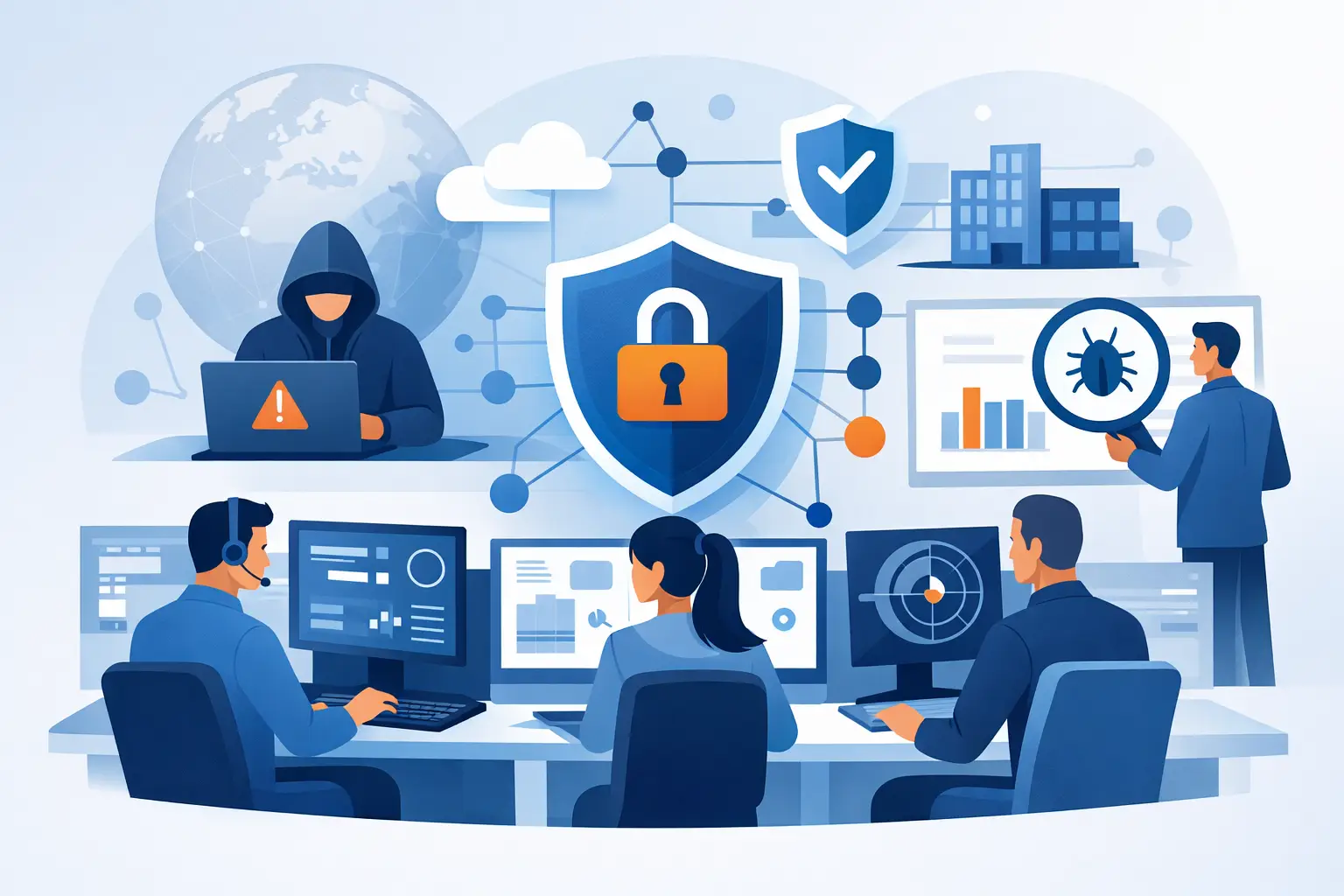
If your business only finds out about a cyber incident after staff cannot log in, card payments stop working, or a customer reports something suspicious, you are already behind. That is exactly where the question what is managed SOC starts to matter – not as a technical acronym, but as a practical way to spot threats early and respond before they disrupt the business.
What is managed SOC?
A managed SOC is a managed Security Operations Centre. In simple terms, it is a security monitoring and response service run by a specialist team on your behalf. Instead of building your own in-house security operations function, you rely on a provider to watch your environment, investigate suspicious activity, and help contain threats.
That environment can include endpoints, servers, firewalls, Microsoft 365, cloud platforms, identity systems, and network traffic. The aim is not just to collect alerts. It is to turn noise into action, so real risks are identified quickly and dealt with properly.
For most small and mid-sized businesses, that distinction matters. Security tools by themselves generate data. A managed SOC adds people, process, and round-the-clock oversight to make that data useful.
What a managed SOC actually does day to day
A lot of businesses assume a SOC is simply a dashboard with lots of red and amber warnings. In practice, a good managed SOC is much more operational than that.
It gathers logs and security events from across your systems, correlates them, and looks for patterns that suggest compromise, misuse, or abnormal behaviour. That might be repeated failed logins, unusual administrator activity, suspicious PowerShell commands, impossible travel logins, malware detections, or unexpected data movement.
When something looks wrong, analysts investigate. They work out whether the alert is a false positive, a low-level issue to monitor, or a genuine incident that needs action. If it is serious, the service should escalate quickly and support the response – for example by isolating a device, disabling an account, blocking malicious traffic, or guiding your team through containment steps.
The best managed SOC services also improve over time. They tune detection rules, reduce repeat noise, align monitoring with your business systems, and provide reporting that makes sense to both IT teams and business leaders.
Why businesses outsource instead of building a SOC
In theory, any business can create its own security operations capability. In reality, very few should.
Running an effective SOC takes skilled analysts, tooling, documented playbooks, threat intelligence, and 24/7 coverage if you want meaningful protection. That is expensive, difficult to recruit for, and hard to sustain. Even larger organisations struggle with alert fatigue and staffing gaps.
For a busy retailer, professional services firm, manufacturer, or multi-site operator, the in-house model often does not stack up. You may have a capable IT lead or managed IT provider, but not a dedicated team watching logs overnight, triaging alerts at speed, and responding to incidents as they unfold.
That is where managed SOC makes sense. It gives you access to specialist capability without having to build the whole function yourself. You get operational coverage, defined escalation, and a clearer picture of your security posture, usually through a predictable monthly service model.
We've got your back
What is managed SOC not?
It helps to clear up a common misunderstanding. A managed SOC is not the same as buying antivirus, a firewall, or multi-factor authentication. Those tools are important, but they are only part of the stack.
It is also not the same as a one-off security audit or penetration test. Those give you a point-in-time view. A managed SOC is ongoing. It exists to monitor continuously, investigate changes, and respond to threats as they happen.
It is not a guarantee that nothing bad will ever happen either. No provider can honestly promise that. What a managed SOC should do is reduce detection time, improve response quality, and limit business impact when something does go wrong.
The main components of a managed SOC service
Not every service is built the same, so the detail matters.
Most managed SOC offerings sit on a foundation of log collection, alerting, analysis, and incident response support. Many also include a SIEM platform, which pulls security data together, and often an endpoint detection and response tool to monitor devices more closely.
Beyond that, services can vary. Some providers focus mainly on monitoring and escalation. Others take a more hands-on role, with active containment and close coordination with your IT estate, firewall management, identity controls, and cloud security settings.
That difference is important for businesses that do not want to manage several suppliers during an incident. If your connectivity, infrastructure, security controls, and support are split across separate vendors, response can slow down just when speed matters most. A single accountable partner can often move faster because there is less handoff and less debate about where the issue sits.
Who needs a managed SOC?
You do not need to be a bank or a large enterprise to need security operations. You need enough digital dependence, enough risk, and enough consequence if systems fail.
That is why managed SOC is often a good fit for small and mid-sized businesses with cloud systems, remote access, payment environments, multiple sites, or lean internal IT teams. If your staff depend on email, shared files, SaaS platforms, line-of-business software, and internet connectivity to keep trading, then a security incident becomes an operational problem very quickly.
Retail and hospitality businesses are a good example. If payments, WiFi, tills, staff devices, and head office systems are all connected, attackers only need one weak point to cause disruption. The same applies to firms handling sensitive client data, healthcare providers, logistics operators, and growing businesses that have added systems faster than they have added security oversight.
A managed SOC is especially valuable when the cost of downtime is high but the budget and headcount for a full internal security team are not realistic.
Signs your business may have outgrown basic security
Many businesses start with sensible essentials: endpoint protection, backups, email filtering, password management, and user awareness training. Those remain necessary, but there comes a point when basic controls are no longer enough on their own.
If your team is receiving alerts nobody investigates properly, if incidents are being handled ad hoc, or if you are unsure what is happening across your estate after hours, your coverage may be too thin. The same applies if compliance requirements are rising, cyber insurance questions are getting more detailed, or board-level conversations are moving from prevention to resilience.
Another sign is complexity. The more systems, users, locations, suppliers, and cloud services you add, the harder it becomes to maintain a clear view of risk without a dedicated monitoring function.
What to ask before choosing a managed SOC
The phrase managed SOC can cover very different service levels, so buyers should look past the label.
Ask what is monitored, how incidents are triaged, and whether the service includes actual response support or simply ticket forwarding. Check whether monitoring runs 24/7, how quickly serious incidents are escalated, and who is responsible for containment actions.
You should also ask how the SOC integrates with the rest of your technology estate. If your provider can see the firewall but not the endpoint tools, or the cloud logs but not the network layer, you may end up with blind spots. Equally, if several suppliers are involved, clarify who owns coordination when something breaks at 2am.
Reporting matters too. Good reporting should show trends, actions taken, and areas for improvement in plain language, not bury you in raw alerts.
The trade-off: capability versus control
Some internal IT teams worry that outsourcing security operations means losing control. That depends on how the service is set up.
A well-run managed SOC should give you more visibility and more structure, not less. You still set priorities, approve key actions where required, and decide how the service fits your business risk. What you gain is specialist coverage and a clearer response model.
The trade-off is that you are depending on a partner’s processes and people, so trust, accountability, and integration matter. The service works best when it is part of a joined-up operating model rather than an isolated add-on.
For businesses that want technology to be simpler, more reliable, and easier to support, that joined-up model is usually where the value sits. It is one reason providers such as Vetta Group position security as part of a broader managed service, not a standalone toolset.
What is managed SOC really buying you?
At its best, a managed SOC buys time. Time to detect threats earlier, time to respond before damage spreads, and time back for your own team so they are not trying to piece together alerts in the middle of a busy working day.
It also buys clarity. You know who is watching, what happens when something looks wrong, and how incidents are escalated. For operationally busy businesses, that is often just as valuable as the technical controls themselves.
If your business depends on connected systems to serve customers, process payments, support staff, and keep sites running, security monitoring is no longer a nice-to-have. The real question is not whether you need security operations. It is whether you want to build and manage that capability yourself, or have a partner take responsibility for helping keep you online, protected, and productive.





