







When a card terminal stops authorising payments, cloud files will not load, or a team cannot reach customers, the leased line vs broadband decision stops being a technical debate. It becomes an operational one. The right connection keeps your business trading, communicating and serving customers. The wrong one can leave staff waiting, customers frustrated and several suppliers pointing elsewhere for an answer.
For many small and mid-sized businesses, standard business broadband is the sensible choice. For others, particularly sites where every lost minute has a clear cost, a leased line is worth the higher monthly spend. The difference is not simply speed. It is about how the connection is delivered, how predictable it is under pressure and who takes responsibility when something goes wrong.
Leased line vs broadband: the practical difference
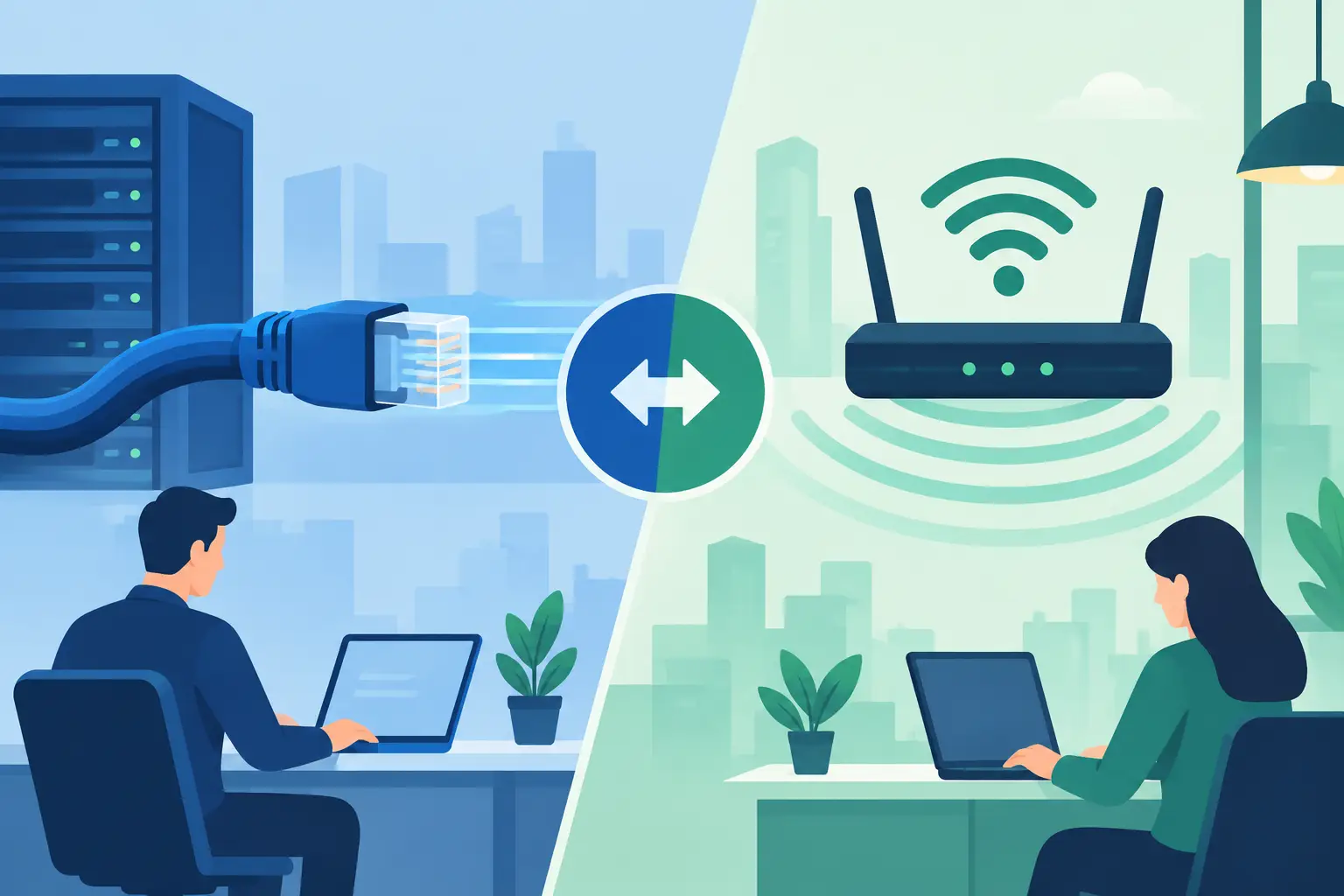
Broadband is a shared internet service. Your premises connect to a wider network whose capacity is also used by other customers in the area. Modern fibre broadband can deliver excellent download speeds and, depending on the service, strong upload performance too. It is cost-effective, readily available and more than capable of supporting email, cloud applications, video meetings, guest WiFi and everyday point-of-sale activity for many organisations.
A leased line is a dedicated connection between your site and the provider’s network. Its bandwidth is reserved for your business rather than shared locally with neighbouring users. It is normally symmetrical, meaning upload and download speeds are the same, and it is supplied with a business-grade service level agreement.
That distinction matters most at busy times. A broadband connection may perform very well for most of the day but vary as local demand changes. A leased line is designed to deliver its contracted capacity consistently. If your business sends large files, runs cloud-based systems, supports a busy contact centre or has several sites relying on central applications, predictable upload capacity can be as valuable as headline download speed.
Speed is only part of the decision
It is easy to compare packages by megabits or gigabits per second and assume the largest number wins. In reality, the useful question is whether the connection supports your critical activity when the business is at its busiest.
A single retail site with cloud tills, staff devices and customer WiFi may work very comfortably on quality business broadband. However, if payment terminals, CCTV uploads, inventory systems and guest access all compete on one connection, performance can become less predictable. Separating guest WiFi from business traffic and applying sensible network controls can often extend the life of a broadband service before a leased line is necessary.
For an office with twenty people on video calls, cloud telephony and hosted software, upload speed and latency deserve close attention. Download-heavy broadband can look fast in a test but still struggle when multiple people are sending data at once. A symmetrical leased line gives more headroom for those workloads and generally more stable latency, which helps real-time voice, video and remote access feel more consistent.
There is also a middle ground. Fibre-based business broadband with a stronger service agreement may meet the need without the cost of a fully dedicated circuit. The best answer depends on actual usage, the number of users, available infrastructure and the financial impact of downtime.
Reliability, contention and service levels
No connection is invulnerable. Roadworks can damage fibre, power failures can affect equipment, and a fault can occur anywhere between a site and the wider internet. The difference is how likely disruption is, how it is handled and what recovery commitment sits behind the service.
Broadband is generally supplied on a best-efforts basis, even when it is sold as a business service. Support may be available around the clock, but repair targets and escalation processes can vary. This is not automatically a problem. A business that can tolerate a short disruption, switch to mobile data or work offline may sensibly prioritise value over a premium service level.
Leased lines are usually backed by clearer availability commitments, defined fault response arrangements and proactive monitoring. That accountability is valuable when connectivity directly affects revenue, safety or customer service. A multi-site operator, for example, may need a provider to identify whether a fault is at the branch, within the network, with the firewall or with a cloud application, then coordinate the fix rather than asking the manager to chase several helpdesks.
We've got your back
Ask providers what their service level agreement actually covers. Check the target fix time, support hours, escalation route, planned maintenance process and any exclusions. A promise of “business support” is not the same as an agreed restoration commitment.
The real cost includes downtime
Broadband nearly always has the lower monthly price and faster installation where service is already present. A leased line has higher construction and rental costs because dedicated capacity must be provisioned to the site. Lead times can also be longer, especially where new fibre build is required.
But the monthly fee is only one part of the calculation. Consider what an hour without internet costs your operation. Include missed sales, inability to process payments, idle staff, delayed dispatches, reputational damage and the time spent managing an incident. If the answer is modest, broadband with a resilient backup may be the most proportionate option. If an outage quickly costs more than the price difference, a leased line becomes easier to justify.
For many businesses, resilience provides better value than simply buying the most expensive primary circuit. A leased line with a separate broadband or 4G/5G failover connection protects against different failure points. Equally, a primary business broadband service with managed mobile failover can provide a highly practical setup for a smaller site. The backup should use independent infrastructure wherever possible. Two services delivered through the same route or cabinet may not protect against the same physical fault.
Security and network management matter too
A faster connection does not make a business safer. Whether you choose broadband or a leased line, the network still needs a properly configured firewall, secure WiFi, device management, patching and monitored backups. Payment environments require particular care: terminals, staff devices and guest networks should not all sit on an open, unmanaged network.
A dedicated connection can make it easier to build predictable site-to-site networks, apply fixed addressing and manage traffic policies. Yet these benefits only materialise when the network is designed and maintained well. A poorly configured leased line can still expose systems; a well-managed broadband connection can support a secure, productive business.
This is where a single accountable partner reduces friction. Rather than treating connectivity, firewall rules, WiFi access points, cloud systems and payment devices as separate jobs, they should be assessed as one operating environment. Vetta takes this approach by combining network services with managed IT and security support, so faults can be traced and resolved without customers being passed between providers.
When business broadband is the right choice
Business broadband is usually a strong fit when your site has modest to moderate demand, your applications can tolerate occasional variation and you have a workable fallback plan. It suits independent retailers, small offices, home workers and sites where a short outage is inconvenient but not catastrophic.
Choose a service with sufficient upload speed, a router suitable for the number of devices, clear support arrangements and an option for automatic mobile failover. Do not overlook WiFi design. Poor wireless coverage is often blamed on broadband when the real issue is an overloaded or badly positioned access point.
When a leased line earns its place
A leased line is more appropriate where internet access is core infrastructure rather than a useful utility. That includes busy retail or hospitality locations processing continuous transactions, organisations dependent on cloud platforms, multi-site businesses connecting back to central systems, and teams with heavy upload, voice or video requirements.
It is also a sensible choice where predictable performance, fixed capacity and a meaningful service level agreement are non-negotiable. The investment is easier to defend when it removes a known bottleneck, supports growth or reduces the risk of costly disruption.
Before choosing, map the services that must remain available, estimate the cost of an outage and test the assumptions behind the quoted speeds. Then design primary connectivity, backup connectivity, network security and support as one plan. Technology should make life easier, and the best connection is the one that lets your people keep working while someone accountable is already dealing with the problem.





