







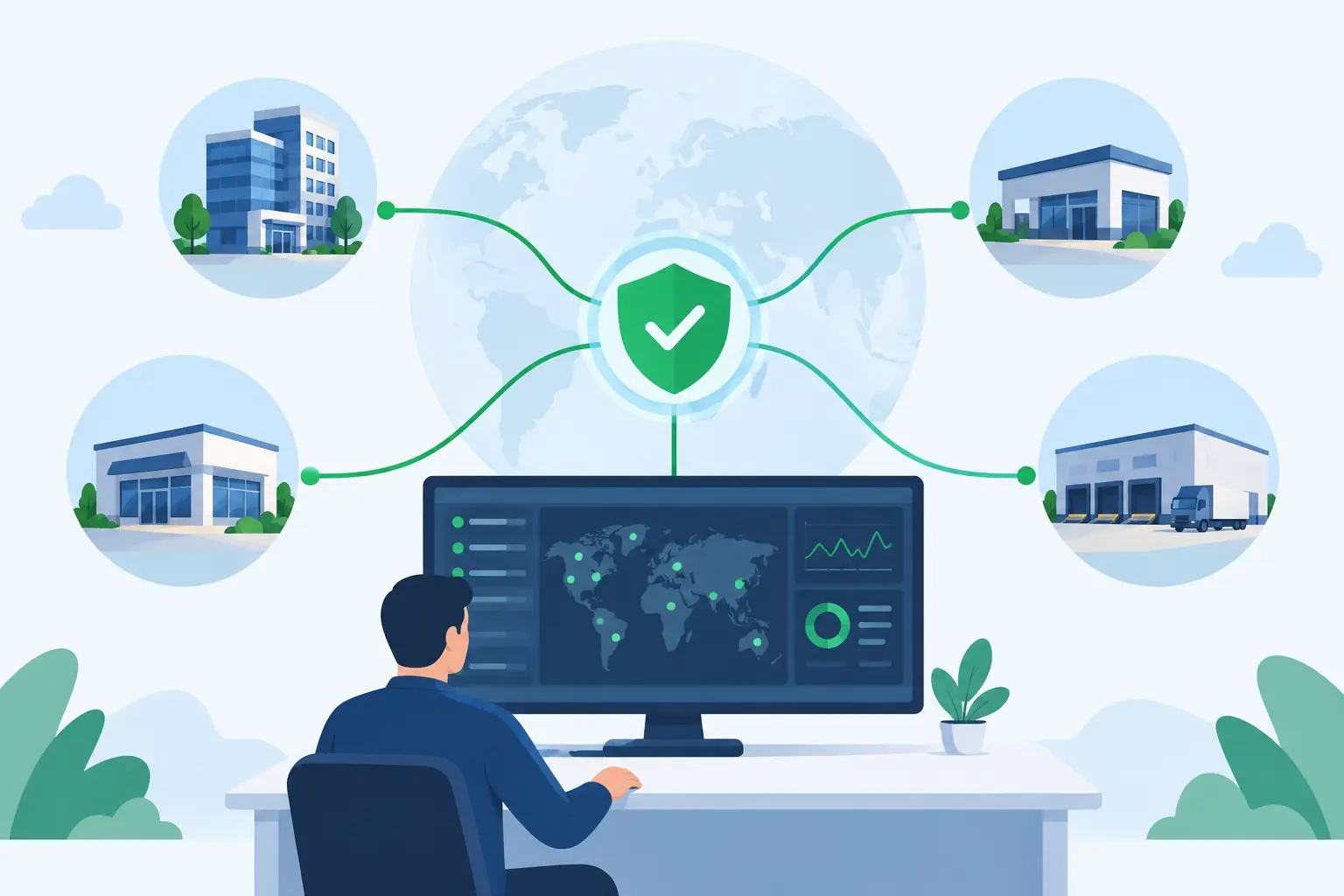
A network outage at one location is disruptive. The same fault repeated across several branches can stop card payments, isolate staff from cloud systems and leave customers walking away. This case study on multi-site network outage prevention looks at how a growing multi-site retailer can move from reactive fixes to a practical, managed approach that keeps trading when a connection fails.
This is a representative scenario based on the operational issues commonly faced by multi-site businesses. The lessons apply equally to retail, hospitality, professional services and any organisation where each site depends on online systems to serve customers.
The problem: one business, too many points of failure
The retailer operated eight locations, each with broadband supplied under separate arrangements. Its point-of-sale systems, payment terminals, stock platform, staff communications and guest WiFi all relied on internet access. Individual sites had been set up over time, often by whoever could get a service connected fastest.
That approach appeared economical until faults started to overlap. A fibre issue at one branch meant payment terminals could not authorise transactions. At another, a router failure removed both the tills and back-office devices from the network. The operations team spent hours calling different providers, trying to establish whether the problem sat with the broadband line, local equipment, payment provider or cloud application.
The immediate loss was sales. The larger cost was uncertainty. Store managers did not know who to call, head office lacked a reliable view of what was happening, and internal IT was pulled away from planned work to coordinate escalations. Even short outages caused manual workarounds, stock discrepancies and frustrated customers.
The business did not need more technology for its own sake. It needed each site to be designed, monitored and supported as part of one operating environment.
What outage prevention means in a multi-site network
No provider can promise that no cable will ever be cut, no power issue will occur and no hardware will fail. Multi-site network outage prevention is about reducing the chance of failure, limiting its impact when it happens and restoring normal service quickly.
That distinction matters. A low-cost connection may meet an initial budget, but if it has no backup path, no proactive monitoring and no clear escalation route, the business carries most of the risk. On the other hand, duplicating every service at every location can be unnecessary expense. The right design depends on each branch’s trading hours, transaction volume, local mobile coverage and tolerance for disruption.
For this retailer, the priority was clear: payment and core business systems needed to remain available, while guest WiFi and non-critical traffic could take a lower priority during a failover event.
Designing the network around business continuity
The first step was not ordering circuits. It was mapping what each location needed to keep operating. The technical team identified critical devices, existing connectivity, likely failure points and whether the current local network separated sensitive payment traffic from staff and customer use.
The resulting design used primary business connectivity at every site, with an independently delivered backup connection where the risk justified it. In some locations, mobile failover was the sensible option because it could activate quickly and provided a different path from the fixed service. At higher-volume branches, the business chose a secondary fixed connection alongside mobile contingency, as the cost of a prolonged outage was greater.
A managed firewall and correctly configured network equipment sat at each site. This was not simply a security measure. It also gave the support team visibility of connection health, traffic patterns and device status. Critical systems were prioritised so that, when a site moved to backup connectivity, payment terminals and business applications had the capacity they needed first.
We've got your back
The implementation also separated the network into sensible segments. Point-of-sale devices, staff systems and guest WiFi did not need unrestricted access to one another. Segmentation reduced security exposure and prevented a busy guest network from competing with operational traffic.
Why diverse failover matters
Failover only helps if the backup is unlikely to fail for the same reason as the primary service. A second connection using the same physical route or local cabinet may improve capacity, but it may not provide meaningful resilience against an infrastructure fault.
This is why site assessment matters. In urban areas, two fixed services may be appropriate if they enter the building through different paths. In regional locations, fixed broadband plus managed mobile failover may deliver a better balance of resilience, availability and cost. Mobile coverage must be tested properly, rather than assumed from a phone signal near the front door.
Monitoring turns faults into managed events
Before the change, the retailer often learned about an outage from a store manager after customers had already been affected. The new model introduced 24/7 monitoring of primary links, backup links, managed firewalls and key network equipment.
When a primary connection dropped, the network automatically moved eligible traffic to the backup service. Monitoring generated an alert for the support team, which could confirm the event, check that failover had worked as intended and begin escalation with the relevant carrier. Store managers received a clear update rather than being asked to diagnose technical symptoms.
This changed the experience of an outage. A fault still required investigation, but it no longer automatically became a trading stoppage or a chain of disconnected support calls. The business had one team accountable for coordinating connectivity, local equipment and the response process.
Vetta’s role in this type of arrangement is to take ownership across the network, managed IT and security layers. That means support is not passed between a broadband supplier, hardware vendor and security provider while a branch waits for an answer.
The operational controls that made the difference
Technology was only one part of the improvement. The retailer also agreed a practical operating plan with its provider. Site managers knew what the status lights on their equipment meant, who to contact and what to expect if a service moved to backup connectivity. They were not expected to reboot equipment repeatedly or make configuration changes during a busy trading period.
The plan included four controls:
- documented site diagrams and device records, so support teams could identify the affected equipment quickly;
- automatic failover testing at agreed intervals, including payment and core application checks;
- defined escalation contacts for store managers, operations leaders and technical support; and
- post-incident reviews for significant faults, focused on preventing recurrence rather than assigning blame.
These controls sound straightforward, but they are frequently missing where sites have been added gradually. Documentation can become outdated, passwords can be held by former contractors and a backup connection can sit unused for months. A backup that has not been tested is an assumption, not a continuity plan.
Results: less disruption and clearer accountability
After the rollout, the retailer had fewer incidents that reached store managers as emergencies. Some carrier faults still occurred, as they will in any real-world network, but branches could continue processing payments and accessing priority systems through their backup connection.
The operations team also gained a better picture of its estate. It could see which sites had recurring connectivity issues, whether mobile backups were being used and where equipment needed attention before it failed. That data informed investment decisions instead of relying on anecdotal reports from individual stores.
There was a cost to building resilience. Managed hardware, backup connectivity and monitoring are not free. Yet the business could assess that cost against lost sales, staff downtime, emergency call-outs and reputational damage from customers unable to pay. For its busiest locations, the case was compelling. For lower-volume sites, a lighter design still delivered a clear recovery path without over-engineering the solution.
Questions to ask before your next outage
If your business operates from more than one site, start with the consequences rather than the connection type. Ask what must remain online for a branch to trade, how long it can operate without those systems and whether the current backup has been tested under real conditions.
Then look at ownership. If a router, broadband service, payment terminal and firewall are supported by separate parties, who coordinates the response when they stop working together? A single accountable partner does not remove every fault, but it removes the uncertainty of vendor handoffs when time matters.
The best time to find a weakness in a network is during a planned test, not while customers are waiting at the counter. Build for the way your sites actually operate, test the recovery plan and make sure someone is responsible for the outcome from connection to checkout.





