







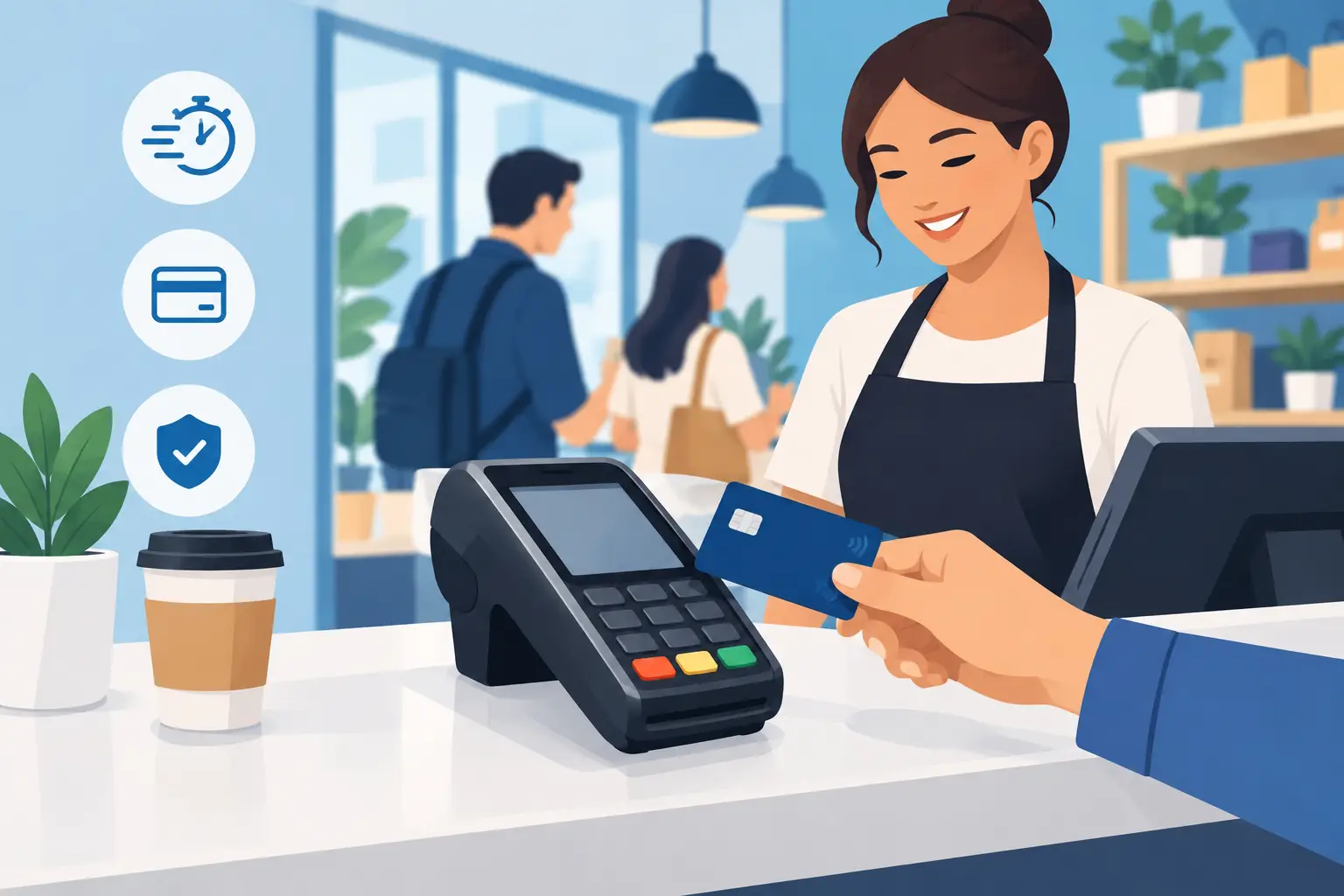
A card terminal can look like a simple purchase until it stops taking payments at the busiest point of the day. That is why useful payment terminal reviews do more than compare hardware and transaction rates. They show whether a provider can keep your business trading when the connection drops, a device fails, or staff need help quickly.
For a retailer, café, trades business or multi-site operator, payments are part of the operational chain. The terminal depends on power, connectivity, secure configuration and support. A low monthly price may be attractive, but it is rarely the full cost if it comes with long downtime, unclear responsibility or a different supplier for every part of the problem.
What payment terminal reviews should actually assess
The best review is not necessarily the one with the longest list of features. It is the one that helps you decide whether a payment solution suits the way your business operates. Start with the real conditions at your counter, on the road or across your sites.
A terminal needs to process the payment methods your customers use, including contactless cards, mobile wallets and, where relevant, EFTPOS. It should be straightforward for staff to use, with a clear display and dependable battery life for portable devices. These points matter, but they are the baseline rather than the deciding factor.
The more meaningful questions are about continuity. How does the terminal connect? Does it use your fixed broadband, Wi-Fi, mobile data or a combination? Is there a practical fallback if the primary connection has an issue? Who identifies whether a fault sits with the terminal, point-of-sale system, router, broadband service or merchant facility?
When those answers involve several providers, your team can lose valuable time repeating the same fault description. A single accountable partner reduces that hand-off. It gives your staff one place to call and makes it easier to coordinate the fix.
Look beyond the headline transaction fee
Transaction fees deserve attention, particularly for businesses with high card volumes or tight margins. But they should be considered alongside the full operating cost over the term of the agreement.
Check the terminal rental or purchase cost, setup charges, replacement fees, mobile data charges, early exit terms and any cost for software updates or support. A package can appear inexpensive until a failed unit, seasonal peak or contract change reveals costs that were not obvious at the outset.
It also helps to separate predictable costs from variable ones. A monthly terminal hire charge may be easier to budget for than an upfront equipment purchase, especially if replacement and support are included. Buying equipment can make sense for a stable, long-term setup, but the business should be clear about who maintains it and how quickly a replacement arrives.
For multi-site businesses, consistency has value too. Standardising terminals, support processes and reporting across locations makes staff training easier and reduces the chance that one branch is left with a different configuration or support route.
Questions to ask about the contract
A payment agreement should be easy to explain in plain language. Ask how long the minimum term is, what happens when you add or remove terminals, and whether the provider can support a move to a new site. Confirm the replacement process for damaged or faulty equipment and whether a loan unit is available.
Also ask what support is included after installation. There is a real difference between help during office hours and assistance when a Saturday trading issue leaves a queue at the counter. The right level depends on your trading hours and the impact of being unable to accept card payments.
We've got your back
Connectivity is part of the payment decision
Payment terminals are often reviewed as standalone devices. In practice, their reliability is closely tied to the network around them. A well-designed terminal cannot overcome weak Wi-Fi coverage, an overloaded connection or a router placed in the wrong part of the building.
For a fixed checkout, a wired connection may offer the most dependable option where the environment allows it. Wi-Fi can be practical and flexible, but it needs proper coverage, capacity and security. Portable terminals may need mobile connectivity, particularly for hospitality, events, delivery teams and businesses operating away from a main counter.
The right approach depends on your premises and the cost of an interruption. A small shop with a single till has different needs from a retailer with several lanes, a warehouse counter and an online operation. If card payments are critical, ask about backup connectivity and how quickly the service can fail over when there is a fault.
This is where an integrated provider can make a material difference. When the same team understands the broadband connection, local network and payment terminal, it can diagnose the whole service rather than treating each component as somebody else’s responsibility.
Security needs to be practical, not assumed
A payment terminal processes sensitive data, so security cannot be an afterthought. Your chosen solution should support current payment security requirements, receive software updates and be configured correctly from the start. Just as importantly, the wider business network must be protected.
Keep payment devices separated from guest Wi-Fi and non-essential traffic where possible. Use secure passwords, limit access to terminal administration and make sure staff know how to spot tampering or suspicious behaviour. A terminal that looks physically altered, behaves unexpectedly or has an unfamiliar attachment should be investigated before it is used.
Security also extends to the people supporting the system. A provider should have clear processes for device provisioning, replacements, remote access and escalation. If a payment issue crosses into your network or point-of-sale environment, the response should be coordinated, not passed between separate helpdesks.
Compare support, not just specifications
Terminal specifications are easy to put side by side. Support quality is harder to assess before you need it, yet it often determines whether a minor fault becomes a disruptive outage.
During your evaluation, ask who answers the phone, what information they can see about your setup and whether they can arrange on-site assistance if remote troubleshooting does not resolve the issue. Look for clear ownership of incidents and realistic response expectations rather than vague assurances.
It is also worth considering onboarding. A provider should make installation, testing and staff handover straightforward. Before go-live, terminals should be tested on the actual connection and in the locations where they will be used. Staff should understand basic checks, such as confirming power, connection status and paper supply, without being expected to become technical specialists.
For busy businesses, the goal is not to build an in-house payments support desk. It is to ensure your people can take payments confidently while a capable partner manages the technology behind them.
A practical way to compare payment terminals
Use payment terminal reviews to create a shortlist, then test each option against your own operation. Consider how many terminals you need, where they will be used, which payment types you accept and what an hour of payment downtime would cost at your busiest time.
From there, compare total monthly cost, contract flexibility, connection options, replacement arrangements, security processes and support availability. Do not assume the cheapest terminal is the lowest-cost choice. A slightly higher monthly cost can be justified if it includes dependable connectivity, faster fault resolution and a provider that takes ownership when several systems are involved.
Vetta Group approaches payments as part of the wider technology environment, not as an isolated box on the counter. By bringing connectivity, managed IT, security, field services and payment solutions together, the focus stays where it belongs: keeping your business online, protected and able to serve customers.
Before signing, ask the provider to talk through a realistic failure scenario: the terminal cannot connect during peak trade, the Wi-Fi is unstable, and your point-of-sale system is still running. Their answer will tell you more than a feature table ever can. Choose the partner that can coordinate the response, communicate clearly and get you trading again.





