







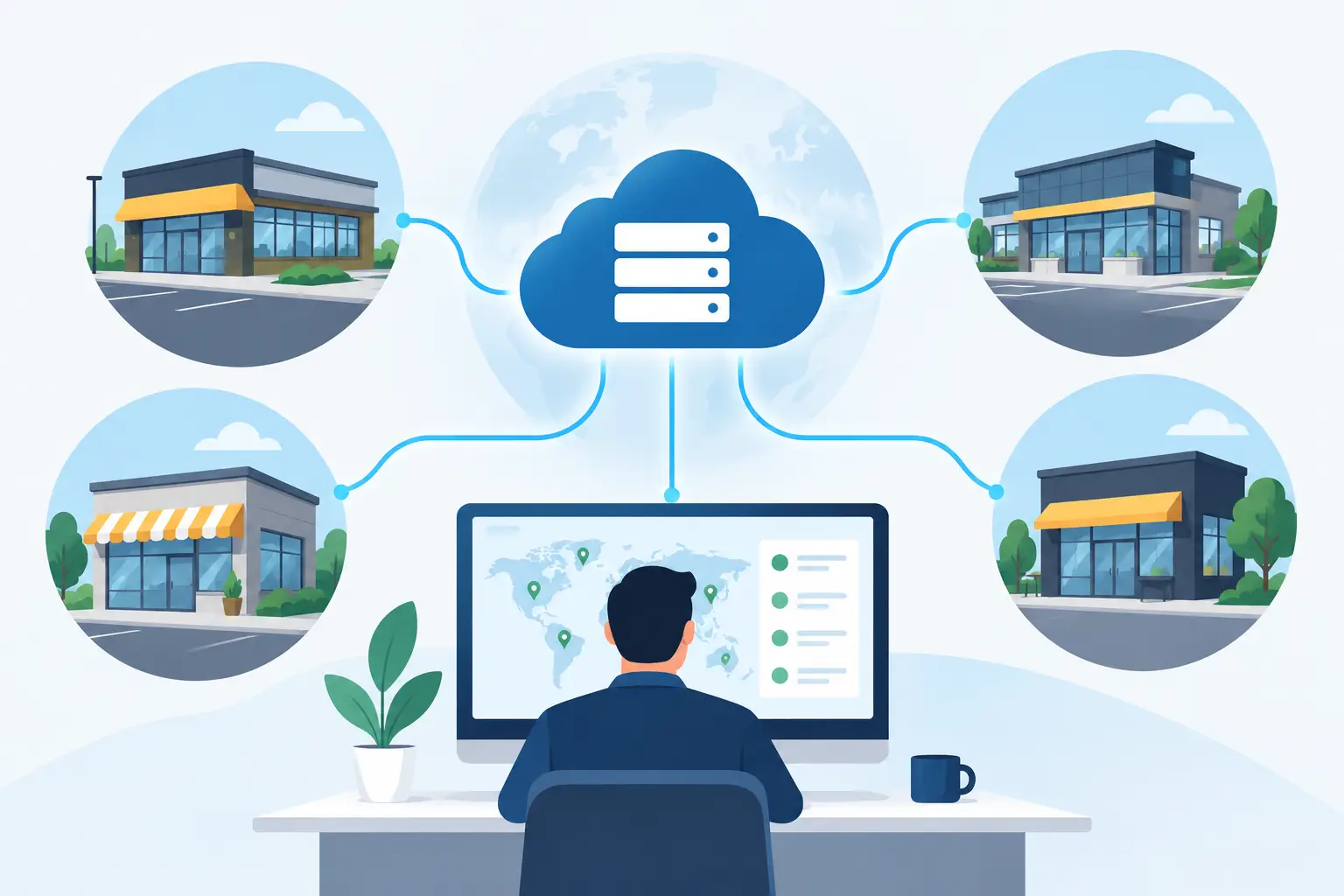
A card terminal stops accepting payments at one branch. The local manager calls the internet provider, who points to the IT company. The IT company suspects the payment supplier. Hours pass, customers leave, and nobody owns the outcome. Multi-site systems integration replaces that chain of hand-offs with one coordinated technology service built around keeping every location operating.
For retailers, hospitality groups, professional services firms and other growing businesses, each new site can add more risk as well as more revenue. Connections, Wi-Fi, devices, user accounts, cloud applications, security controls and payment systems all need to work together. If they are bought and supported separately, a small fault can become a costly interruption.
Why separate systems create operational risk
Most multi-site businesses do not set out to create a fragmented technology estate. It happens gradually. A new shop needs broadband quickly. A regional office uses a different IT supplier. Payment terminals arrive under a separate contract. Security is added after an incident, and the person who set up the original network has long since moved on.
The result is a collection of services with unclear boundaries. A branch may have working internet but unreliable Wi-Fi. A point-of-sale system may be online while its card terminal cannot reach the payment processor. Staff may be able to access business applications from one location but not another. When a fault occurs, the business has to establish what has failed before it can even get help.
That is not simply an IT problem. It affects queue times, customer confidence, staff productivity and daily revenue. It can also leave gaps in cyber security, especially where each site has different passwords, firewall settings, software versions or backup arrangements.
A better approach is to treat technology as one operating environment, not a set of unrelated purchases.
What multi-site systems integration should achieve
Effective multi-site systems integration connects the foundations of a business so they can be managed as one service while still meeting each location’s needs. A busy retail site, a warehouse and a small office do not need identical equipment, but they do need consistent standards, visibility and support.
The starting point is reliable connectivity. Every site needs a connection appropriate to its trading requirements, with a clear plan for continuity if the primary service is disrupted. For some operations, mobile failover is sufficient. For a site processing a high volume of transactions or relying on cloud systems all day, a secondary connection may be justified. The right answer depends on the cost of downtime, not on a one-size-fits-all package.
From there, the network should be designed to separate and protect different types of traffic. Staff devices, guest Wi-Fi, payment terminals, CCTV and operational equipment should not all sit on the same open network. Segmentation reduces the chance that a problem with one device or service spreads across the site.
Identity and access matter just as much. Staff should be able to use the tools they need without sharing logins or relying on informal workarounds. Centralised user management makes it easier to add starters, remove access when people leave and apply consistent security controls across every location.
Finally, payment technology must be included in the design rather than treated as an afterthought. EFTPOS and point-of-sale systems depend on stable, secure connectivity. Their support path should be clear, particularly during peak trading hours when an unresolved payment issue has an immediate impact.
Build around the customer journey, not the supplier list
The most useful integration plans begin with practical questions. What happens when a customer pays? How does a staff member connect a new device? Which systems must remain available to open the doors in the morning? Who needs access to which information, from which site?
We've got your back
This approach exposes dependencies that a supplier-by-supplier review can miss. A café, for example, may depend on broadband for ordering, Wi-Fi for handheld devices, a cloud-based till, card payments, security cameras and music. Losing one connection can affect every part of service, even if the individual applications are all functioning correctly.
It also helps businesses decide where to invest. Not every site needs the same level of resilience or support. A small administration office with flexible working arrangements has different requirements from a flagship store that takes payments continuously. Integration should standardise what needs to be standardised, while allowing sensible variation where the business case supports it.
Standardise the essentials
Consistency is what makes a multi-site environment manageable. Use common standards for network equipment, Wi-Fi configuration, firewall policies, device setup, backup and user access wherever practical. This simplifies support, makes onboarding faster and reduces the number of exceptions that internal teams need to remember.
Standardisation does not mean forcing unsuitable technology into every branch. It means documenting approved options, defining how they are configured and ensuring they can be monitored and supported properly. A rural site may need a different connectivity solution from a city centre location, but both can sit within the same security and support model.
Keep visibility central
A problem at a remote branch should not depend on a manager noticing it and finding the right telephone number. Central monitoring can identify connection failures, equipment issues and unusual activity early, often before they become a major interruption.
Visibility also makes growth less disruptive. When a business opens a new site, relocates or changes its trading model, a central view of the estate shows what needs to be ordered, installed, configured and tested. It turns expansion from a series of urgent fixes into a repeatable process.
Security needs to travel with the business
Multi-site growth expands the attack surface. Every router, laptop, tablet, shared account and remote connection creates another potential entry point. A security approach based only on antivirus software or an annual review is unlikely to be enough.
Security should be part of the operating model: managed firewalls at the edge, protected email, strong password management, controlled access, monitored alerts and reliable backup. Staff awareness training also has a place, because many incidents begin with a convincing email or an unsafe request rather than a sophisticated technical attack.
Payment environments deserve particular care. Businesses do not need to become payment security specialists, but they do need to know who is responsible for the connection, terminal, network configuration and escalation process. Clear accountability helps limit disruption and supports better compliance practices.
There is a trade-off to manage. More controls can create friction if they are poorly designed. The goal is not to make staff jump through unnecessary hoops. It is to apply proportionate protection that supports safe, productive work across sites.
Choose one accountable support model
Technology works best when people know who will act when it does not. A multi-vendor setup can work for organisations with a large internal IT team and strong supplier management capability. For many small and mid-sized businesses, however, it creates unnecessary administration and too many opportunities for responsibility to be passed elsewhere.
A single partner model brings connectivity, managed IT, cyber security, field services and payments into one support structure. Instead of asking a site manager to diagnose whether the issue is the line, router, Wi-Fi, till or terminal, the service provider coordinates the investigation and owns the next step.
That accountability is especially valuable outside normal office hours. A trading site cannot always wait until Monday morning. Monitoring, clear escalation routes and access to real technical support are part of operational resilience, not optional extras.
Vetta Group combines these services around its own nationwide network, giving businesses a clearer route from fault report to resolution. The value is not merely fewer invoices. It is having one team responsible for the experience at every location.
A practical path to integration
There is no need to replace every system at once. In fact, a rushed rip-and-replace programme can introduce more disruption than it removes. Start by mapping each site: its connections, equipment, critical applications, payment devices, suppliers, contracts and known issues.
Next, identify the services that would stop trading if they failed. Prioritise those for monitoring, resilience and documented support procedures. Then set common standards for new sites and planned refreshes, so the estate becomes more consistent over time rather than more fragmented.
Before rollout, test real scenarios. Can staff process a payment if the primary connection fails? Can a new employee be set up without local workarounds? Can support see the site and act remotely? Is there a clear plan if on-site help is required? Testing these questions during a calm period is far better than answering them during a Saturday trading rush.
Technology should make life easier for the people running each location. When systems are connected, monitored and supported as one, managers can focus on customers and staff instead of chasing suppliers. The useful next step is simple: identify the one failure at each site that would hurt most, then make sure someone is accountable for preventing it and responding when it happens.





